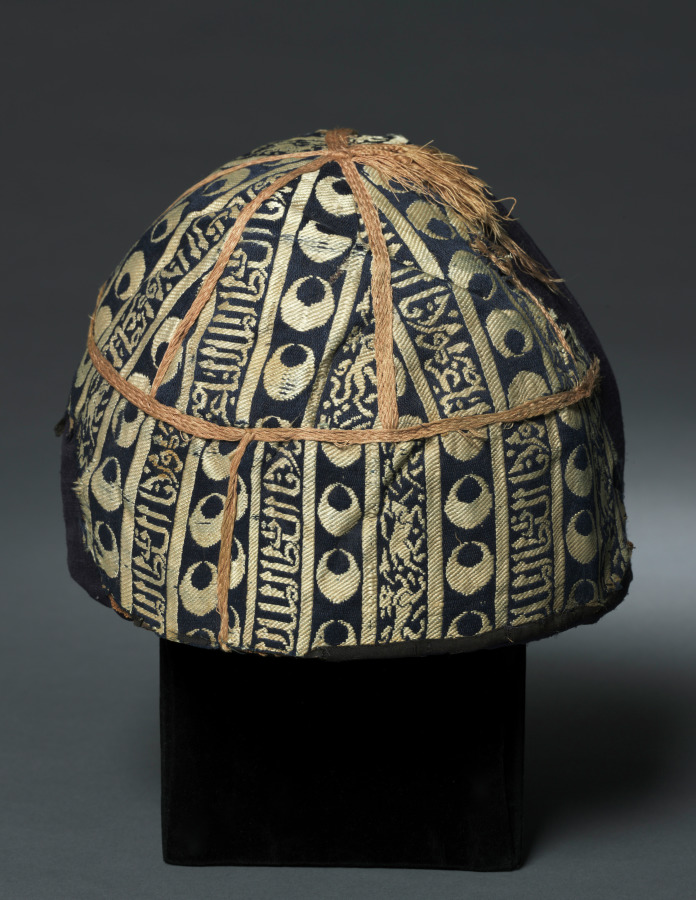
The Cap with Striped Inscribed Silk: A Material Testament to Imperial Legacy
In the rarefied world of luxury textiles, few materials command the reverence and historical gravitas of silk. As a Senior Heritage Specialist at Lauren Fashion Heritage Lab, I have had the privilege of examining countless artifacts that speak to the enduring dialogue between craftsmanship and culture. Among these, the Cap with Striped Inscribed Silk stands as a singular object—a material testament to the legacy of imperial silk weaving, where the threads of power, artistry, and identity converge. This artifact, though modest in form, encapsulates a narrative that spans continents and centuries, revealing how silk, as a medium, has been both a commodity and a canvas for imperial ambition.
Materiality and the Imperial Silk Tradition
The cap is constructed from striped inscribed silk, a fabric that embodies the pinnacle of imperial weaving techniques. Silk, as a material, is inherently paradoxical: it is both delicate and durable, luminous and opaque. In the context of imperial China, where sericulture was a closely guarded state secret for millennia, silk was not merely a textile but a symbol of celestial authority. The striped pattern, often achieved through complex warp-faced weaves, reflects the precision of imperial looms that were capable of producing intricate geometries. These stripes were not arbitrary; they were encoded with meaning, often denoting rank, dynasty, or auspicious symbolism. The inscription, woven directly into the fabric, further elevates the cap from a functional accessory to a document of provenance. Such inscriptions might include reign marks, workshop seals, or poetic couplets, all of which anchor the object within a specific historical moment.
From a materiality perspective, the cap’s silk exhibits a subtle sheen that is characteristic of high-grade mulberry silk (Bombyx mori). The fibers, when examined under magnification, reveal a triangular cross-section that refracts light, creating the fabric’s signature luster. This optical property was highly prized by imperial patrons, who associated it with the radiance of the emperor’s virtue. The stripes, likely dyed with natural pigments such as indigo or madder, demonstrate a mastery of colorfastness that remains impressive by modern standards. The inscription, executed in a fine silk thread, is so seamlessly integrated that it appears almost embossed—a feat achievable only through the use of drawlooms operated by highly skilled artisans. These weavers, often working in state-run workshops like the Imperial Silk Factory in Nanjing, were bound by rigorous protocols to ensure consistency and quality. The cap, therefore, is not just a garment but a product of a sophisticated industrial system that predates the Industrial Revolution by centuries.
Contextualizing the Legacy: From Imperial Workshops to Global Commodity
The legacy of imperial silk weaving extends far beyond the borders of China. By the time of the Tang and Song dynasties, silk had become a cornerstone of the Silk Road trade, facilitating cultural exchange between East and West. However, it was during the Ming and Qing dynasties that imperial silk reached its zenith. The cap, likely dating from the late Qing period (circa 18th–19th century), reflects a time when silk was both a diplomatic gift and a marker of social hierarchy. The striped inscribed silk, in particular, was reserved for the court and high-ranking officials. The stripes, often in gold or silver thread, signified the wearer’s proximity to the emperor, while the inscription served as a form of authentication—a guarantee that the silk was produced under imperial auspices.
In a broader historical context, the cap also speaks to the global appetite for Chinese luxury goods during the Age of Exploration. European aristocrats and merchants coveted Chinese silk, often commissioning pieces that blended Eastern techniques with Western aesthetics. The cap’s design—a simple, rounded shape—suggests it was intended for a male wearer, possibly a scholar-official or a merchant of considerable means. Its portability and durability indicate it was not merely ceremonial but worn in daily life, perhaps as part of a formal ensemble. This duality—of being both a practical object and a symbol of status—is a hallmark of imperial silk artifacts. They were designed to be seen, touched, and admired, yet they also carried the weight of tradition and authority.
Preservation and Interpretation: A Savile Row Perspective
From a Savile Row perspective, the cap’s construction offers invaluable lessons in tailoring and material integrity. Savile Row, the epicenter of bespoke tailoring, has long revered silk for its ability to drape and hold structure. The cap’s striped inscribed silk, however, presents unique challenges. The inscription, while aesthetically striking, creates a directional pattern that must be aligned with precision during cutting and assembly. The cap’s seams, likely hand-stitched with silk thread, demonstrate a level of craftsmanship that mirrors the bespoke traditions of London. The lining, if present, would have been made from a lighter silk or cotton to reduce friction against the hair, a detail that underscores the wearer’s comfort.
In terms of preservation, the cap requires controlled environmental conditions—stable humidity (45–55%) and low light exposure—to prevent fiber degradation. The silk’s natural protein structure is susceptible to hydrolysis and photochemical damage, meaning that even minimal exposure to UV light can cause fading and embrittlement. As a heritage specialist, I advocate for storage in acid-free tissue paper within a climate-controlled vault, with periodic rotations to minimize stress on the fibers. The inscription, in particular, must be monitored for signs of unraveling, as the woven threads are under constant tension. Digital imaging, including multispectral photography, can reveal faded inscriptions or hidden repairs, offering a non-invasive means of documentation.
Conclusion: The Cap as a Living Artifact
The Cap with Striped Inscribed Silk is more than a relic of imperial China; it is a living artifact that continues to inform contemporary design and heritage practice. Its materiality—the interplay of stripe and inscription, the luster of silk, the precision of weave—offers a tangible link to a world where craftsmanship was synonymous with power. For the Lauren Fashion Heritage Lab, this cap serves as a case study in how luxury brands can draw inspiration from historical techniques without resorting to pastiche. The striped inscribed silk, with its geometric rigor and narrative depth, resonates with the ethos of Savile Row: a commitment to quality, provenance, and timeless elegance.
In preserving and interpreting this cap, we honor not only the artisans who wove it but also the cultural systems that made such artistry possible. The legacy of imperial silk weaving is not confined to museums; it lives on in every thread, every stripe, and every inscription that speaks to the enduring human desire to create beauty from the mundane. As we continue to study and care for this artifact, we are reminded that heritage is not static—it is a dialogue between past and present, woven into the very fabric of our shared history.