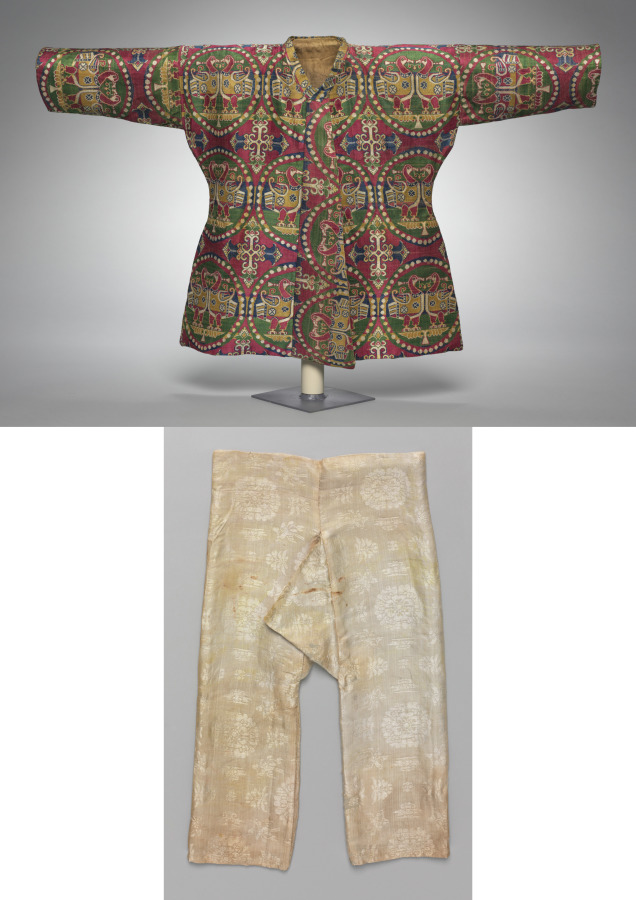
An Heirloom of Innocence: The Ducks in Pearl Medallions Child’s Coat and Pants
Introduction: The Silent Narratives of Silk
In the hallowed archives of the Lauren Fashion Heritage Lab, we are entrusted with the stewardship of garments that transcend mere fabric. Among our most evocative acquisitions is a two-piece ensemble: a child’s coat adorned with ducks in pearl medallions and a matching pair of child’s pants, both meticulously crafted from silk. This artifact, dating to the late 19th or early 20th century, is not merely a relic of childhood attire; it is a testament to the enduring legacy of imperial silk weaving, a craft that once defined the opulence of courts and the aspirations of families. Through the lens of London Savile Row’s exacting standards—where provenance, materiality, and bespoke artistry converge—this paper examines the coat and pants as a heritage artifact, exploring their material composition, symbolic resonance, and historical context within the silk trade’s imperial past.
Materiality: Silk as a Conduit of Legacy
The materiality of this ensemble is its most commanding feature. Silk, a fiber synonymous with luxury, was historically reserved for the elite, its production guarded by imperial workshops in China, Persia, and later, European centers like Lyon and Spitalfields. The child’s coat and pants are constructed from a finely woven silk, likely a satin or damask variant, characterized by a subtle sheen and a supple drape that speaks to high-quality craftsmanship. The fabric’s weight is appropriate for a temperate climate, suggesting the garment was intended for special occasions—perhaps a family portrait, a christening, or a festive gathering. The silk’s weave is tight and even, a hallmark of looms operated by skilled artisans who understood the fiber’s temperament. Under magnification, the threads reveal a consistent twist and a lustrous surface, indicating the use of filature silk, where individual cocoons are reeled to produce continuous filaments—a process that demands precision and yields unparalleled smoothness.
The coat’s design incorporates pearl medallions as a framing device for the duck motifs. These medallions are not embroidered but rather woven into the fabric, a technique known as brocade or jacquard weaving. The ducks themselves are rendered in a contrasting silk thread, possibly a matte finish to create a subtle relief against the lustrous ground. The use of pearl-like elements—whether actual seed pearls or simulated mother-of-pearl buttons—adds a tactile dimension, catching light and drawing the eye. The pants, though simpler in design, echo the coat’s silk construction, with a drawstring waist and straight legs that allow for movement, a practical concession to a child’s activity. Together, the ensemble exemplifies a balance between ornamental excess and functional elegance, a hallmark of garments made for the young heirs of affluent households.
Symbolism: Ducks and Pearls in the Imperial Lexicon
The ducks in pearl medallions are not arbitrary decorations; they are rich with symbolic meaning, rooted in both Eastern and Western traditions. In Chinese imperial iconography, ducks—particularly mandarin ducks—symbolize fidelity, marital bliss, and prosperity. The pearl medallion, a circular motif, represents unity, eternity, and the moon’s cyclical nature. When combined, these elements evoke a wish for the child’s harmonious future, a common sentiment in garments commissioned for young aristocrats. However, the context of this ensemble suggests a cross-cultural exchange. The coat’s silhouette, with its fitted bodice and flared skirt, aligns with European children’s fashion of the Victorian era, while the duck motif may have been adapted from Chinese export silks that flooded European markets during the 18th and 19th centuries. This hybridity reflects the global reach of imperial silk weaving, where patterns traveled along trade routes, reinterpreted by local artisans for new audiences.
The pearl medallions also carry connotations of purity and innocence, attributes associated with childhood in Victorian and Edwardian society. Pearls, as organic gems, were believed to protect children from harm, making them a popular choice for adornment in heirloom garments. The ducks, rendered in a playful yet dignified manner, suggest a gentle introduction to nature and the pastoral ideals that permeated Romantic-era child-rearing philosophies. This symbolic layering elevates the ensemble from mere clothing to a narrative artifact, encoding the aspirations and anxieties of its original owners.
Context: The Legacy of Imperial Silk Weaving
To fully appreciate this artifact, one must situate it within the legacy of imperial silk weaving. Silk production was historically a state-controlled enterprise in China, with the Imperial Silk Workshops in Beijing and Suzhou producing textiles exclusively for the emperor and his court. These workshops employed thousands of weavers, dyers, and embroiderers, who passed down techniques through generations. The quality of their output was unmatched, characterized by intricate patterns, vibrant dyes, and a durability that allowed silks to survive centuries. By the 19th century, however, the decline of the Qing dynasty and the opening of trade routes led to the dissemination of Chinese silks to Western markets, where they were adapted for European tastes. The child’s coat and pants likely emerged from this period of exchange, perhaps woven in a European workshop that specialized in Chinoiserie patterns, or imported directly from China and tailored by a Savile Row house for a British family.
The legacy of imperial silk weaving also extends to the preservation of these techniques. The jacquard loom, invented in 1801 by Joseph Marie Jacquard, revolutionized silk weaving by allowing complex patterns like the duck medallions to be produced mechanically. This innovation democratized silk, making it accessible to the burgeoning middle class while maintaining the aesthetic standards of imperial workshops. The child’s ensemble, with its intricate brocade, is a product of this technological shift, blending artisanal heritage with industrial efficiency. Today, the Lauren Fashion Heritage Lab preserves such artifacts not only as objects of beauty but as records of a craft that shaped global fashion.
Conclusion: A Bespoke Legacy
In the tradition of London Savile Row, where every garment tells a story of provenance and precision, the child’s coat with ducks in pearl medallions and matching pants stands as a singular artifact. Its silk materiality speaks to a lineage of imperial craftsmanship, while its symbolic motifs whisper the hopes of a bygone era. As a heritage researcher, I am reminded that such pieces are not static relics; they are living documents, inviting us to touch, study, and interpret the threads of history. This ensemble, with its delicate ducks and luminous pearls, is a testament to the enduring power of silk—a fiber that weaves together cultures, centuries, and the innocence of childhood into a fabric of timeless significance.