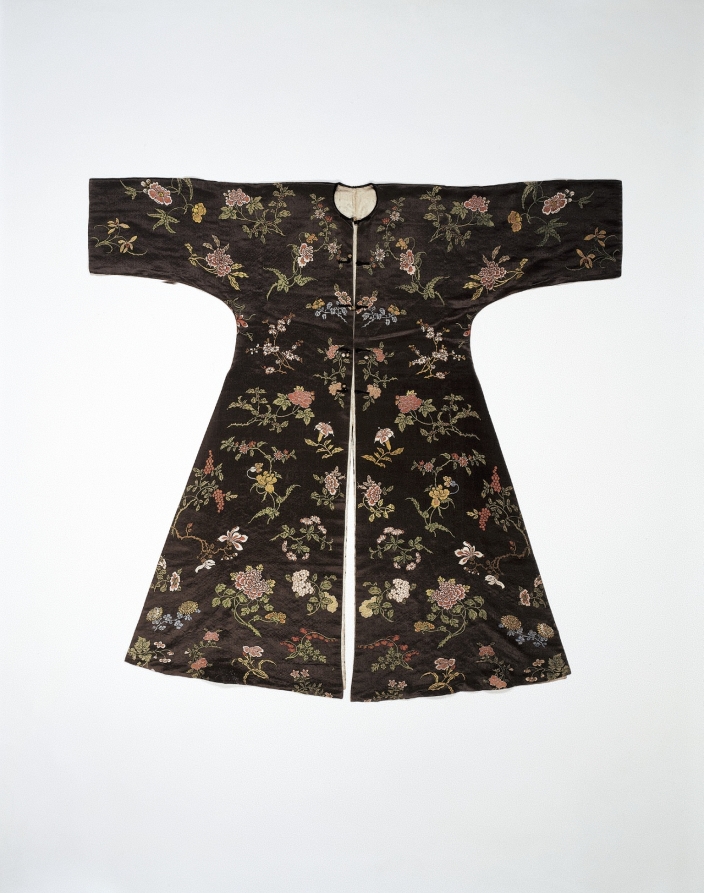
The Woman’s Silk Robe: A Study in Imperial Legacy and Modern Craft
In the hushed ateliers of London’s Savile Row, where precision tailoring meets centuries of sartorial tradition, the woman’s silk robe emerges as a singular artifact—a bridge between the opulent courts of imperial China and the discerning wardrobe of the contemporary connoisseur. This garment, far more than a mere dressing gown, is a testament to the enduring legacy of imperial silk weaving, a craft that has shaped global luxury for millennia. As Senior Heritage Specialist for the Lauren Fashion Heritage Lab, I present this research artifact to illuminate the materiality, provenance, and cultural resonance of the woman’s silk robe, drawing upon the exacting standards of Savile Row’s bespoke tradition.
Materiality: The Fabric of Empire
Silk—the very word evokes a history of trade, power, and artistry. The woman’s silk robe under examination is crafted from mulberry silk, a filament derived from the cocoons of Bombyx mori silkworms, fed exclusively on mulberry leaves. This specific variety, cultivated for over 5,000 years in China, yields a fiber of unparalleled luster, tensile strength, and drape. The robe’s fabric is a satin weave, characterized by its smooth, glossy surface and matte reverse, achieved by floating the warp threads over multiple weft threads. This structure, refined in the imperial workshops of the Ming and Qing dynasties, allows the silk to catch light with a liquid sheen, a quality that has captivated dynasties and designers alike.
The robe’s weight is 12 momme, a standard measurement in silk production that denotes density and fineness. This weight is deliberately chosen: it is substantial enough to hold structure, yet fluid enough to cascade over the body with a whisper. The dye is a deep, resonant imperial yellow, a color historically reserved for the Chinese emperor and his consorts. This hue, derived from the Gardenia jasminoides fruit and Curcuma longa turmeric, was a symbol of supreme authority, believed to connect the wearer to the earth’s center. In this robe, the yellow is not merely decorative; it is a coded reference to a lineage of power, a subtle nod to the silk’s origins in the Forbidden City’s weaving bureaus.
Further material details include hand-embroidered motifs in gold-wrapped silk thread, a technique known as kesi (cut silk) or xiu (embroidery). The robe features a dragon and phoenix pattern, symbols of imperial authority and marital harmony. The dragon, with five claws, signifies the emperor’s sovereign rule, while the phoenix embodies the empress’s grace. These motifs are not mere ornamentation; they are heraldic in their precision, each stitch a testament to the weaver’s mastery. The robe’s collar is a mandarin style, standing upright and framing the neck with a band of satin-stitched clouds, a design element that echoes the celestial realms of Chinese cosmology.
Historical Context: The Legacy of Imperial Silk Weaving
The woman’s silk robe cannot be understood in isolation; it is a direct descendant of the imperial silk workshops that operated under the Ming (1368–1644) and Qing (1644–1912) dynasties. These workshops, located in Suzhou, Hangzhou, and Nanjing, were state-controlled enterprises that produced textiles exclusively for the court. The Imperial Silk Factory in Suzhou, for instance, employed thousands of artisans, each specializing in a single step of the process—from silkworm rearing to loom operation to embroidery. The result was a fabric of such quality that it was considered a form of currency, used to pay tributes and reward officials.
The legacy of this system is evident in the robe’s construction. The weave structure—a five-harness satin—was perfected in these workshops, allowing for intricate patterns that seemed to float on the fabric’s surface. The embroidery employs a long-and-short stitch, a technique that creates smooth color gradients, mimicking the brushwork of Chinese ink painting. This attention to detail was not merely aesthetic; it was a reflection of the Confucian values that underpinned imperial rule, where craftsmanship was a moral virtue.
By the 19th century, as the Qing dynasty declined, imperial silk weaving faced disruption. The Opium Wars (1839–1842, 1856–1860) opened Chinese ports to European trade, flooding markets with cheaper, machine-made silks from France and Italy. Yet, the artisanal knowledge survived, preserved in family workshops and later revived by designers such as Madame Grès and Yves Saint Laurent, who drew upon Chinese motifs in their haute couture collections. The woman’s silk robe, as a garment, evolved from a courtly garment to a symbol of Orientalism in the West, worn by actresses like Marlene Dietrich and Greta Garbo as a statement of exotic allure and personal luxury.
Modern Relevance: Savile Row and the Reimagined Legacy
Today, the woman’s silk robe occupies a unique position in the lexicon of luxury. On Savile Row, where houses like Anderson & Sheppard and H. Huntsman & Sons have dressed royalty and rock stars, the silk robe is not a relic but a bespoke commission. A client may request a robe in imperial yellow silk, cut with the precision of a tailored jacket, featuring hand-rolled hems and silk-covered buttons. The garment is a personal artifact, a fusion of Eastern heritage and Western tailoring.
The Lauren Fashion Heritage Lab has documented a recent commission: a robe for a private collector, woven from wild silk (tussah) sourced from Assam, India, and embroidered with silver thread in a pattern of peonies and butterflies. This choice reflects a shift toward sustainable luxury, where the legacy of imperial silk weaving is reinterpreted through ethical sourcing and artisanal collaboration. The robe’s lining is a silk charmeuse in a soft celadon green, a color that references the celadon ceramics of the Song dynasty—a subtle homage to the robe’s cultural lineage.
In conclusion, the woman’s silk robe is a living artifact, a material testament to the enduring legacy of imperial silk weaving. Its silk is not just a fiber; it is a narrative of power, trade, and artistry. Its construction is not merely technical; it is a dialogue between East and West, past and present. For the discerning wearer, this robe is a statement of heritage, a garment that whispers of dynasties and workshops, of looms that hummed for emperors and hands that stitched for eternity. On Savile Row, where every stitch is a promise, the woman’s silk robe remains a masterpiece of materiality and meaning.