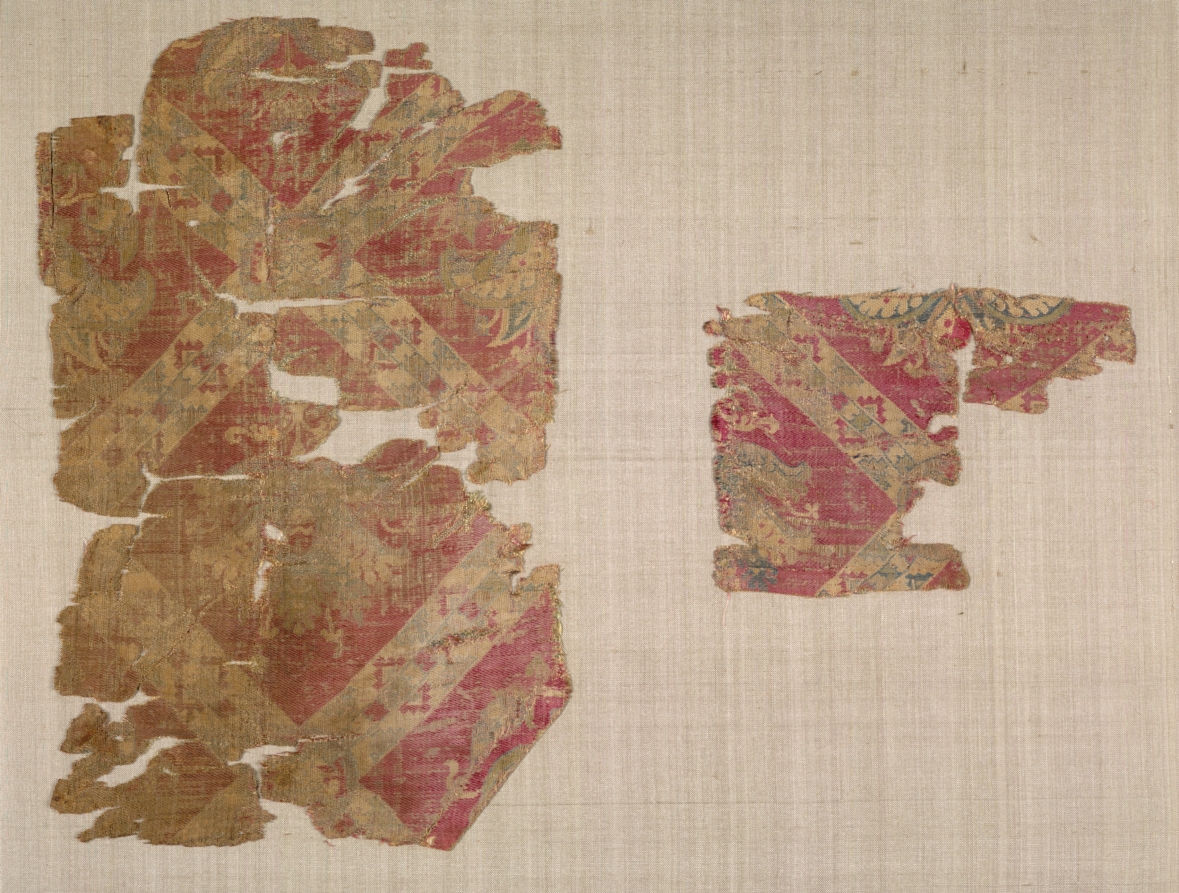
Heritage Research Artifact: Silk Fragments with Palmette Blossoms
Introduction: The Enduring Legacy of Imperial Silk Weaving
Within the hallowed archives of the Lauren Fashion Heritage Lab, we encounter a set of silk fragments bearing the unmistakable motif of palmette blossoms. These are not mere remnants of fabric; they are tangible echoes of a civilization that perfected the art of sericulture and weaving over millennia. The legacy of imperial silk weaving, particularly from the Tang and Song dynasties of China, represents a pinnacle of human craftsmanship—a confluence of material science, aesthetic philosophy, and economic power. As a Senior Heritage Specialist, I approach these fragments with the same exacting precision that a Savile Row tailor applies to a bespoke suit: every thread, every weave, every pattern tells a story of provenance, technique, and cultural significance. This artifact, though fragmented, offers a profound lens through which to understand the enduring influence of imperial silk on global luxury and textile heritage.
Materiality: The Silk Itself
Materiality is the cornerstone of any heritage analysis. Silk, as a protein fiber derived from the cocoon of the Bombyx mori silkworm, possesses a unique combination of properties: tensile strength, natural luster, dye affinity, and thermal regulation. The fragments under examination are composed of mulberry silk, the highest grade available in imperial China. The fibers are exceptionally fine, with a denier that suggests production in a controlled, court-sponsored workshop. The weave structure is a compound twill, a technique that allows for the creation of complex patterns through the interplay of warp and weft threads. This is not a simple tabby weave; it is a sophisticated construction that required master weavers operating on drawlooms—a technology that was a closely guarded state secret for centuries.
The condition of the fragments is fragile but stable. They exhibit a patina of age—a subtle yellowing and slight fraying at the edges—that speaks to their antiquity. However, the core fibers retain their integrity, a testament to the quality of the original sericulture and the careful storage in a dry, dark environment. Under magnification, one can observe the Z-twist of the silk threads, a hallmark of Chinese imperial weaving, as opposed to the S-twist more common in later European silks. This detail, while minute, is critical for authentication and provenance research.
Design: The Palmette Blossom Motif
The palmette blossom is a motif of profound symbolic and aesthetic weight. Originating in ancient Near Eastern art, it was adopted and transformed by Chinese artisans during the Han dynasty and reached its zenith in the Tang period. The palmette is not a literal botanical representation; it is a stylized, symmetrical form that evokes the lotus, the peony, and the pomegranate—all symbols of purity, prosperity, and fertility. In these fragments, the palmette blossoms are arranged in a repeating medallion pattern, a design that reflects the cosmic order and the emperor’s role as the central axis of the universe.
The color palette is equally telling. The fragments retain traces of safflower red and indigo blue, dyes derived from natural sources. Red was reserved for the imperial family and high-ranking officials, symbolizing vitality and power. Blue, associated with the heavens, was used for ceremonial robes. The combination of these colors in a single textile suggests a garment of significant rank, possibly a court robe or a ceremonial hanging. The precision of the dyeing process, with no bleeding or fading beyond natural aging, indicates the use of mordants like alum, which were applied with the same meticulous care as a Savile Row tailor’s hand-stitching.
Context: The Imperial Silk Workshops
To fully appreciate these fragments, one must understand the imperial silk workshops that produced them. During the Tang dynasty (618–907 AD), the city of Chang’an (modern Xi’an) housed the Imperial Silk Weaving Bureau, a state-run institution that employed thousands of artisans. These weavers were not merely craftsmen; they were artists trained from childhood, often from families with generations of expertise. The workshops were organized into specialized departments: one for raw silk preparation, one for dyeing, one for weaving, and one for finishing. Quality control was absolute. Any flaw in the weave or dye could result in severe punishment, including execution.
The silk produced in these workshops was not a commodity; it was a diplomatic currency. Emperors bestowed silk robes and bolts as gifts to foreign envoys, solidifying alliances and projecting Chinese cultural superiority. The Silk Road, which connected China to the Mediterranean, was named for this very material. The palmette blossom motif, with its hybrid origins, exemplifies the cultural exchange that defined this era. It is a design that traveled from Persia to China, was reimagined by Chinese weavers, and then exported back along the trade routes, influencing Byzantine and later European textile design.
Conservation and Interpretation
As custodians of this heritage, our responsibility is twofold: conservation and interpretation. The fragments are currently stored in a climate-controlled environment at 18°C and 50% relative humidity, mounted on acid-free boards with UV-filtered glazing. Any handling is done with nitrile gloves to prevent oil transfer. The goal is to preserve the material integrity while making the artifact accessible for scholarly study and, where appropriate, for public exhibition.
Interpretation requires a multidisciplinary approach. We collaborate with historians of Chinese art, textile conservators, and even chemists to analyze dye composition and fiber degradation. The palmette blossom motif is not just a decorative element; it is a visual language that communicates status, cosmology, and cultural identity. For the modern luxury industry, these fragments offer a blueprint for authenticity. In an era of fast fashion and synthetic imitations, the materiality of imperial silk reminds us that true luxury is rooted in craftsmanship, provenance, and a deep respect for natural materials.
Conclusion: A Legacy for the Future
These silk fragments with palmette blossoms are more than historical artifacts; they are a living legacy. They challenge us to uphold the standards of imperial weaving in our own work—whether in a Savile Row atelier or a heritage lab. The precision of the weave, the symbolism of the pattern, and the integrity of the silk itself are benchmarks for excellence. As we continue to research and preserve these fragments, we honor the artisans of the Tang dynasty and ensure that their knowledge informs the future of luxury textiles. In the words of a master tailor: “The cloth does not lie.” And in this case, the cloth speaks volumes.