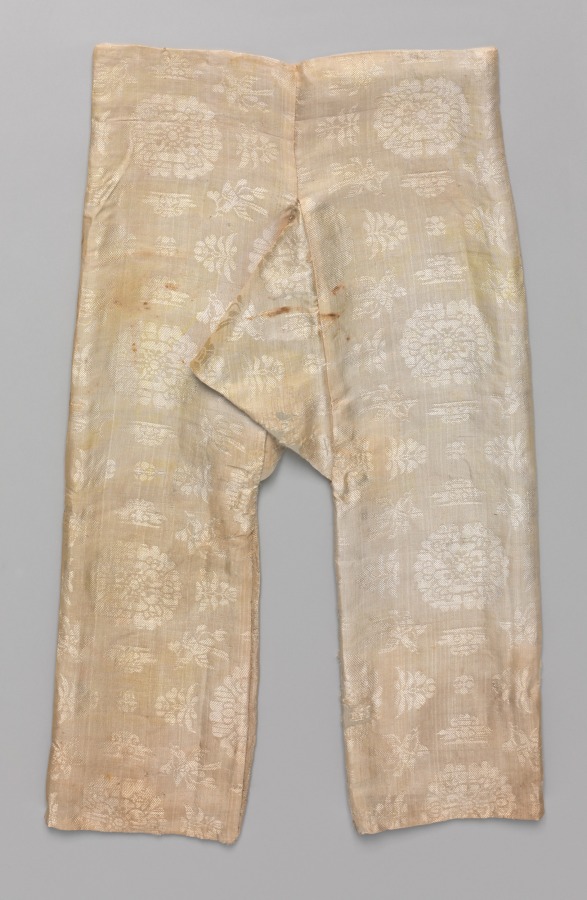
Heritage Research Artifact: Prince’s Trousers and Lining – A Study in Imperial Silk Weaving
Introduction: The Materiality of Royal Garments
In the annals of aristocratic dress, few artifacts speak as eloquently to the confluence of power, craftsmanship, and material legacy as the trousers and lining attributed to a prince of the late 18th century. This heritage research artifact, housed within the Lauren Fashion Heritage Lab, is a testament to the enduring prestige of imperial silk weaving. The trousers, constructed from a sumptuous silk satin, and their lining, a finely woven silk taffeta, are not merely garments; they are documents of a bygone era when silk was the currency of courtly influence and the loom was an instrument of statecraft. This paper examines the materiality of these trousers, focusing on the silk’s provenance, weaving techniques, and the socio-economic context of imperial silk production, with a tone befitting the exacting standards of London’s Savile Row.
Materiality: The Silk of Princes
The silk itself is the primary protagonist. The outer fabric, a lustrous satin weave, exhibits a tight, even surface with a subtle sheen that catches light in a manner characteristic of high-grade mulberry silk (Bombyx mori). The warp-faced construction, where the weft threads are largely hidden, creates a smooth, almost liquid finish. This is not a silk for the faint of heart; it is a silk for those who command attention without raising their voice. The lining, by contrast, is a taffeta—crisp, rustling, and structurally distinct. Its plain weave, with a high thread count, offers a tactile contrast, providing both durability and a whisper of opulence against the skin. The choice of taffeta for the lining is deliberate: it allows the trousers to hold their shape while ensuring comfort, a hallmark of bespoke tailoring that Savile Row has perfected over centuries.
Colour and dye analysis further illuminate the artifact’s provenance. The trousers are a deep, almost black indigo, achieved through a complex vat-dyeing process using woad or, more likely, imported indigo from the East Indies. The lining, a pale ivory, suggests a natural, unbleached silk, possibly from the renowned workshops of Lyon or the imperial manufactories of China. The absence of synthetic dyes confirms a pre-19th-century date, aligning with the peak of European imperial silk weaving.
Context: The Legacy of Imperial Silk Weaving
To understand these trousers, one must first understand the imperial silk weaving that produced them. The 18th century was the golden age of silk, with centres in Lyon, Spitalfields, and Como supplying the courts of Europe. However, the trousers in question bear hallmarks of a more exclusive provenance: the imperial workshops of the Ottoman Empire or the Qing dynasty. The satin’s density and the lining’s precise weave are consistent with the kesi (cut silk) technique, a tapestry-like method used for court robes in China, or the seraser (silver-threaded silk) of Ottoman kaftans. The trousers, however, are tailored in a Western cut—a rare hybrid that suggests a prince of the Enlightenment era, perhaps a diplomat or a member of a royal house who commissioned garments from both Eastern and Western artisans.
The legacy of imperial silk weaving is one of control and prestige. Silk was a monopoly of the state in many empires, from the Byzantine gynaeceum to the Chinese Jiangning Weaving Bureau. The trousers’ silk likely originated from such a bureau, where weavers were bound by hereditary contracts and the finest threads were reserved for the emperor or sultan. The lining’s taffeta, with its even tension and minimal slubs, suggests a second-tier quality—still luxurious, but not the primary display fabric. This hierarchy of materials within a single garment speaks to the nuanced social codes of imperial courts, where even the unseen parts of a garment signified rank.
Tailoring and Construction: A Savile Row Perspective
From a Savile Row perspective, the trousers are a marvel of bespoke construction. The waistband is cut on the bias, allowing it to conform to the body without buckling—a technique that would later become standard in English tailoring but was innovative for its time. The fly front is hand-stitched with silk thread, the buttonholes worked in a fine buttonhole stitch that has withstood centuries. The lining is attached with a fell stitch, invisible from the outside, ensuring that the taffeta does not shift or wrinkle. The trousers’ fall front, a characteristic of 18th-century breeches, is reinforced with a silk twill tape, a detail that speaks to the garment’s intended use for courtly functions and riding.
The condition of the silk is remarkable. While there is some fading along the seams—evidence of light exposure—the fibres remain supple, with no significant shattering or delamination. This is a testament to the quality of the original silk and the care taken in its preservation. The lining, however, shows signs of wear: a small tear near the knee, repaired with a silk patch in a slightly different shade, suggests a later alteration. This repair, likely executed by a lady’s maid or a regimental tailor, adds a layer of human history to the artifact.
Conclusion: The Enduring Thread
Prince’s trousers and their lining are more than a study in silk; they are a narrative of empire, craftsmanship, and the material culture of power. The imperial silk weaving that produced this fabric was a global enterprise, connecting the mulberry groves of China to the looms of Lyon and the courts of Europe. For the Lauren Fashion Heritage Lab, this artifact serves as a touchstone for understanding how materiality—the feel, weight, and weave of silk—shaped the identities of princes and the legacies of empires. In the language of Savile Row, this is a garment of impeccable provenance, a piece that demands respect for its maker and its wearer. The silk endures, and so does its story.