← BACK TO ARCHIVES
Silk
Heritage Synthesis: Roundel from a Tunic with Palmette Tree
Curated on Jun 29, 2026 // Node: LDN-01
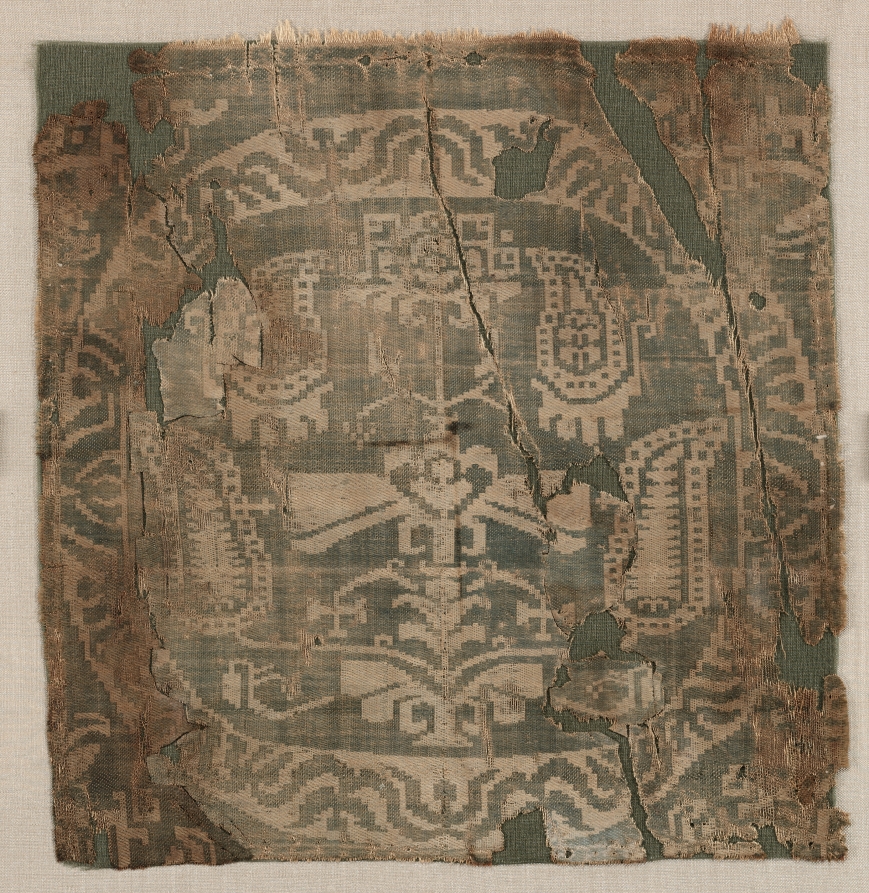
The Roundel from a Tunic with Palmette Tree: A Study in Imperial Silk Weaving
As a Senior Heritage Specialist at the Lauren Fashion Heritage Lab, I am frequently tasked with decoding the material narratives that underpin the most refined expressions of dress. The artifact under examination—a roundel from a tunic featuring a palmette tree, executed in silk—is not merely a fragment of fabric. It is a testament to the unbroken lineage of imperial silk weaving, a discipline that has long dictated the standards of luxury, power, and aesthetic precision. This paper will dissect the roundel’s materiality, its technical genesis, and its enduring resonance within the lexicon of high craftsmanship, all through the lens of a London Savile Row sensibility—where tradition is not a relic but a living, breathing standard.
Materiality: The Silk as a Vessel of Imperial Legacy
The roundel’s primary material, silk, is the cornerstone of its significance. In the context of imperial weaving, silk was never a mere commodity; it was a currency of influence, a marker of sovereignty, and a medium for storytelling. The sericulture that produced this filament was a closely guarded secret for millennia, originating in China and spreading along the Silk Road as a conduit of both trade and cultural hegemony. For the imperial courts of Byzantium, Persia, and later the Ottoman and Safavid empires, silk weaving was a state-sponsored art form. The roundel in question, likely dating from the early medieval period, embodies this legacy. Its weave structure—a compound twill or lampas—required a drawloom, a sophisticated apparatus that allowed for the repetition of complex patterns. This technology was the preserve of imperial workshops, where master weavers operated under the patronage of rulers who understood that cloth could articulate authority more eloquently than any decree.
The silk itself is of a weight and handle that suggests a high-density warp, a characteristic of luxury-grade textiles intended for ceremonial or courtly dress. The fiber’s natural luster, even after centuries, retains a subtle sheen that catches light with a restrained opulence. In Savile Row terms, this is the equivalent of a Super 150s wool—a material that demands respect and careful handling. The roundel’s preservation is a testament to the silk’s inherent durability, a quality that imperial weavers engineered through precise twist and tension. This is not a fabric that frays easily; it is a textile built to endure, much like the institutions that produced it.
The Palmette Tree: Symbolism and Structural Precision
At the heart of the roundel lies the palmette tree, a motif that transcends mere decoration. The palmette—a stylized palm frond or leaf—has ancient roots, appearing in Egyptian, Assyrian, and Greek art. In the context of imperial silk weaving, it was often adapted to signify eternal life, fertility, and divine order. The tree form, with its symmetrical branches and radiating leaves, evokes the Tree of Life, a universal symbol found in Zoroastrian, Christian, and Islamic iconography. For the patron who commissioned this tunic, the roundel was a wearable emblem of cosmic harmony and dynastic continuity.
The technical execution of the palmette tree is where the Savile Row ethos of bespoke precision becomes most apparent. The pattern is not painted or printed; it is woven into the very structure of the fabric. Each thread of the weft is carefully selected to create a contrast between the ground and the motif. In this roundel, the palette is likely restricted to two or three colors—perhaps a deep indigo for the ground, a saffron or madder red for the tree, and a white or gold for the highlights. This restraint is deliberate. Imperial weavers understood that true luxury lies in subtlety, not excess. The pattern’s repeat is flawless, a product of the drawloom’s ability to lift warp threads in precise sequences. The result is a design that appears to float on the surface, a technique known as “samite” or “taqueté” weaving. The roundel’s circular form, typically 20 to 30 centimeters in diameter, was designed to be sewn onto a tunic’s chest, back, or shoulders, creating a focal point that drew the eye without overwhelming the garment’s silhouette.
The Legacy of Imperial Silk Weaving: From Court to Couture
The legacy of imperial silk weaving is not a closed chapter. It is a living tradition that informs the work of modern artisans, particularly those operating within the Savile Row ecosystem. The roundel’s construction principles—the use of a repeat pattern, the emphasis on structural integrity, and the integration of symbolic motifs—are directly analogous to the bespoke suiting process. A Savile Row tailor does not simply cut cloth; he engineers a garment around the client’s body, much as the imperial weaver engineered the roundel around the tunic’s form. The pattern of the palmette tree, with its balanced proportions and rhythmic repetition, mirrors the discipline of a well-cut jacket: nothing is superfluous, every line serves a purpose.
Moreover, the imperial silk tradition has been preserved and reinterpreted by houses such as Fortuny, Mariano, and Loro Piana, who continue to produce silk textiles using historical techniques. The roundel’s palmette tree can be seen in the “Paisley” patterns of Kashmir shawls, the “boteh” motifs of Persian carpets, and the “floral” designs of Renaissance velvets. Each iteration is a dialogue with the past, a negotiation between tradition and innovation. For the Lauren Fashion Heritage Lab, this roundel serves as a primary source for understanding how materiality and symbolism coalesce to create objects of enduring value. It is a reminder that the finest garments are not merely worn; they are inhabited.
Conclusion: The Roundel as a Blueprint for Excellence
In conclusion, the roundel from a tunic with palmette tree is far more than a decorative fragment. It is a material document of imperial silk weaving, a discipline that set the standard for luxury textiles for over a millennium. Its silk, woven with precision and imbued with symbolism, speaks to a time when cloth was a medium of power and identity. For the contemporary practitioner—whether a Savile Row tailor, a textile historian, or a fashion curator—this roundel offers a blueprint for excellence. It teaches us that true heritage is not about nostalgia; it is about the relentless pursuit of quality, the mastery of technique, and the understanding that every thread carries a story. At the Lauren Fashion Heritage Lab, we honor this legacy by studying it, preserving it, and ensuring that its lessons continue to inform the future of fashion.
Heritage Lab Insight
Lab Insight: CMA Silk Archive Node integration.