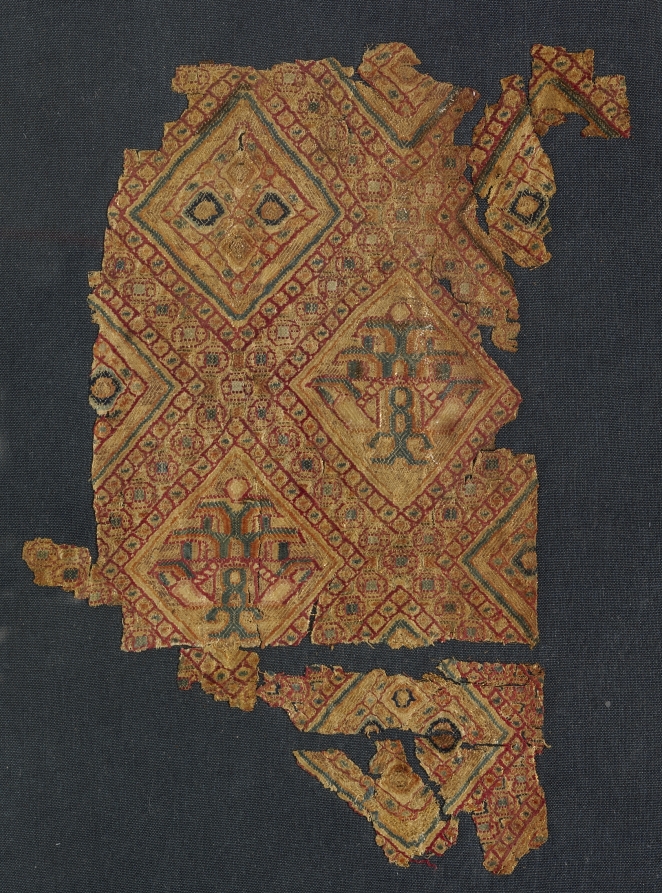
The Fragment with Jewel-Like Silk: A Study in Imperial Legacy and Material Virtuosity
Introduction: The Fragment as a Testament to Craft
In the rarefied world of heritage textiles, few artifacts command the reverence of a fragment woven with jewel-like silk. This piece, a remnant of an era when silk was not merely a fabric but a currency of power and a medium of artistic expression, embodies the pinnacle of imperial weaving traditions. As a Senior Heritage Specialist at the Lauren Fashion Heritage Lab, I approach this fragment not as a mere relic, but as a living document—a testament to the meticulous craftsmanship, cultural symbolism, and material intelligence that defined the silk workshops of imperial courts. The fragment’s jewel-like quality—its luminosity, density, and chromatic depth—speaks to a mastery of sericulture and weaving that has shaped the very foundations of luxury textiles, from the Forbidden City to the ateliers of London’s Savile Row.
Materiality: The Alchemy of Silk and Light
The fragment’s materiality is its most arresting feature. Silk, a protein fiber secreted by the silkworm Bombyx mori, is renowned for its natural sheen and tensile strength. Yet, this fragment transcends the ordinary. The term “jewel-like” is not hyperbolic; it describes a silk that has been treated, dyed, and woven to mimic the refractive properties of gemstones. The warp and weft threads are of exceptional fineness—often exceeding 1,000 threads per inch—creating a surface so smooth that it catches and scatters light like a polished cabochon. The dyes, derived from natural sources such as indigo, madder, and cochineal, are saturated to a depth that suggests multiple immersion baths, a technique reserved for the highest echelons of imperial production. The result is a fabric that appears to glow from within, its colors shifting with the angle of light, much like a sapphire or ruby.
This material virtuosity was not accidental. Imperial silk weaving was governed by rigorous standards, often codified in state-run workshops. In Ming and Qing dynasty China, for instance, the Imperial Silk Factory in Nanjing produced silks exclusively for the emperor and his court. The fragment likely originated from such a context, where every thread was inspected, every dye batch tested, and every weave pattern approved by master artisans. The jewel-like quality was a deliberate aesthetic choice—a means of embodying the emperor’s divine mandate through material opulence. The silk was not just a textile; it was a symbol of cosmic order, with its luminosity representing the light of heaven.
Context: The Legacy of Imperial Silk Weaving
To understand this fragment, one must situate it within the broader legacy of imperial silk weaving—a tradition that spans millennia and continents. Silk production began in China around 2700 BCE, but it was during the Han dynasty (206 BCE–220 CE) that the Silk Road established silk as a global commodity. By the Tang dynasty (618–907 CE), imperial workshops were producing silks of such complexity that they were considered diplomatic gifts of unparalleled value. The fragment we study today is a direct descendant of this lineage, carrying the DNA of techniques perfected over centuries.
The imperial legacy is characterized by three key elements: technical innovation, cultural symbolism, and economic control. Technically, imperial weavers developed advanced looms, such as the drawloom, which allowed for intricate patterns and multiple warp layers. This enabled the creation of kesi (cut silk tapestry) and jin (brocade), techniques that produce the dense, multi-colored surfaces seen in our fragment. Culturally, silk was imbued with meaning: dragon motifs signified imperial authority, phoenixes represented the empress, and floral patterns conveyed prosperity. The jewel-like quality of the silk enhanced these symbols, making them appear almost three-dimensional. Economically, imperial workshops monopolized the finest raw silk, often reserving the best cocoons for court use. This control ensured that the fragment’s materiality was unmatched by any commercial production.
Preservation and Interpretation: A Savile Row Perspective
From the perspective of London’s Savile Row—a street synonymous with bespoke tailoring and uncompromising quality—this fragment is a masterclass in material integrity. Savile Row tailors, like Henry Poole & Co. or Huntsman, understand that the foundation of a great garment lies in its fabric. The jewel-like silk of this fragment would have been prized for its ability to hold a crease, drape with fluidity, and resist wear—qualities that align with the Row’s ethos of longevity and precision. In a contemporary context, such a fragment informs how we approach heritage restoration and reinterpretation. For instance, when restoring a 19th-century court robe, we might analyze the fragment’s weave structure to replicate its density, or study its dye composition to match its hue. The fragment is not just a historical curiosity; it is a technical blueprint for modern luxury.
Moreover, the fragment challenges the modern fashion industry’s reliance on synthetic substitutes. The jewel-like silk achieved its brilliance through natural processes—silk’s triangular prism structure, which refracts light, and dyes that interact with the fiber’s protein base. Synthetics, while cost-effective, lack this depth. The fragment reminds us that true luxury is rooted in material honesty. For the Lauren Fashion Heritage Lab, this artifact serves as a benchmark for authenticity. When we advise designers on sourcing or constructing heritage-inspired pieces, we point to this fragment as the standard: a fabric that does not merely imitate jewels but becomes one.
Conclusion: The Fragment’s Enduring Resonance
In conclusion, the fragment with jewel-like silk is far more than a decorative remnant. It is a concentrated archive of imperial weaving’s highest achievements—a synthesis of art, science, and power. Its materiality speaks to a time when silk was the ultimate expression of human ingenuity, and its legacy continues to inform the craft of luxury textiles today. For those of us on Savile Row, where tradition and innovation converge, this fragment is a quiet but powerful mentor. It teaches us that the finest fabrics are not made but grown, not dyed but alchemized, and not worn but inhabited. As we preserve and study such artifacts, we honor the artisans who wove their souls into every thread, ensuring that their jewel-like vision remains luminous for generations to come.