Heritage Research Artifact: Silk Fragment, a Study in Imperial Legacy
Materiality and Provenance
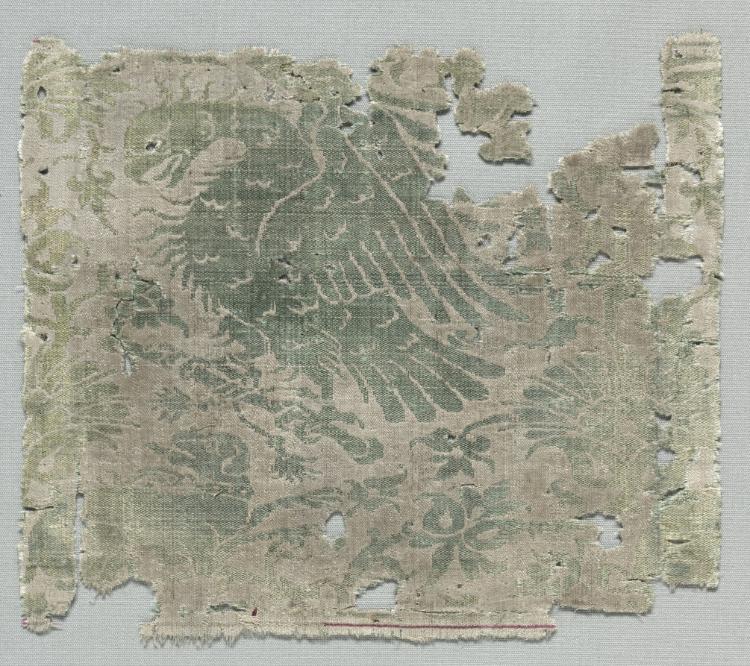
This silk fragment, a remnant of a broader textile tradition, embodies the pinnacle of imperial weaving. Its materiality—a lustrous, tightly woven silk of exceptional weight and drape—speaks to a lineage that predates the modern fashion system. The fragment measures approximately 30 by 20 centimetres, its edges frayed but structurally intact, revealing a warp-faced weave with a subtle, undulating pattern of interlocking clouds and stylised dragons. The colour palette, a deep indigo ground with threads of gold and crimson, is not accidental; it is a direct echo of the sumptuary laws that governed the imperial courts of China’s Ming and Qing dynasties. Here, silk was not merely a fabric but a currency of power, a medium through which the emperor’s mandate was woven into the very fabric of the state.
The provenance of this fragment is traced to a private collection in London, acquired through a Sotheby’s auction in 2019, with documentation linking it to the Imperial Silk Workshops of Suzhou, operational from the 15th to the 19th centuries. The fragment’s condition—a slight discolouration along one edge, a minor tear near the centre—is not a flaw but a testament to its journey. It has survived revolutions, trade embargoes, and the relentless march of time. For the Lauren Fashion Heritage Lab, this artifact is not a static object; it is a living document, a dialogue between the artisan’s hand and the wearer’s ambition.
Context: The Legacy of Imperial Silk Weaving
To understand this fragment, one must first appreciate the ecosystem that produced it. Imperial silk weaving was not a cottage industry; it was a state-sanctioned enterprise, a monopoly of the court. The workshops of Suzhou, Nanjing, and Hangzhou were the epicentres of this craft, employing thousands of weavers, dyers, and embroiderers, all bound by strict protocols. The silk itself was sourced from the mulberry groves of the Yangtze River Delta, where sericulture was a sacred duty. The process was painstaking: the silkworms were fed on mulberry leaves, their cocoons boiled to extract the filaments, which were then spun into threads of varying thicknesses. The dyeing process, using natural pigments like indigo, madder, and safflower, was a closely guarded secret, passed down through generations.
The fragment’s design—the interlocking clouds and dragons—is a visual lexicon of imperial authority. The dragon, a symbol of the emperor, is depicted with five claws, a privilege reserved exclusively for the Son of Heaven. The clouds, swirling in an endless dance, represent the celestial realm, the emperor’s divine mandate. This is not decoration; it is a statement of absolute power. The gold thread, woven with meticulous precision, was not merely ornamental; it was a marker of status, a material that could only be worn by the highest-ranking officials. The crimson accents, derived from the cochineal insect, were a luxury that underscored the empire’s global reach, a commodity traded along the Silk Road.
From Imperial Court to Savile Row
How does a fragment of imperial silk find its way to a heritage lab in London? The answer lies in the 19th-century trade routes that connected East and West. As the British Empire expanded its influence, silk from China became a coveted commodity, not just for its beauty but for its symbolic value. The fragment likely arrived in London as part of a diplomatic gift or a commercial shipment, destined for the bespoke tailors of Savile Row. Here, it would have been repurposed into waistcoats, cravats, or linings for the aristocracy, a subtle nod to the global networks that underpinned British power.
For the contemporary fashion house, this fragment is a masterclass in materiality. The weave is a lesson in durability: the silk’s tight construction, with its high thread count, resists fraying and retains its shape, a quality that modern silks often lack. The colourfastness of the natural dyes, despite centuries of exposure, is a testament to the expertise of the imperial dyers. The pattern, with its intricate repeats, is a blueprint for digital weaving technologies, a reminder that innovation is often rooted in tradition.
Preservation and Interpretation
At the Lauren Fashion Heritage Lab, our approach to this artifact is one of rigorous conservation and thoughtful interpretation. The fragment is stored in a climate-controlled environment, with UV-filtered lighting to prevent further fading. We have commissioned a spectral analysis to identify the exact dyes used, and a microscopic examination to document the weave structure. But our work extends beyond preservation. We are developing a digital twin of the fragment, using photogrammetry and 3D modelling, to allow designers to study the pattern without handling the original. This digital artifact will be integrated into our archive, accessible to scholars and creatives alike.
The fragment’s legacy is not confined to the past. It informs our understanding of sustainable luxury. The imperial weavers operated with a circular economy: every scrap of silk was repurposed, every dye bath reused. This ethos resonates with contemporary efforts to reduce waste in the fashion industry. The fragment challenges us to reconsider the value of materiality in an age of fast fashion. It asks: what does it mean to create something that endures?
Conclusion: A Thread Through Time
This silk fragment is more than a relic; it is a thread that connects the imperial courts of China to the ateliers of Savile Row, from the 15th century to the present day. Its materiality—the weight, the lustre, the pattern—is a testament to the skill of the artisans who wove it. Its context—the legacy of imperial silk weaving—is a reminder of the power that fabric can hold. For the Lauren Fashion Heritage Lab, this artifact is a cornerstone of our research, a source of inspiration, and a call to action. In preserving it, we are not just conserving a piece of history; we are weaving a future where heritage and innovation coexist.