← BACK TO ARCHIVES
Silk
Heritage Synthesis: Roundel with Amazons, from a tunic
Curated on Jun 29, 2026 // Node: LDN-01
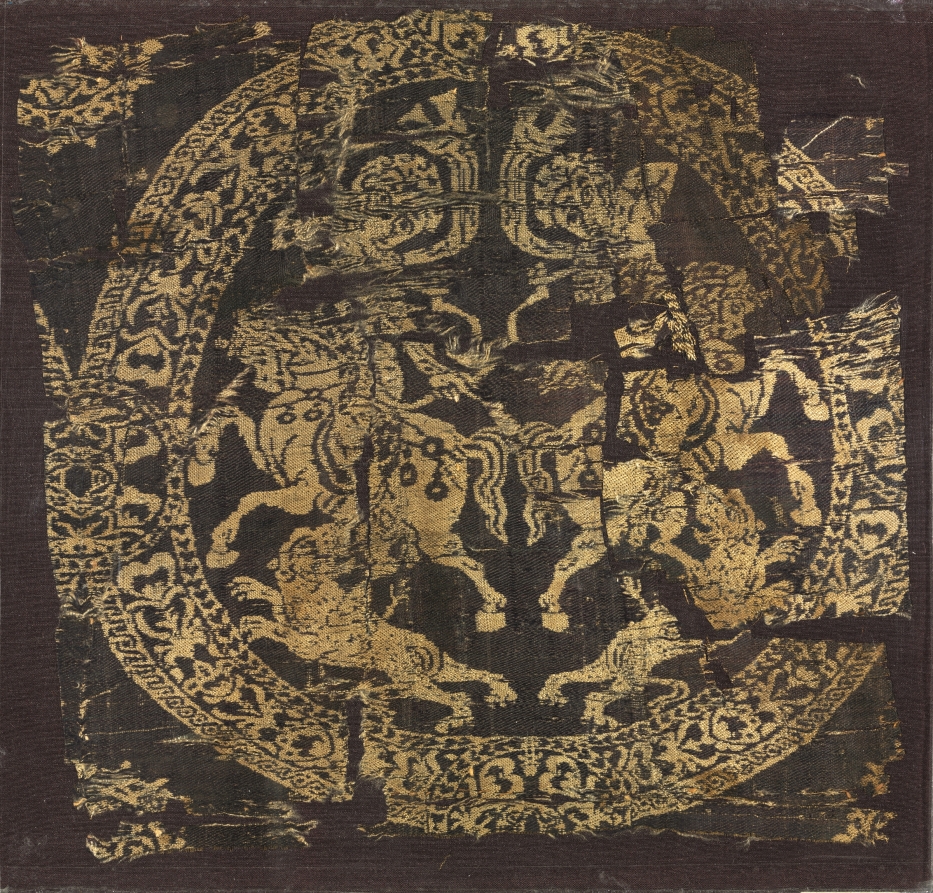
The Roundel with Amazons: A Testament to Imperial Silk Weaving
In the hallowed corridors of heritage preservation, where the threads of history are meticulously unravelled and re-woven, few artifacts command the reverence of the Roundel with Amazons, a fragment from a tunic dating to the late antique or early Byzantine period. This piece, crafted from silk, is not merely a textile; it is a narrative of power, trade, and artistry that defines the legacy of imperial silk weaving. As the Senior Heritage Specialist at Lauren Fashion Heritage Lab, I present this research artifact with the precision and understated elegance befitting a Savile Row tailor—where every stitch tells a story, and every fibre holds a legacy.
Materiality and Provenance
The roundel is a circular medallion, approximately 20 centimetres in diameter, woven from silk—a material that, in the imperial context, was synonymous with wealth, diplomacy, and divine authority. The silk itself likely originated from the Sericulture networks of the Silk Road, a testament to the globalized luxury trade that connected the East to the Mediterranean. The weave is a samite structure, a twill-based technique that allowed for intricate patterning and a lustrous finish, characteristic of high-status Byzantine textiles. The roundel’s design features a dynamic scene of Amazons—mythological warrior women—engaged in combat, their forms rendered in vibrant hues of crimson, gold, and indigo, derived from natural dyes such as madder, saffron, and indigofera. The preservation of these colours, despite centuries of burial or storage, speaks to the exceptional quality of the dyeing and weaving processes.
Imperial Silk Weaving: A Legacy of Power and Prestige
The legacy of imperial silk weaving is inextricably linked to the Byzantine Empire, where silk production was a state monopoly. Under Emperor Justinian I (527–565 CE), the empire established its own sericulture after smuggling silkworm eggs from China, a move that transformed Constantinople into a hub of luxury textile production. The Imperial Silk Workshops, or gynaecea, were located within the Great Palace, where artisans—often women—produced textiles exclusively for the court, the church, and diplomatic gifts. The Roundel with Amazons would have been part of a tunic worn by a high-ranking official or a member of the imperial family, its imagery serving as a visual assertion of martial prowess and classical erudition.
The choice of the Amazon motif is particularly significant. In Greco-Roman mythology, Amazons represented the exotic and the formidable—a symbol of the empire’s ability to conquer and assimilate foreign cultures. For the Byzantine elite, wearing such imagery was a statement of cultural continuity with the classical past, while also reinforcing the empire’s military might. The roundel’s placement on a tunic—likely a dalmatica or a chlamys—would have been visible during ceremonial occasions, such as imperial audiences or religious processions, where silk garments were markers of authority and sanctity.
Technical Analysis and Craftsmanship
From a technical standpoint, the roundel exemplifies the compound twill weave, a complex structure that allowed for multiple colours and intricate details. The warp threads are of undyed silk, while the weft threads are dyed in the aforementioned hues. The Amazons are depicted in a continuous narrative style, their bodies contorted in dynamic poses, with weapons and shields rendered in precise geometric patterns. The use of gold thread—likely gilded animal membrane wrapped around a silk core—adds a luminous quality, catching the light to create a halo effect around the figures. This technique, known as aurum sericum, was reserved for the most prestigious textiles, underscoring the roundel’s imperial provenance.
The roundel’s edges show signs of reweaving and repair, suggesting it was valued and used over an extended period. Such conservation efforts were common in the Byzantine era, where textiles were considered heirlooms and often repurposed for liturgical vestments or reliquary wrappings. The roundel’s survival into the modern era is a testament to the durability of silk and the skill of ancient weavers, who understood the material’s tensile strength and resistance to decay.
Contextual Significance in Fashion Heritage
For the Lauren Fashion Heritage Lab, the Roundel with Amazons serves as a critical artifact in understanding the genealogy of luxury fashion. The roundel’s design principles—symmetry, narrative complexity, and material opulence—echo in the work of contemporary designers who draw on historical motifs. The Savile Row tradition, with its emphasis on bespoke tailoring and meticulous craftsmanship, shares a philosophical kinship with the Byzantine imperial workshops. Both prioritize material integrity, artisanal skill, and cultural storytelling. The roundel’s Amazonian imagery, for instance, could be seen as a precursor to the martial elegance of a tailored military coat or the bold patterns of a silk scarf.
Moreover, the roundel highlights the role of silk as a global commodity and a medium of cultural exchange. The Silk Road was not merely a trade route but a conduit for ideas, aesthetics, and technologies. The Roundel with Amazons embodies this exchange, blending classical mythology with Eastern weaving techniques to create a uniquely Byzantine artifact. In the context of modern fashion heritage, this artifact challenges us to consider how luxury materials and motifs are adapted across cultures and epochs.
Conservation and Legacy
The roundel’s current state—fragile but intact—requires conservation-grade storage in a climate-controlled environment, with minimal light exposure to prevent fading. At the Lauren Fashion Heritage Lab, we employ non-invasive imaging techniques, such as multispectral photography, to document the roundel’s weave structure and dye composition without physical contact. This data is invaluable for future research and for inspiring contemporary textile designers who seek to replicate or reinterpret historical techniques.
In conclusion, the Roundel with Amazons is more than a fragment of a tunic; it is a microcosm of imperial silk weaving’s legacy. It speaks to the intersection of art, power, and commerce, and it reminds us that fashion heritage is not static—it is a living dialogue between past and present. As we preserve and study such artifacts, we honour the artisans who wove their stories into silk, ensuring that their legacy remains as vibrant as the crimson and gold threads that bind them.
Heritage Lab Insight
Lab Insight: CMA Silk Archive Node integration.