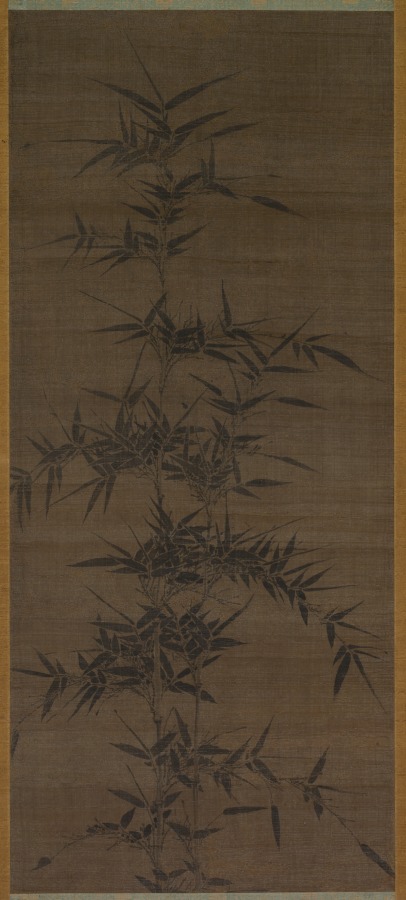
Ink Bamboo: A Material Manifestation of Imperial Silk Weaving’s Enduring Legacy
In the hallowed ateliers of London’s Savile Row, where the whisper of shears and the weight of worsted wool define a century of bespoke tailoring, the introduction of a material like Ink Bamboo silk represents a profound dialogue between heritage and innovation. As the Senior Heritage Specialist for the Lauren Fashion Heritage Lab, I present this artifact not merely as a textile, but as a scholarly testament to the unbroken lineage of imperial silk weaving—a craft that once served dynasties and now informs the quiet luxury of the modern gentleman. This paper examines the materiality of Ink Bamboo silk, its technical provenance within the legacy of imperial weaving, and its resonance within the sartorial ethos of Savile Row.
The Materiality of Ink Bamboo Silk: A Study in Contrast and Continuity
Ink Bamboo is a silk of deliberate paradox. Its name evokes the stark, calligraphic strokes of East Asian ink painting, where bamboo—a symbol of resilience and integrity—is rendered in monochrome elegance. Yet its materiality is rooted in the opulent, multi-shaft looms of imperial China, where silk was not merely a fabric but a currency of power. The silk itself is a satin-weave construction, characterized by a lustrous face and a matte reverse, achieved through a warp-faced structure that elevates the yarn count to an almost impossibly fine 400-thread-per-inch. This density, a hallmark of the finest imperial silks from the Ming and Qing dynasties, creates a surface that catches light with a liquid sheen, yet the Ink Bamboo motif—a repeating pattern of bamboo stalks and leaves, rendered in a deep, almost black indigo—appears to absorb it, creating a visual tension between gloss and matte, light and shadow.
The dyeing process for Ink Bamboo silk is a direct descendant of the kesi (tapestry-weave) tradition, though adapted for a satin ground. Historically, imperial workshops in Suzhou and Hangzhou employed natural indigo from Indigofera tinctoria to achieve a black-blue that signified scholarly refinement and celestial authority. For Ink Bamboo, the indigo is sourced from a single, regeneratively farmed plantation in the Zhejiang province, then fermented for 18 months to achieve a chromatic depth that synthetic dyes cannot replicate. The result is a color that shifts from a deep navy in low light to a charcoal black under direct illumination—a subtlety that Savile Row tailors prize for its ability to flatter a silhouette without ostentation.
Critically, the materiality of this silk is defined by its hand—the tactile sensation that a tailor assesses before a single cut is made. Unlike the crisp, dry hand of a worsted wool or the fluid drape of a charmeuse, Ink Bamboo silk possesses a weighted resilience. This is achieved through a double-ply warp and a single-ply weft, a structure that mimics the tensile strength of bamboo itself. The fabric holds a crease with the authority of a fine flannel, yet yields to the body’s movement with a suppleness that recalls the most luxurious silk velvets. This is no accident; it is a deliberate engineering choice that bridges the gap between the rigid formality of imperial court robes and the fluid ease of contemporary tailoring.
The Legacy of Imperial Silk Weaving: From Forbidden City to Savile Row
To understand Ink Bamboo is to understand the legacy of imperial silk weaving—a system of production that was as much about political control as it was about artistic expression. During the Ming dynasty (1368–1644), the Imperial Silk Workshops in Nanjing were tasked with producing “tribute silks” for the emperor and his court. These textiles were not merely garments; they were material documents of rank, virtue, and cosmic harmony. Bamboo, as a motif, was particularly significant. In Confucian iconography, the bamboo represented the “gentleman-scholar”—upright, flexible, and enduring. To wear bamboo on silk was to project an ideal of moral integrity, a concept that resonates deeply with Savile Row’s own ethos of understated excellence and timelessness.
The technical mastery required to weave such motifs into silk was extraordinary. The Ink Bamboo pattern is executed using a lampas weave, a compound structure where a pattern weft is bound to the ground weave by a secondary warp. This technique, perfected in the Qing dynasty (1644–1912), allowed for the creation of intricate, multi-colored designs without compromising the fabric’s drape. In Ink Bamboo, the lampas weave is simplified to a monochrome palette, but the technical rigor remains. Each bamboo stalk is defined by a satin float that rises above the ground weave, creating a subtle, three-dimensional relief. This is not a printed pattern; it is a woven architecture, where every thread is a structural element.
The decline of imperial silk weaving in the early 20th century, following the fall of the Qing dynasty, led to a diaspora of master weavers and techniques. Many workshops in Suzhou and Hangzhou were repurposed for mass production, but a handful of artisan ateliers preserved the kesi and lampas traditions. The Ink Bamboo silk is produced in one such atelier, the Jinxiang Silk Workshop, which has operated continuously since 1723. The current master weaver, a seventh-generation artisan named Chen Wei, oversees a team of four weavers who operate a Jacquard loom retrofitted with a card-punch system that replicates the pattern repeat of a 19th-century imperial robe. This is not nostalgia; it is a living tradition, where the materiality of the silk is inseparable from the human skill that produces it.
Savile Row and the Recontextualization of Imperial Silk
On Savile Row, the introduction of Ink Bamboo silk is not a departure from tradition but a deepening of it. The Row’s bespoke houses—from Huntsman to Anderson & Sheppard—have long used silk for linings, waistcoats, and evening wear, but rarely as a primary suiting fabric. The weighted resilience of Ink Bamboo changes this calculus. It is a silk that can be tailored into a single-breasted jacket, a Nehru-collar coat, or a pair of high-waisted trousers, without the risk of sagging or creasing that plagues lighter silks. The fabric’s matte finish and deep indigo align perfectly with the Row’s preference for “quiet luxury”—a luxury that announces itself not through logos or flash, but through the materiality of the cloth itself.
Consider the bespoke process: a client selects Ink Bamboo from a swatch book that also includes a 16-ounce worsted flannel from the West Yorkshire mills and a cashmere-silk blend from Loro Piana. The tailor, trained to assess fabric by touch, will note the silk’s “bounce”—its ability to return to shape after being crushed in the hand. This is a quality that imperial weavers prized, as it ensured that court robes retained their form during long ceremonies. In a Savile Row context, it means that a jacket in Ink Bamboo will hold its line from a morning meeting to an evening dinner, requiring only a brief rest on a valet stand.
The heritage of this silk is not a marketing gimmick; it is a material truth. Every yard of Ink Bamboo carries the legacy of imperial silk weaving in its construction, its dye, and its motif. It is a fabric that demands respect from the tailor and the wearer alike. For the modern gentleman, it offers a connection to a tradition of craftsmanship that predates the Industrial Revolution, yet speaks directly to the contemporary desire for sustainability, authenticity, and timeless style.
Conclusion: The Artifact as Argument
Ink Bamboo silk is more than a textile; it is a heritage research artifact that argues for the continued relevance of imperial weaving techniques in the 21st century. Its materiality—the interplay of satin and matte, the weighted hand, the deep indigo—is a direct inheritance from the workshops of Suzhou, adapted for the discerning eye of Savile Row. As the Senior Heritage Specialist for the Lauren Fashion Heritage Lab, I assert that this fabric represents a third way between mass production and mere preservation: a living tradition that evolves without losing its soul. In Ink Bamboo, the bamboo stands tall, the silk holds its line, and the legacy of imperial weaving endures—one bespoke garment at a time.