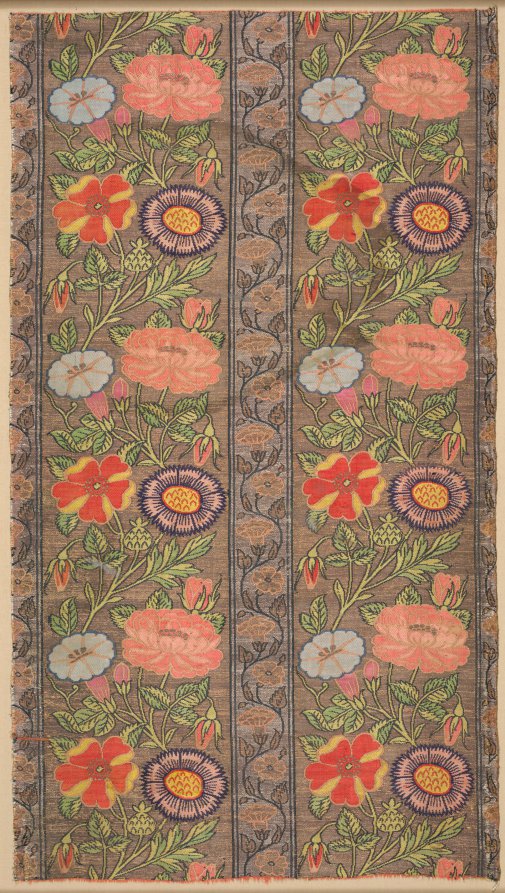
A Discourse on the Floral Striped Silk upon a Golden Ground: An Artifact of Imperial Command
To consider this particular textile—a floral striped silk upon a golden ground—is to engage not merely with a material, but with a profound statement of authority, a deliberate orchestration of technical mastery and symbolic language. The foundation, a ground of gold, is the non-negotiable premise. It speaks not of gaudiness, but of latent power; the very warp and weft are infused with the suggestion of immutable value. This is not colour applied, but substance woven. The gold thread, likely a silk core wrapped with fine gilt membrane or a cunning blend of yellow silk, captures and refracts light with a subdued, inherent richness. It provides a field of absolute prestige upon which the narrative is to be displayed.
The Architecture of the Stripe: Order Imposed upon Opulence
The stripe, so often a mere decorative motif, is here elevated to a principle of governance. It imposes a vertical regimentation upon the luminous chaos of the golden ground. These stripes are the architectural columns of the textile, establishing rhythm, proportion, and a disciplined framework. Within this imposed order, the true virtuosity unfolds. The stripes themselves are not flat bands of colour, but complex channels, often defined by subtle variations in weave structure—a shift from a satin ground to a damask—creating a play of light that delineates them with sophistication rather than brute contrast.
It is within these ordained channels that the flora resides. The stripe, therefore, acts as both boundary and showcase. This is a curated nature, a botanical collection arranged with imperial precision. The wild, spreading tendril is brought to heel, presented in ordered repetition, its vitality framed and thus controlled by the sovereign structure of the stripe. The message is unambiguous: even the boundless fecundity of nature answers to a higher order.
The Florilegium: A Botanical Lexicon of Power
The specific choice of flora is, of course, paramount. This is no random assortment of blossoms. One is to read them as a coded heraldry. The peony, undisputed sovereign of the floral realm, speaks of wealth, honour, and the full bloom of dynastic power. The chrysanthemum, with its radial precision, denotes longevity and perfection, perhaps a nod to the enduring nature of the imperial institution itself. The lotus, rising unsullied from mud, embodies purity and spiritual authority, a necessary virtue for the legitimised ruler.
Crucially, these are not isolated specimens. They are woven into intricate, reciprocal relationships—a peony bud nestled against a full bloom, a chrysanthemum attended by a curling leaf. This suggests lineage, succession, and the interconnected ecosystem of the court. The weaving technique, likely a kesi (slit-tapestry) or a fine jin silk satin damask, allows for this painterly detail, rendering each petal, vein, and stamen with a clarity that transforms the silk into a permanent, wearable garden of imperial allegory.
The Legacy of the Loom: Materiality as Manifest Destiny
The materiality is the incontrovertible evidence of command. Imperial silk workshops were not ateliers; they were engines of state, consuming vast resources and corralling the empire’s most skilled artisans—weavers, dyers, pattern-drawers—into a single, directed purpose. The production of such a silk was an act of logistics as much as artistry. The flawless, consistent quality of the thread, the unwavering precision of the repeat, the depth and fastness of the dyes (vermilion, sapphire, emerald) all testify to a system of uncompromising standards and centralised control.
To drape oneself in this fabric was to literally cloak one’s person in the output of the imperial machine. It was a direct, tactile connection to the throne’s administrative and artistic might. The weight of the silk, its substantial hand-feel, the soft, rustling whisper—the scroop—it produced, were all sensory affirmations of its authenticity and cost. It could not be imitated by lesser principalities; it was a product of scale, secrecy, and sovereign investment.
Conclusion: The Enduring Grammar of Grandeur
Thus, this floral striped silk upon a golden ground stands as a definitive artifact of imperial silk weaving. It is a tripartite manifesto: the golden ground declares inherent, monumental value; the striped architecture imposes a disciplined, governing order; and the curated florilegium articulates a specific language of virtue, longevity, and power. It represents the apex of a culture that understood textile as text, and weave as word.
For the modern connoisseur, appreciating such a piece requires this understanding of its foundational grammar. It is not merely "patterned silk." It is a woven decree. The legacy it carries is one of absolute intentionality—where every thread, every colour, every botanical form was mobilised in the service of a singular vision: to make tangible, through the sublime manipulation of the silkworm’s filament, the enduring authority of the throne. In its presence, one does not simply see a fabric; one reads a constitution of splendour.