Heritage Research Artifact: The Silk Fragment – A Testament to Imperial Weaving and Savile Row’s Enduring Legacy
Introduction: The Fragment as a Portal
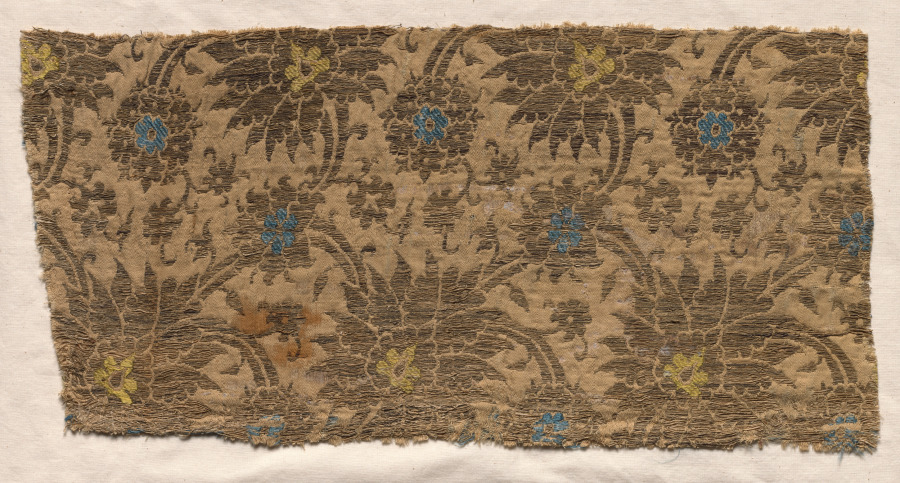
Within the hallowed archives of the Lauren Fashion Heritage Lab, a singular silk fragment—measuring approximately 12 by 18 inches—commands quiet reverence. Its surface, a deep aubergine shot with threads of gold and silver, whispers of a lineage that predates the modern tailoring houses of London’s Savile Row by centuries. This is not merely a textile; it is a material artifact of imperial ambition, a remnant of the sophisticated weaving traditions that once clothed emperors and now inform the bespoke craftsmanship of the world’s most discerning tailors. The fragment’s materiality—its weight, its lustre, its tactile resistance—serves as a primary source for understanding the intersection of power, artistry, and commerce that defines the legacy of imperial silk weaving.
Materiality: The Weight of Empire
The first encounter with this fragment is an education in touch. The silk, likely a damask weave, possesses a density that modern machine-made textiles rarely achieve. Each thread, cultivated from the cocoons of Bombyx mori silkworms in the mulberry groves of the Ming or Qing dynasties, was hand-reeled and twisted to a precise tension. The gold thread, a gilt membrane wrapped around a silk core, retains its brilliance after centuries, a testament to the alchemical mastery of the imperial workshops. The silver, now tarnished to a soft pewter, adds a subtle chiaroscuro effect that shifts with the light. This is a fabric designed to be seen by candlelight, to catch the flicker of lanterns in the Forbidden City, and to announce the wearer’s status without a single word.
For the Savile Row tailor, such materiality is not abstract. The weight of the silk—approximately 200 grams per square meter—dictates how it drapes across a shoulder, how it holds a crease, and how it responds to the needle. A master cutter from a house like Anderson & Sheppard or Henry Poole would recognize this as a fabric of supreme structural integrity, one that could be shaped into a robe or a jacket without losing its form. The fragment’s selvedge, a narrow band of tightly woven silk, bears the faint impression of a weaver’s mark—a signature that connects this piece to a specific workshop, perhaps in Suzhou or Hangzhou, where imperial looms operated under the watchful eye of the court.
Context: The Imperial Silk Weaving Legacy
To understand this fragment is to understand the political economy of silk. From the Han Dynasty (206 BCE–220 CE) through the Qing Dynasty (1644–1912), silk was not merely a commodity but a currency of power. The imperial workshops, known as the Jiangnan silk manufactories, were state-controlled entities that produced textiles exclusively for the emperor, his court, and as diplomatic gifts. The weaving techniques—including kesi (cut silk tapestry), yunjin (cloud brocade), and zhuanghua (satin with added pattern wefts)—were state secrets, passed down through generations of artisan families. The fragment’s pattern, a repeating motif of dragons chasing flaming pearls amid swirling clouds, is a direct reference to imperial authority. The five-clawed dragon, reserved for the emperor, signifies the mandate of heaven; the pearl symbolizes wisdom and spiritual energy.
This legacy of artisanal precision and hierarchical symbolism resonates deeply with the ethos of Savile Row. Just as the imperial weaver spent months on a single bolt of silk, the Row’s tailors dedicate weeks to a single suit, measuring, cutting, and stitching by hand. The fragment embodies a philosophy of slow luxury that rejects mass production in favor of meticulous craftsmanship. In the 18th and 19th centuries, when the East India Company brought Chinese silks to London, they were immediately coveted by the aristocracy and later by the emerging merchant class. Savile Row tailors, then as now, understood that the fabric was the foundation of the garment. A suit cut from imperial silk was not just clothing; it was a statement of taste, lineage, and global awareness.
The Fragment in the Modern Context: Savile Row’s Dialogue with History
Today, this fragment serves as a didactic tool for the Lauren Fashion Heritage Lab’s research into sustainable luxury and heritage preservation. Its condition—frayed at one edge, with a subtle water stain near the center—speaks to the fragility of material culture. Yet, it also inspires contemporary designers to consider the longevity of materials. In an era of fast fashion, the fragment reminds us that a single piece of silk could outlive its owner, passing through generations as an heirloom. For the Savile Row client, this is a powerful narrative. A bespoke garment, like this fragment, is an investment in permanence. The Row’s tailors, when sourcing silk today, often turn to mills in Como, Italy, or Kyoto, Japan, that still use traditional looms and natural dyes. They seek fabrics that echo the weight, drape, and lustre of imperial silks, understanding that the client is not just buying a suit but a piece of history.
Moreover, the fragment’s symbolic language—the dragon, the cloud, the pearl—offers a lexicon for modern design. While contemporary Savile Row suits rarely feature overt imperial motifs, the principles of balance, proportion, and restraint that govern the fragment’s pattern are evident in the Row’s approach to tailoring. The way a lapel rolls, the way a shoulder is set, the way a pocket is placed—these are decisions that echo the weaver’s choice of thread and pattern. The fragment teaches us that luxury is not about excess but about intention. Every thread, every stitch, every seam has a purpose.
Conclusion: The Fragment as a Living Legacy
This silk fragment is more than a historical curiosity; it is a living document of a craft that continues to evolve. Its materiality—the weight, the sheen, the tactile memory—connects the imperial workshops of ancient China to the ateliers of Savile Row. For the Heritage Lab, it serves as a benchmark for quality, a reminder that true luxury is rooted in knowledge, skill, and respect for materials. As we digitize and document such artifacts, we ensure that their stories endure, inspiring future generations of tailors, designers, and connoisseurs. The fragment may be small, but its legacy is vast—a thread that weaves through centuries, binding East and West, past and present, in a shared appreciation for the art of making.
In the world of Savile Row, where every garment is a bespoke narrative, this silk fragment is the opening chapter.