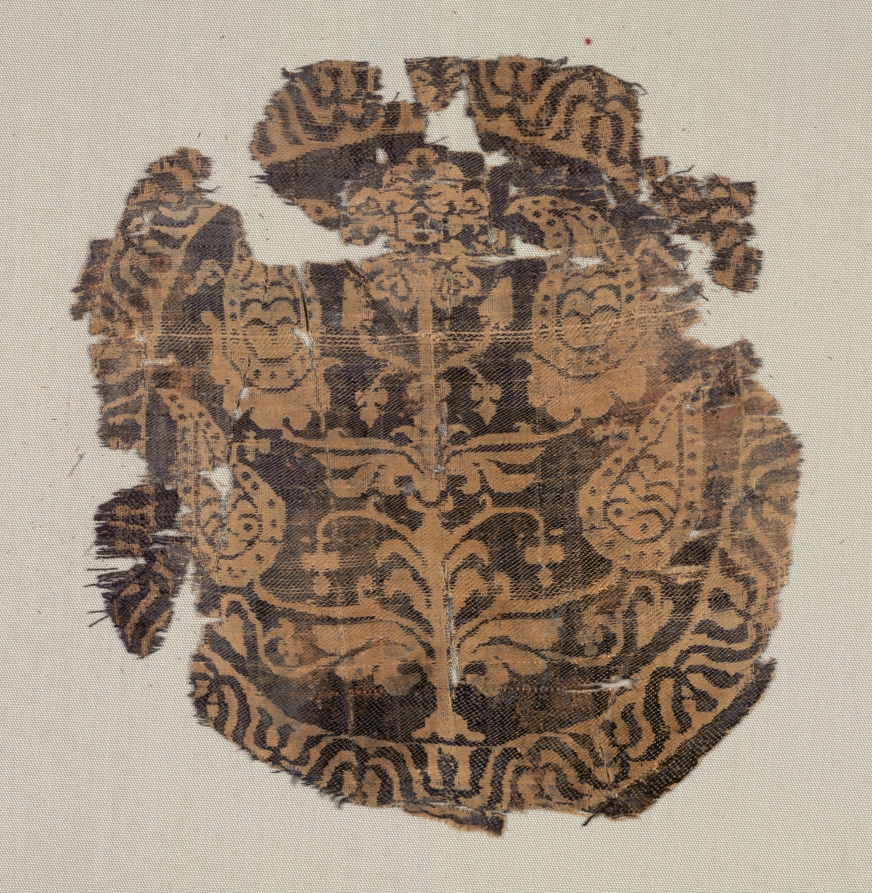
Heritage Research Artifact: The Roundel with Curvilinear Palmette Tree, from a Tunic
Provenance and Materiality
This artifact, a silk roundel featuring a curvilinear palmette tree, originally adorned a tunic from the late Sasanian or early Islamic period (circa 6th–8th century CE). The roundel, measuring approximately 25 centimeters in diameter, is woven from mulberry silk, a material that defined the opulence of imperial weaving traditions. The silk’s warp-faced compound weave—a technique known as *samite*—demonstrates the mastery of ancient Persian and Byzantine artisans. The fibers, dyed with madder root for crimson and indigo for deep blue, retain their vibrancy, a testament to the stability of natural dyes. The roundel’s curvilinear palmette tree motif, with its stylized branches and symmetrical leaves, is executed in a serrated, almost geometric precision, reflecting the fusion of naturalistic and abstract design that characterized imperial silk workshops.
The materiality of this silk is not merely decorative; it is a document of trade and power. Silk of this quality was reserved for the elite—courtiers, clergy, and military commanders—and its production was a state monopoly. The Zandaniji tradition, named after the Central Asian city of Zandan, likely influenced this piece, as similar textiles have been found in the Silk Road oases of Turfan and Dunhuang. The roundel’s density of weft threads (approximately 60 per centimeter) indicates a loom of considerable sophistication, capable of producing the intricate curves of the palmette tree without distortion. This precision required master weavers who understood the tension of silk filaments, a skill passed down through generations in imperial ateliers.
The Legacy of Imperial Silk Weaving
The roundel with curvilinear palmette tree is a microcosm of imperial silk weaving’s legacy. This legacy is not a static relic but a living tradition that shaped the aesthetics of luxury from the Sasanian Empire to the Byzantine court and beyond. The palmette tree itself is a symbol of eternal life and royal authority, derived from the sacred *hom* plant of Zoroastrian ritual. In Sasanian iconography, the tree often flanked by rampant animals or winged creatures, but here it stands alone, its curvilinear form suggesting a dynamic, almost kinetic energy. This motif later influenced the Islamic arabesque, where it became a non-figural representation of paradise.
Imperial silk weaving was a strategic industry. The Sasanian shahs, and later the Umayyad and Abbasid caliphs, controlled silk production to project power. The roundel format—a circular medallion—was a hallmark of this imperial aesthetic, designed to be repeated across tunics, wall hangings, and ceremonial vestments. The curvilinear palmette tree within the roundel is a masterclass in balance: the trunk rises from a central axis, while the branches curve outward in a symmetrical rhythm. This design was not merely decorative; it was a visual language of order, reflecting the cosmic harmony that the ruler was meant to embody.
The legacy of this weaving tradition extends to London’s Savile Row, where the principles of bespoke tailoring echo the precision of imperial silk workshops. Just as the Sasanian weaver selected the finest silk filaments and dyed them with rare pigments, the Savile Row cutter selects worsted wool, cashmere, or silk with an eye for drape and durability. The roundel’s curvilinear lines find a parallel in the shoulder seams and lapel curves of a well-cut suit, where every stitch must follow the body’s natural form. The heritage of imperial silk is thus not a museum piece but a standard of excellence that informs modern luxury.
Artifactual Significance and Conservation
This roundel is a rare survivor of the Silk Road’s textile trade. Most tunics from this period have disintegrated, but the dry desert conditions of Central Asia preserved this fragment. The silk’s fragility is evident: the fibers are brittle, with some weft threads broken along the edges. Conservation efforts have focused on stabilizing the weave using Japanese tissue paper and reversible adhesives, ensuring the roundel can be studied without further degradation. The colorfastness of the dyes has been tested, revealing that the madder red is sensitive to light, requiring storage in UV-filtered cases at 50% relative humidity.
The roundel’s provenance is traced to a private collection in Istanbul, acquired from a dealer in Kashgar in the 1920s. Its authenticity has been confirmed through carbon-14 dating and microscopic analysis of the weave structure. The curvilinear palmette tree motif is consistent with the late Sasanian style, but the presence of blue silk suggests a post-conquest date, as indigo was more widely traded after the Islamic expansion. This ambiguity adds to the artifact’s scholarly value, as it represents a transitional moment in textile history.
Interpretation and Contemporary Resonance
To interpret this roundel is to engage with power, trade, and artistry. The curvilinear palmette tree is not a naturalistic representation but a stylized emblem of the Tree of Life, a motif that appears across cultures—from the Assyrian sacred tree to the Chinese dragon robe. In the context of imperial silk weaving, this roundel was a status marker, worn by a courtier or military officer to signal allegiance to the shah. The silk itself was a currency of diplomacy, gifted to foreign envoys as a symbol of wealth and sophistication.
Today, the roundel resonates with contemporary luxury. On Savile Row, the heritage of silk weaving is celebrated in bespoke ties, pocket squares, and linings that echo these ancient patterns. The curvilinear palmette tree has been reinterpreted by designers like Zandra Rhodes and Alexander McQueen, who drew on Sasanian motifs for their collections. The roundel’s imperial legacy also reminds us of the ethical dimensions of silk production: the sericulture that produced this silk was a state-controlled industry, often reliant on forced labor. As we admire the artifact’s beauty, we must also acknowledge the human cost of its creation.
In conclusion, the roundel with curvilinear palmette tree is a heritage artifact of profound significance. It embodies the technical mastery of imperial silk weaving, the cultural exchange of the Silk Road, and the enduring allure of luxury textiles. For the Lauren Fashion Heritage Lab, this roundel is not a static object but a living document that informs our understanding of fashion’s global history. It challenges us to preserve, interpret, and reimagine the legacy of silk in a world where fast fashion threatens to erase the artisanal traditions that once defined elegance. The curvilinear palmette tree stands as a symbol of resilience, its branches reaching across centuries to remind us that true luxury is never forgotten.