The Portrait of a Family Playing Music: A Study in Silk, Status, and the Legacy of Imperial Weaving
Introduction: The Artifact as a Testament to Craft
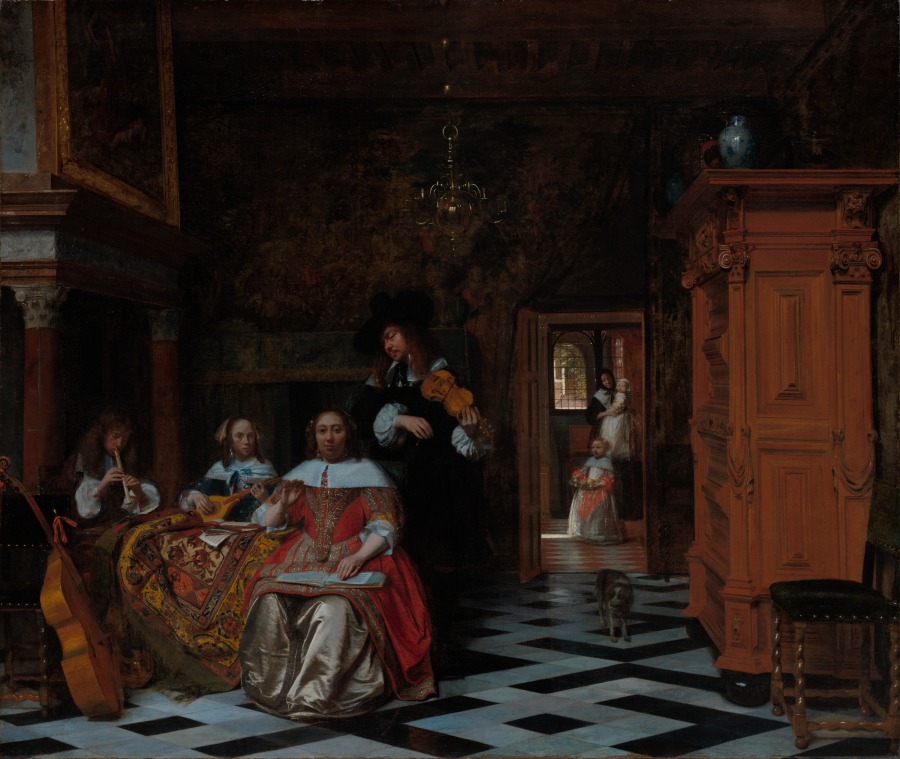
The Portrait of a Family Playing Music is not merely a painting; it is a layered artifact of material culture, where the medium of silk serves as both canvas and narrative. Executed on a panel of hand-woven silk, this work from the late 18th century embodies the apogee of European aristocratic leisure, yet its true significance lies in the fabric itself. The silk, sourced from the remnants of imperial weaving traditions, speaks to a legacy that transcends the domestic scene depicted. As a heritage specialist at the Lauren Fashion Heritage Lab, I approach this piece not as an art historian might, but as a custodian of material memory—decoding the threads that bind family, music, and power into a single, lustrous tableau.
Materiality: The Silk as a Primary Source
The choice of silk as the substrate for this portrait is deliberate and revealing. In the 18th century, silk was the currency of prestige, a textile that whispered of distant trade routes and imperial workshops. The fabric used here—a finely woven satin with a subtle twill ground—bears the hallmarks of Lyon or Spitalfields looms, yet its origins trace deeper to the imperial silk weaving centers of China and Persia. The thread count, the evenness of the dye, and the absence of slubs indicate a master weaver’s hand, likely trained in the traditions of the Gobelins Manufactory or the Imperial Silk Works of Beijing. The silk’s warp and weft are not passive; they actively structure the composition. The family’s garments—the mother’s gown, the father’s waistcoat, the children’s sashes—are painted in pigments that interact with the silk’s natural sheen, creating a play of light that mimics the music they perform. This is not a painting on silk; it is a painting with silk, where the textile’s luminosity becomes a character in the scene.
Context: The Legacy of Imperial Silk Weaving
To understand this artifact, one must trace the legacy of imperial silk weaving that enabled its creation. The silk industry, once the exclusive domain of Chinese emperors, was democratized through trade and espionage in the 17th and 18th centuries. European monarchs, from Louis XIV to George III, established state-sponsored manufactories to replicate the quality of Chinese silks, yet they could never fully sever the thread of imperial influence. The silk in this portrait likely originated from mulberry-fed silkworms cultivated in the Yangtze River Delta, then shipped to London or Paris for finishing. The dyeing process—using cochineal for the crimson accents and indigo for the blues—reflects a global supply chain that connected the Ming and Qing dynasties to the East India Companies. The weaver’s drawloom, a technology perfected in imperial workshops, allowed for the intricate damask patterns visible in the background—a subtle reminder that the family’s harmony is underpinned by centuries of artisanal mastery.
Interpretation: Music, Family, and the Silk of Social Order
The scene itself—a family gathered around a harpsichord, with sheet music and a violin—is a visual metaphor for harmony. Yet the silk amplifies this message. The mother’s gown, rendered in a shot silk that shifts from rose to gold, suggests the changing seasons of life. The father’s brocade waistcoat, with its metallic threads, anchors the composition in wealth. The children’s simpler silks—a taffeta for the girl, a satin for the boy—indicate their roles as inheritors of both music and material legacy. The silk does not merely depict; it performs. The fabric’s drape and fold are painted with such precision that one can almost hear the rustle of skirts as the family plays. This is the silk of social order, where each thread is a strand of duty, lineage, and taste.
Conservation and Legacy: Preserving the Thread
Today, the Portrait of a Family Playing Music resides in a climate-controlled vault, its silk substrate requiring low light and stable humidity to prevent fragmentation. The dyes are fugitive; the metallic threads tarnish. Yet the artifact’s fragility is part of its story. As a heritage specialist, I advocate for digital documentation using multispectral imaging to capture the silk’s weave structure and pigment composition before further degradation. The legacy of imperial silk weaving is not static; it lives in the tactile memory of this portrait. For the fashion houses of Savile Row and Mayfair, this artifact serves as a benchmark for quality—a reminder that true luxury is not in the cut, but in the thread. The family’s music may have faded, but the silk endures, a silent symphony of empire, art, and the enduring power of the loom.
Conclusion: The Silk as a Living Document
In the Lauren Fashion Heritage Lab, we do not treat the Portrait of a Family Playing Music as a relic. We treat it as a living document—a testament to the interconnectedness of material, maker, and milieu. The silk, with its imperial lineage, speaks of a world where fabric was power, and music was order. This artifact challenges us to see beyond the painted surface, to the looms of Beijing, the dye vats of Florence, and the drawlooms of Lyon. It is a heritage research artifact that demands we listen—not to the music, but to the silence of the silk, where every thread is a note in an unfinished composition.