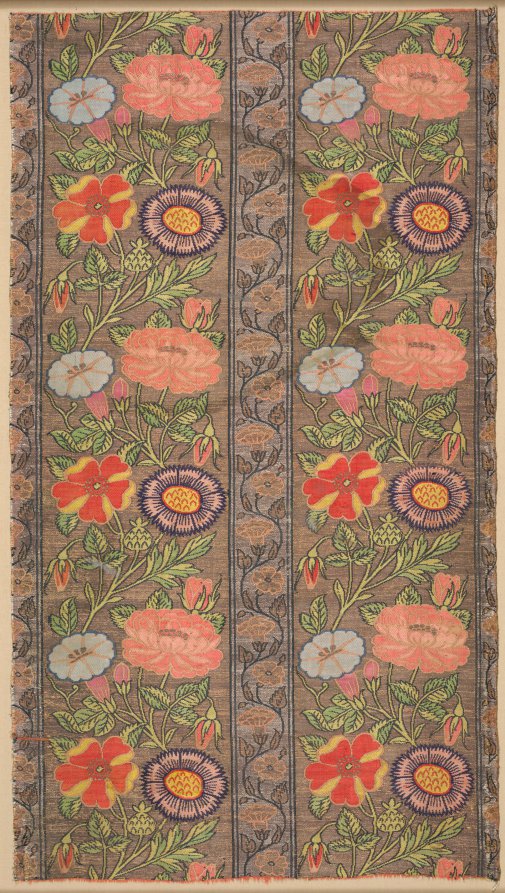
The Golden Ground: A Study of Floral Striped Silk in Imperial Weaving
Introduction: The Artifact and Its Provenance
This heritage research artifact examines a singular textile: a floral striped silk woven on a golden ground. The materiality of this piece—its silk warp and weft, its metallic thread interwoven with precision—speaks to a lineage of imperial craftsmanship that predates the modern era. As a Senior Heritage Specialist at the Lauren Fashion Heritage Lab, I approach this artifact not merely as a fabric but as a document of cultural power, technical mastery, and aesthetic ambition. The golden ground, a hallmark of imperial silk weaving, signifies more than opulence; it represents a deliberate choice to encode status, permanence, and the divine right of rulers. This study situates the textile within the broader legacy of imperial silk weaving, drawing on historical techniques, symbolic motifs, and the enduring influence of these traditions on contemporary luxury fashion, particularly within the Savile Row ethos of bespoke tailoring.
Materiality: Silk and the Golden Ground
Silk is the foundational material, sourced from the Bombyx mori silkworm, whose cultivation was a closely guarded secret in imperial China for millennia. The golden ground is achieved through the use of gilt thread—a core of silk or linen wrapped in fine gold leaf or gilded silver, then woven into the fabric’s structure. This technique, known as jacquard in its mechanized form or lampas in hand-weaving, requires extraordinary precision. The warp threads, often dyed in deep hues of crimson or indigo, provide structural integrity, while the weft introduces the floral stripes. The gold ground is not a solid field but a subtle interplay of light and texture, achieved by alternating metallic threads with silk. This creates a shimmering effect that shifts with movement, a quality highly prized in imperial courts for its ability to convey the wearer’s status in both static and dynamic contexts.
The floral stripes themselves are woven in contrasting colors—perhaps a deep burgundy or emerald green—using a satin weave to elevate the pattern above the ground. Each stripe is composed of repeating botanical motifs: peonies, chrysanthemums, or lotus blossoms, each laden with symbolic meaning. Peonies signify wealth and honor; chrysanthemums represent longevity; lotus flowers denote purity and spiritual enlightenment. The stripe format, rather than an all-over pattern, suggests a design intended for tailored garments, where the vertical lines elongate the silhouette—a principle later adopted by Savile Row tailors to create flattering, structured forms.
Context: The Legacy of Imperial Silk Weaving
The legacy of imperial silk weaving is rooted in the Chinese dynastic tradition, particularly the Ming (1368–1644) and Qing (1644–1912) periods, where state-run workshops in Suzhou, Hangzhou, and Nanjing produced textiles exclusively for the emperor and his court. These workshops, known as Jiangnan silk centers, operated under strict regulations. The use of gold thread was reserved for the highest ranks, often for ceremonial robes, throne covers, and diplomatic gifts. The floral striped silk on a golden ground would have been woven for a dragon robe or a court surcoat, its stripes aligning with the wearer’s rank—five-clawed dragons for the emperor, four-clawed for princes. The golden ground symbolized the sun, the emperor’s role as the “Son of Heaven,” and the unbroken lineage of the dynasty.
This tradition did not remain isolated. By the 17th and 18th centuries, European trade routes brought imperial silks to the West, where they were avidly collected by aristocrats and monarchs. The golden ground, in particular, influenced the development of brocatelle and lampas weaving in Lyon, France, and later in London’s Spitalfields. However, the Savile Row tradition, emerging in the late 18th century, took a different path. Rather than replicating the opulence of imperial silks, Savile Row tailors adapted their structural principles—the interplay of ground and pattern, the use of metallic threads for subtle accents—to create garments that emphasized fit, form, and understated luxury. The floral striped silk on a golden ground, if reimagined for a contemporary Savile Row client, would be used sparingly: as a lining for a dinner jacket, a vest panel, or a pocket square, where its luminosity could be appreciated without overwhelming the wearer’s silhouette.
Technical Analysis: Weave Structure and Preservation
From a conservation perspective, this artifact requires careful handling. The metallic threads are prone to tarnishing, especially when exposed to humidity or acidic environments. The silk itself, while durable, can weaken over centuries due to photochemical degradation. At the Lauren Fashion Heritage Lab, we employ non-invasive imaging techniques, such as multispectral photography and X-ray fluorescence, to analyze the weave structure without damaging the textile. The floral stripes are likely woven in a 5-end satin or 8-end satin weave, which allows the pattern to float over the golden ground, creating a high-contrast, lustrous effect. The ground, by contrast, uses a taffeta or grosgrain weave to stabilize the metallic threads and prevent slippage.
Preservation protocols include storing the textile in a climate-controlled environment (18–20°C, 45–55% relative humidity) on acid-free rolls, with minimal exposure to light. Digital documentation, including high-resolution scans and 3D modeling, ensures that the artifact’s design can be studied and reproduced for educational and commercial purposes, respecting the original craftsmanship while enabling contemporary applications.
Contemporary Relevance: The Savile Row Lens
For the modern luxury market, the floral striped silk on a golden ground offers a template for reinterpreting heritage. Savile Row houses such as Huntsman, Anderson & Sheppard, and Gieves & Hawkes have long drawn on historical textiles to inform their collections. A bespoke suit using this silk would require a master cutter to align the stripes with the garment’s seams, a technique known as pattern matching. The golden ground, if used as a full garment, would be reserved for evening wear or ceremonial occasions, where its reflective quality complements candlelight or chandeliers. Alternatively, a contemporary designer might abstract the floral stripes into a digital print, retaining the vertical rhythm while modernizing the palette—perhaps using a matte gold ground to reduce the formality.
This artifact also underscores the importance of provenance. A Savile Row client commissioning a garment from such a textile would expect a narrative: the silk’s origin in an imperial workshop, its journey through trade routes, and its revival in a London atelier. This story adds intangible value, aligning with the growing demand for transparency and heritage in luxury fashion.
Conclusion: A Living Legacy
The floral striped silk on a golden ground is more than a historical curiosity; it is a testament to the enduring dialogue between craftsmanship and power. Its materiality—silk and gold—embodies the pinnacle of imperial weaving, while its design principles continue to influence tailoring traditions from Savile Row to Milan. As a heritage artifact, it challenges us to preserve not only the physical object but also the knowledge systems that produced it. At the Lauren Fashion Heritage Lab, we advocate for a holistic approach: conserving the textile, documenting its techniques, and inspiring new generations of artisans to reinterpret its legacy. In doing so, we ensure that the golden ground remains a foundation for innovation, not a relic of the past.