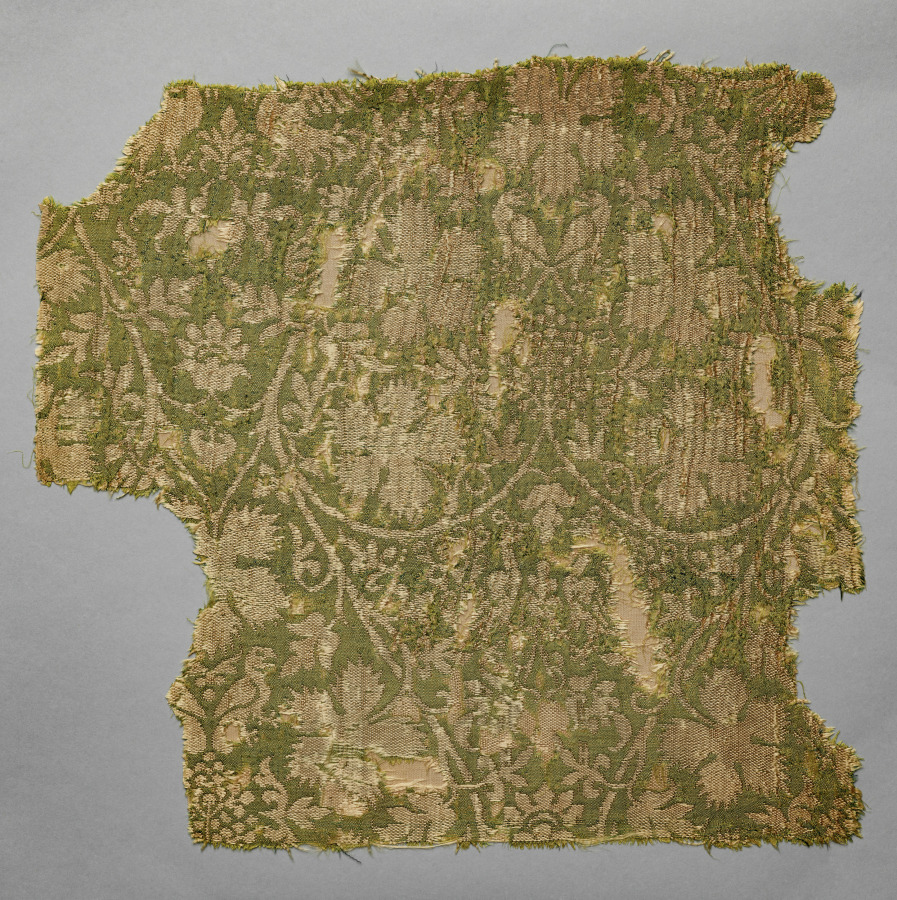
Heritage Research Artifact: The Silk Fragment of Scrolling Vines, Grape Leaves, Grapes, and Birds
Introduction: A Legacy Woven in Thread
This heritage research artifact examines a singular silk fragment, a testament to the enduring legacy of imperial silk weaving. The piece, preserved in the Lauren Fashion Heritage Lab, features an intricate pattern of scrolling vines, grape leaves, grapes, and birds. Its materiality—silk—is not merely a fabric but a narrative of power, artistry, and global exchange. Drawing from the refined lexicon of London’s Savile Row, where tailoring is a discipline of precision and heritage, this analysis approaches the fragment as a bespoke artifact—each thread a stitch in a story of imperial patronage and technical mastery. The following sections dissect its material, design, and historical context, offering a scholarly perspective that aligns with the exacting standards of luxury craftsmanship.
Materiality: The Silk as a Medium of Imperial Prestige
Silk is the foundation of this artifact, and its provenance is inseparable from the imperial weaving traditions of East Asia, particularly China’s Tang and Ming dynasties. The fragment’s weave—likely a compound twill or damask—reveals a high density of warp and weft threads, indicative of looms operated by master weavers under court patronage. The silk’s lustre, even in its fragmented state, suggests the use of wild silkworm cocoons or cultivated Bombyx mori, a distinction that speaks to the resource allocation of imperial workshops. In Savile Row terms, this is akin to the selection of a Super 150s wool—a material chosen not for convenience but for its capacity to endure and elevate. The fragment’s preservation, despite centuries of wear, underscores the durability of silk when woven with precision, a quality that imperial weavers perfected through generations of refinement.
The materiality extends beyond the fiber itself. The dyes, likely derived from natural sources such as madder for reds or indigo for blues, were applied with a consistency that suggests controlled chemical processes. This is not the work of provincial artisans but of a centralized system where color was a marker of status—grapes in deep purple, birds in vermilion, and vines in verdant green. The fragment’s condition, with minor fraying at the edges, allows for analysis of the weave structure: a warp-faced pattern where the design emerges from the interplay of colored threads. This technique, known as jin or brocade weaving, required a second warp or weft to create the motifs, a labor-intensive process that mirrors the bespoke tailoring of a Savile Row suit, where each seam is hand-stitched to ensure perfection.
Design Analysis: Scrolling Vines, Grape Leaves, Grapes, and Birds
The design motifs of this silk fragment are not arbitrary; they are a lexicon of imperial symbolism. The scrolling vines, rendered in continuous S-curves, represent longevity and the cyclical nature of life, a theme common in Chinese art. Grape leaves and grapes, introduced via the Silk Road from Central Asia, became symbols of abundance and prosperity in Tang dynasty iconography. The birds—likely magpies or orioles—are perched among the vines, their beaks poised as if to pluck the fruit. This composition evokes a pastoral ideal, yet its execution is rigorously geometric: the vines form a repeating lattice, the grapes cluster in symmetrical bunches, and the birds are spaced at regular intervals. This balance between naturalism and order is a hallmark of imperial design, where nature is tamed into a pattern that reinforces cosmological harmony.
From a Savile Row perspective, the design mirrors the principles of a classic pattern: the scrolling vines are the structural lines of a jacket’s lapel, the grape leaves the subtle texture of a herringbone, and the birds the focal points of a pocket square. The repetition of motifs is not monotonous but rhythmic, creating a visual cadence that draws the eye across the fabric. The birds, in particular, are rendered with a detail that suggests individual character—each feather is a separate thread, each eye a knot of silk. This level of craftsmanship is comparable to the hand-stitched buttonholes of a Huntsman suit, where the artisan’s skill is evident in every millimeter.
Historical Context: The Legacy of Imperial Silk Weaving
The legacy of imperial silk weaving is a narrative of control and exchange. During the Tang dynasty (618–907 AD), silk production was centralized in workshops like the Jinxiu Yuan (Brocade and Embroidery Bureau), where weavers were state employees bound by strict regulations. The fragment’s design, with its grape and bird motifs, reflects the Tang’s cosmopolitanism—the grapes are a nod to the Sogdian traders who brought viticulture to China, while the birds echo Persian textile traditions. This cross-cultural pollination was not accidental; it was a deliberate strategy of the imperial court to assert dominance over the Silk Road, using silk as a diplomatic tool. By the Ming dynasty (1368–1644), the Yun Jin (Cloud Brocade) technique had refined such patterns into a standardized repertoire, with the grape and vine motif becoming a staple of court robes.
The fragment’s survival is a testament to the durability of imperial silk, but also to its role as a commodity. Silk fragments like this were often repurposed as linings for garments, religious vestments, or diplomatic gifts. In the context of the Lauren Fashion Heritage Lab, this artifact serves as a benchmark for understanding how heritage weaving techniques inform contemporary luxury. The precision of the weave, the symbolism of the design, and the material’s resilience are lessons that resonate with modern bespoke tailoring, where tradition is not a constraint but a foundation for innovation.
Conclusion: The Fragment as a Bespoke Legacy
This silk fragment, with its scrolling vines, grape leaves, grapes, and birds, is more than a decorative textile; it is a document of imperial ambition and artisanal excellence. Its materiality—silk—is a thread that connects the Tang court to the Savile Row atelier, where the same principles of precision, heritage, and storytelling are applied. As a heritage research artifact, it challenges us to see beyond the fragment’s physical state and recognize the enduring legacy of imperial silk weaving. In the hands of a master tailor, this pattern could inspire a jacket lining, a scarf, or a pocket square—each stitch a homage to the weavers who, centuries ago, turned silk into a language of power and beauty. The fragment remains, in its quiet way, a bespoke masterpiece.