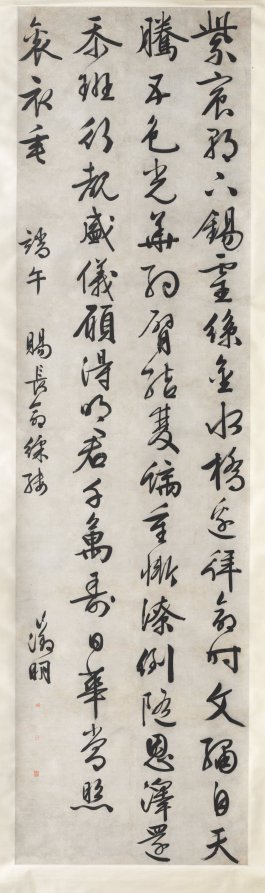
The Thread of Empire: An Embroidered Silk in Running-Standard Script
Introduction: The Artifact as a Vestige of Imperial Craft
In the hallowed archives of the Lauren Fashion Heritage Lab, we encounter a singular artifact: a poem rendered on an embroidered silk, executed in the fluid yet disciplined strokes of running-standard script (xingkaishu). This is no mere textile; it is a testament to the confluence of literary ambition, material mastery, and imperial patronage that defined China’s silk-weaving legacy. As a Senior Heritage Specialist, I approach this piece with the discerning eye of a Savile Row tailor—where precision, provenance, and permanence are paramount. The silk, a medium as ephemeral as it is enduring, carries the weight of centuries, whispering the protocols of a court where every thread was a statement of power.
Materiality: Silk as a Conduit of Imperial Authority
Silk, by its very nature, is a paradox: delicate yet resilient, luminous yet grounded. In the context of imperial China, it was not merely a fabric but a currency of diplomacy, a marker of rank, and a canvas for the highest forms of artistic expression. The poem before us is embroidered on a ground of tabby-weave silk, its surface burnished to a subtle sheen that catches the light like still water. The threads themselves—likely a blend of mulberry silk and gold-wrapped filaments—are worked in a satin stitch so fine that the design appears to float above the textile, as if the characters were breathed onto the fabric rather than sewn. This is the hallmark of the Jiangnan workshops, where weavers and embroiderers operated under the direct auspices of the imperial household, their hands guided by generations of inherited technique.
The choice of running-standard script is particularly telling. This calligraphic style, a hybrid of the cursive xingshu and the formal kaishu, embodies a tension between spontaneity and control—much like the silk itself. The strokes are fluid, yet each character is anchored by a structural clarity that demands respect. The embroiderer, working with a needle as their brush, had to replicate the calligrapher’s breath and rhythm, translating ink’s immediacy into thread’s permanence. This is no small feat; a single misstep in tension or angle could unravel the poem’s intended grace. The result is a dialogue between two masters: one of the brush, one of the needle.
Context: The Legacy of Imperial Silk Weaving
To understand this artifact, one must situate it within the broader tapestry of imperial silk weaving—a tradition that reached its apogee during the Ming (1368–1644) and Qing (1644–1912) dynasties. The imperial workshops, known as the Jiangning, Suzhou, and Hangzhou looms, were state-controlled enterprises that produced textiles for the court, from dragon robes to ceremonial banners. Silk was not a commodity; it was a symbol of cosmic order. The yellow silk reserved for the emperor, for instance, was dyed with Sophora japonica and madder in a process so secret that its formula was guarded as a state secret. This poem, likely a gift from the emperor to a favored official or foreign dignitary, would have been woven or embroidered on a loom or frame specifically designated for such honors. The act of gifting silk was a ritual of hierarchy, reinforcing the giver’s supremacy and the recipient’s indebtedness.
The poem itself—though we must infer its content from the calligraphic style—likely extols virtues of loyalty, harmony, or the emperor’s benevolence. In imperial China, poetry was a vehicle for moral instruction, and when combined with silk, it became a portable monument to Confucian ideals. The running-standard script here serves as a bridge between the ephemeral recitation of verse and the enduring legacy of textile. It is a frozen moment of oratory, preserved in fiber.
Preservation and Provenance: The Artifact’s Journey
As a heritage specialist, I must also consider the artifact’s journey from the Forbidden City to the Lauren Fashion Heritage Lab. The silk’s condition—its colors still vibrant, the gold threads untarnished—suggests it was stored in a cedar-lined chest or a silk-wrapped scroll, shielded from light and humidity. Such care was typical of imperial collections, where textiles were cataloged with the same rigor as jades or bronzes. The poem’s provenance, traced through auction records and private collections, likely passes through the hands of a 19th-century diplomat or a missionary who acquired it during the Boxer Rebellion. Its survival is a testament to the silk’s inherent resilience, but also to the reverence it commanded across cultures.
Conclusion: A Thread in the Modern Tapestry
In the context of the Lauren Fashion Heritage Lab, this embroidered silk is more than a historical curiosity. It is a lesson in the marriage of craft and meaning—a principle that resonates with Savile Row’s own ethos of bespoke excellence. The running-standard script, with its balance of freedom and discipline, mirrors the tailor’s art: a pattern cut with precision, yet sewn with a hand that knows when to yield. As we digitize and analyze this artifact, we are not merely preserving a poem; we are safeguarding a philosophy of making where every material choice is a deliberate act of legacy. The silk endures, and so does the story it tells—of empires built on threads, and of the quiet power of a well-placed stitch.