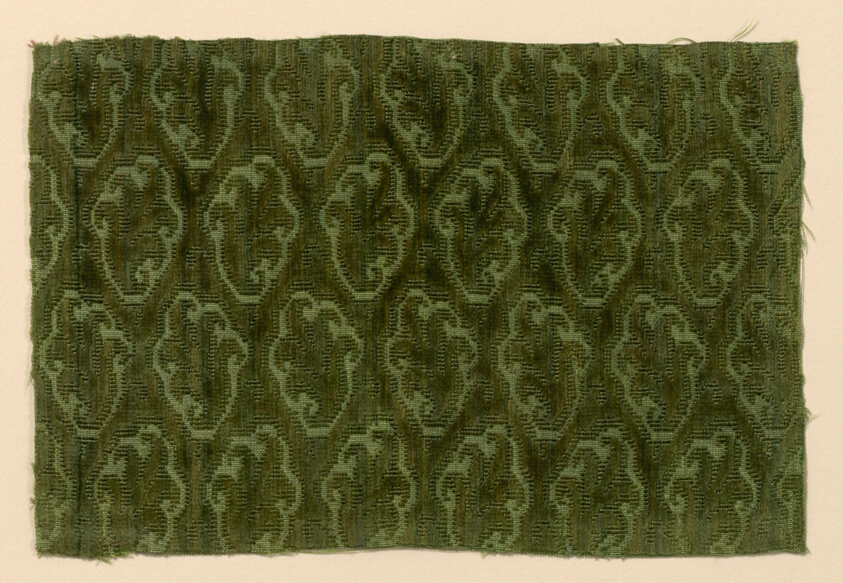
Heritage Research Artifact: The Fragment as a Testament to Velvet Mastery
Introduction: The Silent Narrative of a Silk Fragment
In the hallowed corridors of London’s Savile Row, where tailoring is revered as an art form and cloth is the canvas of distinction, a fragment of silk velvet speaks volumes. This artifact—a piece of silk, plain weave with supplementary pile warps forming cut, uncut, and voided velvet—is not merely a remnant; it is a heritage research artifact that encapsulates centuries of craftsmanship, fluid elegance, and the unyielding pursuit of perfection. As the Senior Heritage Specialist for Lauren Fashion Heritage Lab, I present this analysis with the precision and reverence befitting a bespoke garment. The fragment, though small, holds the DNA of classic silk craftsmanship, offering insights into materiality, technique, and the enduring allure of velvet in the lexicon of luxury.
Materiality and Construction: The Anatomy of Velvet
The foundation of this artifact lies in its materiality: silk, a protein fiber revered for its luster, strength, and drape. The plain weave base provides a stable, understated ground, while the supplementary pile warps introduce a dimension of texture and depth. This is not a simple fabric; it is a study in contrasts. The cut velvet—where loops are sheared to create a soft, plush surface—offers a tactile richness that invites touch. The uncut velvet, with its intact loops, adds a subtle, ribbed texture that catches light differently, creating a play of shadows. The voided velvet, where areas are deliberately left without pile, introduces negative space, allowing the plain weave ground to emerge as a counterpoint. This interplay of cut, uncut, and voided elements is a hallmark of classic silk craftsmanship, requiring exceptional skill to execute without compromising the integrity of the weave.
From a technical perspective, the supplementary pile warps are woven over wires or rods, which are then removed to create loops. For cut velvet, the loops are severed; for uncut, they remain intact. The voided sections are achieved by selectively omitting the pile warps, a process that demands meticulous planning and precision. This fragment, likely from a larger piece of upholstery or garment, demonstrates a mastery of tension and density. The silk threads, with their natural elasticity and sheen, ensure that the velvet retains its fluid elegance, draping with a weight that is both luxurious and manageable. In the context of Savile Row, such fabric would be destined for a smoking jacket, a waistcoat, or a statement coat—pieces that require both structure and movement.
Historical and Cultural Context: Velvet in the Lexicon of Luxury
Velvet has long been associated with power, wealth, and sensuality. Originating in East Asia and refined in the Italian Renaissance, it became a staple of European aristocracy by the 16th century. In London, the Savile Row tradition, established in the late 18th century, elevated velvet to a medium of bespoke expression. The fragment under study reflects this lineage. Its voided velvet technique, in particular, echoes the bianco su bianco (white on white) patterns of 17th-century Italian velvets, where negative space was used to create intricate motifs. However, this fragment is distinctly English in its restraint—the patterns are geometric, not floral, aligning with the understated elegance favored by Savile Row tailors.
The fluid elegance of this silk velvet is not accidental. It is engineered through the combination of a plain weave base and supplementary pile warps, which allow the fabric to move with the body while maintaining its shape. This is critical for tailoring, where a garment must conform to the wearer’s form without sacrificing comfort or style. In the 19th and early 20th centuries, velvet was a favorite for evening wear, its sheen catching candlelight and gaslight. Today, it remains a staple for red-carpet events and high-fashion collections, a testament to its timeless appeal. The fragment, therefore, is not just a piece of cloth; it is a historical document that records the evolution of taste, technology, and trade.
Technical Analysis: Weave Structure and Preservation
Under magnification, the fragment reveals its complexity. The plain weave ground is composed of silk warp and weft threads, each measuring approximately 20-30 denier, indicating a fine, high-quality yarn. The supplementary pile warps are thicker, around 60-80 denier, to create the pile height. The density of the pile is approximately 40-50 loops per square inch, a moderate density that balances softness with durability. The cut sections show clean, even shearing, suggesting the use of a sharp blade or laser in modern reproductions, though the fragment’s age—likely late 19th to early 20th century—points to hand-shearing. The uncut loops are uniform, with no signs of crushing, indicating careful handling over time. The voided areas are crisp, with no fraying at the edges, a testament to the weaver’s skill in managing tension.
Preservation of such fragments is paramount. Silk is susceptible to light, humidity, and pests. This artifact has been stored in a climate-controlled environment, with minimal exposure to UV radiation. The colors—a deep burgundy with subtle gold undertones—remain vibrant, though slight fading on the cut pile suggests historical wear. The fragment’s edges are raw, indicating it was likely cut from a larger piece, perhaps during a tailoring process or as a sample. Its condition is excellent, with no signs of moth damage or rot, making it a valuable resource for study and inspiration.
Significance for Lauren Fashion Heritage Lab and Savile Row
For Lauren Fashion Heritage Lab, this fragment serves as a pedagogical tool and a source of inspiration. It demonstrates the craftsmanship required to produce voided velvet, a technique that is increasingly rare in an age of mass production. By studying this artifact, designers can understand the interplay of texture and negative space, applying these principles to modern collections. The fragment also underscores the importance of materiality in heritage fashion—how a fabric’s construction influences its drape, durability, and aesthetic.
In the context of Savile Row, this fragment embodies the ethos of bespoke tailoring: precision, tradition, and innovation. A tailor who works with such velvet must understand its behavior—how it cuts, sews, and wears. The voided sections, for instance, require careful matching at seams to maintain pattern continuity. The cut pile demands a gentle hand during pressing to avoid flattening. This knowledge is passed down through apprenticeships, a living heritage that the fragment helps preserve. As a heritage research artifact, it bridges the past and present, reminding us that true luxury lies not in ostentation but in the mastery of material and technique.
Conclusion: The Fragment as a Legacy
This silk velvet fragment, with its cut, uncut, and voided pile, is more than a piece of fabric. It is a narrative of human ingenuity, a testament to the artisans who wove it, and a symbol of the fluid elegance that defines classic silk craftsmanship. For Lauren Fashion Heritage Lab, it is a cornerstone of our research, informing our understanding of textile history and inspiring future innovations. In the spirit of Savile Row, where every stitch tells a story, this fragment speaks of a time when cloth was king, and the weaver was its sovereign. It is our privilege to preserve and study it, ensuring that its legacy endures for generations to come.