An Examination of Iconic Form and Imperial Fabrication
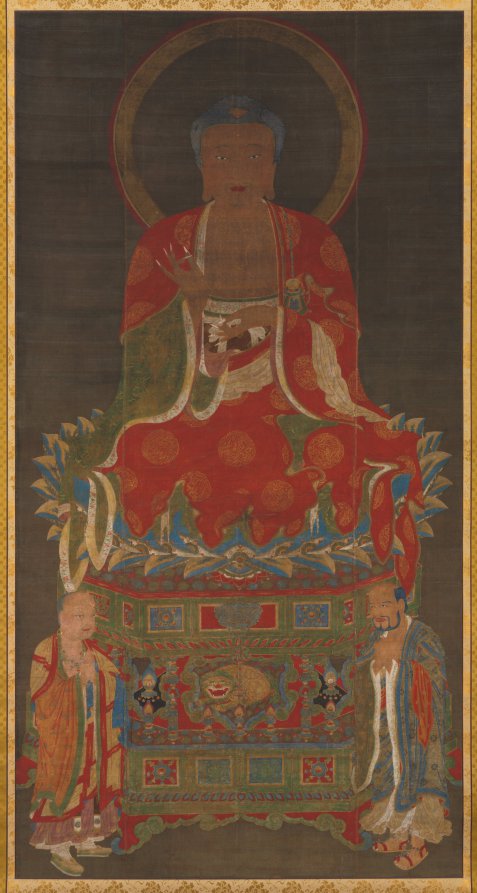
One must approach the subject not merely as a devotional image, but as a consummate artefact of power and patronage. The depiction of Shakyamuni Buddha, flanked by two attendant Bodhisattvas, represents a theological and artistic schema of profound significance. However, to appreciate the piece in its entirety, one must first understand the medium that gives it form. The material is not a passive substrate; it is the very essence of its authority. Here, we speak of silk—specifically, the legacy of imperial silk weaving. This is not simply cloth; it is a engineered textile, the product of a complex, state-controlled apparatus that for centuries served as a direct analogue to imperial authority and cosmological order.
The Loom as Throne: Administrative Weaving
Consider the provenance. Imperial silk workshops were less ateliers and more ministries of visual propaganda. Operated under the meticulous supervision of court officials, these institutions maintained a monopoly on the finest techniques: kesi (slit-tapestry weave), intricate brocades, and complex damasks. The production of a large-scale figurative hanging, such as this Shakyamuni triad, was an undertaking of bureaucratic and temporal magnitude. Patterns were sanctioned, cartoons were drafted by master painters, and the allocation of threads—the vibrant mineral-derived pigments for the Buddha's robes, the subtle gold-wrapped filaments for halos and attributes—was a matter of imperial inventory. The loom itself, a formidable engine of wood and tension, became a instrument of statecraft. Each pass of the weft was an act of disciplined conformity, mirroring the desired social order under heaven. The resulting image, therefore, carries within its very warp and weft the silent, imposing weight of the imperial mandate.
A Cut Above: Iconography Tailored in Thread
The subject matter, while spiritually universal, is rendered with a precision that bespeaks a sartorial sensibility. Observe the drapery of the Buddha's monastic robe. In silk, the artist-weavers have achieved what stone or paint can only suggest: a fluid, cascading fall of cloth, with hems and folds that possess a tangible weight and liquidity. The kesi technique, allowing for curvilinear forms and colour transitions, is employed with particular virtuosity in the depiction of the attendants' elaborate scarves and dhotis. These are not mere garments; they are tailored achievements, their flowing lines articulating a divine physique beneath, much as a master cutter on Savile Row understands that the drape of a worsted wool expresses the form and posture of the wearer. The symmetry of the attendants, their slight inclination towards the central figure, creates a composition of impeccable balance—a visual harmony that reinforces the doctrinal harmony they represent. The iconography is fixed by tradition, yet its execution in silk elevates it to a realm of unparalleled luxury and technical splendour.
The Patina of Prestige: Inherent and Conferred Value
The value of such an artefact is twofold: inherent and conferred. The inherent value lies in the staggering material and labour cost. Thousands of metres of flawless, hand-reeled silk thread, dyed with precious substances, countless hours of labour by teams of master weavers—this constitutes a capital investment of monumental proportions. The conferred value, however, is of greater consequence. As an object likely produced for presentation to a major temple under imperial patronage or for use within the palace precincts, it functioned as a vehicle of soft power. It communicated the dynasty's piety, certainly, but more importantly, it demonstrated its control over the most sophisticated technological and artistic resources of the age. To possess, or to bestow, such an object was to trade in the currency of legitimacy. The silk, with its gentle luminescence and tactile depth, held a visual authority that fresco or woodblock could not aspire to. It was, in the most literal sense, a fabric of empire.
Enduring Legacy: A Statement Beyond Devotion
In conclusion, this silk rendering of Shakyamuni with two attendants transcends its devotional function to stand as a definitive statement of cultural and political capital. It represents the apex of a specialised industrial heritage, where art, technology, and governance were seamlessly interwoven. The image speaks of enlightenment; the material speaks of earthly power. The quiet dignity of the Buddha's countenance is framed by the roaring silence of the loom's legacy—a legacy of administrative precision, artistic supremacy, and the unwavering assertion that the right to rule was echoed in the right to produce the most exquisite fabrics in the known world. To study it is to understand that in certain epochs, the sublime and the sovereign were cut from the very same cloth. It remains, as it was intended, a peerless and commanding presence.