← BACK TO ARCHIVES
Heritage-Black
Heritage Synthesis: Terracotta fragment of a closed shape
Curated on Jul 01, 2026 // Node: LDN-01
The Agony of Form: Terracotta Fragments and the Architecture of Old Money Silence
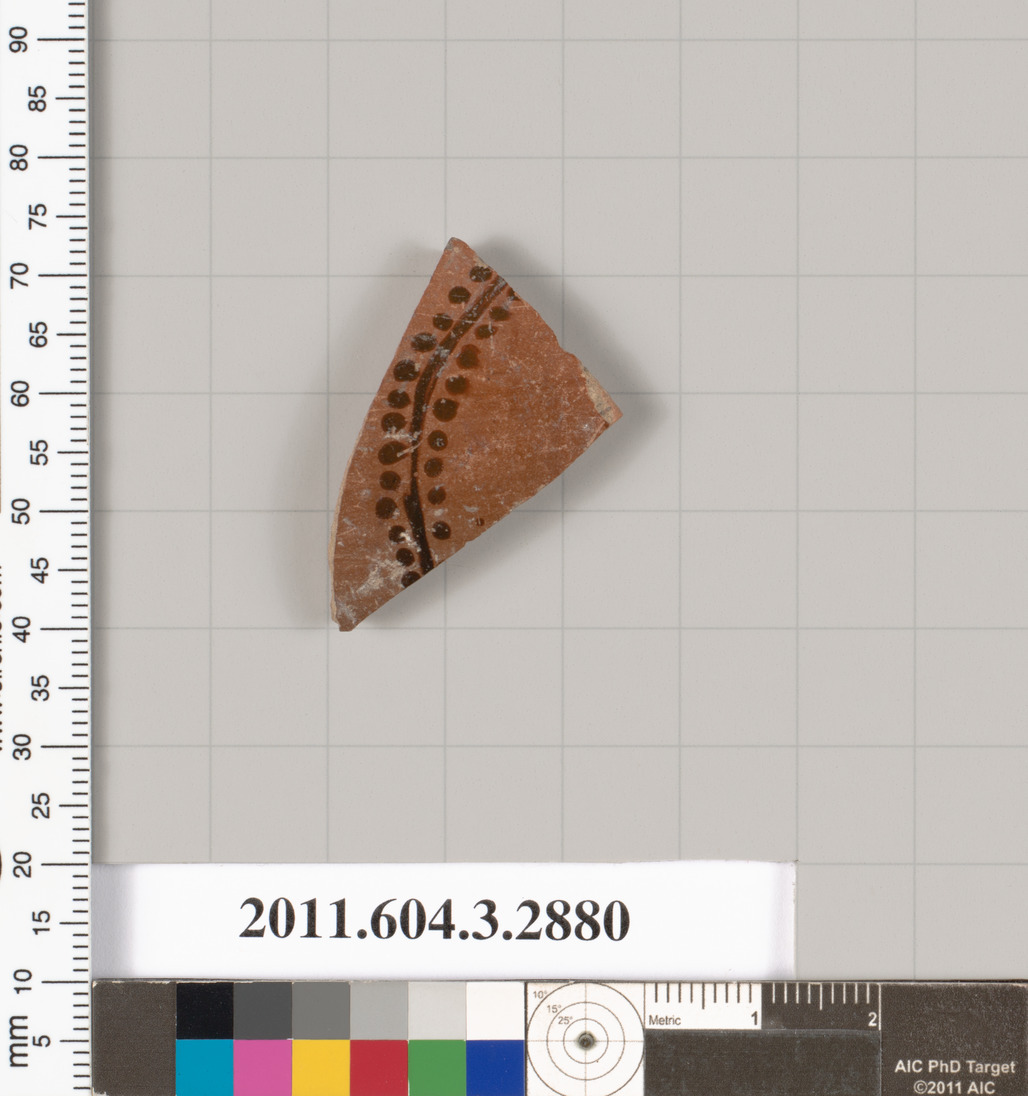
In the Lauren Fashion Heritage Lab, we engage in a continuous dialectic between the archival object and the living garment. The internal genetic code, drawn from a comparative study of *The Agony in the Garden* and *Below, I Saw the Vaporous Contours of a Human Form*, establishes a profound tension between “substantial sublimity” and “vaporous sublimity.” This tension—between the weight of the concrete and the dissolution of the ephemeral—finds an unexpected, yet remarkably potent, material analogue in the museum artifact before us: a terracotta fragment of a closed shape from Attic Greece. This humble shard, a broken curve of fired clay, is not a relic of grandeur but a testament to absence. It is a vessel whose contents are lost, a form whose full silhouette is only implied. For the 2026 Old Money silhouette, this fragment offers a critical lesson in the aesthetics of restraint, incompleteness, and the power of the unseen—a lexicon that directly informs our *Heritage-Black* material philosophy.
I. The Substantial Fragment: Weight as Presence
The terracotta fragment possesses a specific, undeniable physicality. Its weight, its slightly rough texture, the subtle variations in its ochre hue from firing—these are not imperfections but the very evidence of its *being*. In the language of the first painting, *The Agony in the Garden*, this corresponds to the “substantial sublime.” The agony of Christ is made tangible through the density of rock, the gravity of drapery, the precise anatomy of a kneeling figure. The fragment is similarly anchored. It does not float; it sits. It declares its own material truth.
For the 2026 Old Money silhouette, this translates into a renewed emphasis on structural integrity. The “old money” aesthetic is often misread as mere minimalism or quiet luxury. In truth, it is an architecture of presence. A *Heritage-Black* double-faced cashmere coat, for instance, does not merely drape; it *stands*. Its weight is its authority. The shoulder line is not a suggestion but a statement, cut with the precision of a classical pediment. The terracotta fragment teaches us that a garment’s power lies not in its ornamentation but in the unyielding confidence of its foundational shape. The silhouette is closed, like the fragment’s original vessel—a strong, uninterrupted line from shoulder to hem, a column of fabric that asserts its own volume without apology. This is the *agony* of form: the discipline required to achieve a perfect, unbroken contour, a silhouette that bears the weight of tradition without buckling.
II. The Vaporous Contour: Absence as Allure
Yet the fragment is not merely a solid object. Its most potent feature is what it *withholds*. As a “fragment of a closed shape,” it denies us the complete vessel. We are forced to infer the missing curve, the absent lip, the vanished base. This is the “vaporous contour” of the second painting—the “steam-like outline” of a human form that is dissolving, whose boundaries are uncertain. The fragment’s edge is a threshold between the known and the unknown, between the tangible clay and the imagined whole.
This is the critical innovation for the 2026 silhouette. The *Heritage-Black* aesthetic must not only be substantial; it must also be suggestive. The silhouette is not a rigid cage but a frame for absence. Consider a black silk crepe dress with a neckline that is not quite a cowl, not quite a boat—a soft, vaporous edge that blurs the boundary between garment and skin. Or a tailored wool jacket with sleeves that are cut slightly longer, allowing the hand to disappear, creating a “steam-like” termination where the fabric meets the air. The *luxury* here is in the unspoken, the hinted, the incomplete. The terracotta fragment’s broken edge becomes a design principle: the hem that is not quite straight, the lapel that folds into a shadow, the back of a coat that falls in a single, unbroken plane, its interior a secret. This is the “below” of the painting’s title—a glimpse of a form that is always just beyond full visibility, a contour that exists in the space between the garment and the gaze.
III. The Synthesis: Heritage-Black as a Material Philosophy
The genius of the *Heritage-Black* category is its ability to synthesize these two poles. Black is the color of both substance and void. It is the heaviest of pigments, capable of absorbing all light, and yet it is also the color of the abyss, of the unseen. A *Heritage-Black* garment, informed by the terracotta fragment, must operate on both registers.
The *substantial* register is achieved through material choice and construction. A heavy wool barathea, a dense silk faille, a ribbed cashmere—these fabrics have the “weight” of the terracotta. They hold their shape. They create the “closed” silhouette of the fragment: a strong, confident line that speaks of heritage and permanence. The *vaporous* register is achieved through finish and detail. A matte, almost dusty surface texture, like the fired clay itself, diffuses light rather than reflecting it. A subtle, almost imperceptible fraying at the edge of a seam. A lining of the same black, but in a fluid, liquid-like charmeuse, so that the interior of the garment is a secret, a “vaporous contour” that only the wearer knows. The silhouette is not a statement; it is a suggestion. It is a fragment of a larger, more complete self, a self that is both present and dissolving.
IV. Conclusion: The Unseen as Ultimate Luxury
The terracotta fragment, in its broken silence, speaks directly to the soul of the 2026 Old Money silhouette. It reminds us that true luxury is not about display but about discretion. It is not about the complete, the finished, the obvious, but about the fragment, the hint, the threshold. The *Heritage-Black* garment is not a costume; it is a vessel. Its form is a container for the wearer’s own presence, a presence that is both solid and evanescent, both an agony of discipline and a vapor of mystery.
In the end, the most powerful silhouette is not the one that shouts, but the one that whispers. It is the one that, like the Attic fragment, invites the viewer to complete the form in their own imagination. It is the one that, in its *Heritage-Black* depth, holds the tension between the weight of the earth and the dissolution of the spirit—a silent, enduring monument to the art of the unseen.
Heritage Lab Insight
Genetic Bridge: Archive node focusing on Heritage-Black craftsmanship.