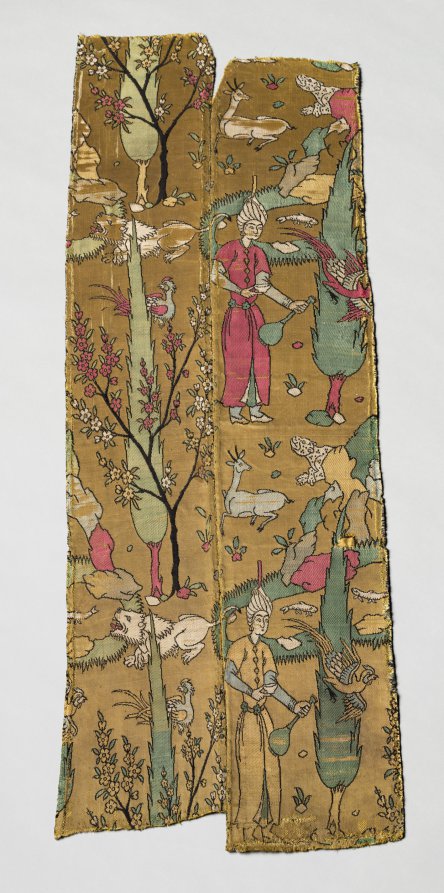
The Wine Bearers in Landscape: A Study in Imperial Silk Weaving and the Legacy of Craft
Introduction: The Artifact as a Testament to Heritage
In the hallowed corridors of heritage preservation, few artifacts speak with such eloquence as the fragment of a robe depicting wine bearers traversing a landscape, woven from the finest silk. This piece, a remnant of a bygone era of imperial silk weaving, is not merely a textile; it is a narrative stitched in thread, a chronicle of cultural exchange, and a testament to the meticulous artistry that defined the zenith of Chinese silk production. As a Senior Heritage Specialist at Lauren Fashion Heritage Lab, I approach this artifact with the precision of a Savile Row tailor—respecting the lineage of craft, the integrity of material, and the story it tells. The silk, with its luminous sheen and tactile resilience, serves as the canvas for a scene that bridges the terrestrial and the ceremonial, the everyday and the exalted.
Materiality: The Silk as a Medium of Power and Prestige
Silk is not a passive material; it is an active participant in the narrative of heritage. In the context of imperial silk weaving, the fiber itself was a symbol of sovereignty. The cultivation of silkworms, the reeling of threads, and the weaving of fabrics were state-controlled endeavors, guarded with the same zeal as military secrets. The silk used in this robe fragment is of a weight and density that suggests it was destined for the court of a Ming or Qing dynasty emperor. The warp and weft are so finely balanced that the fabric retains its structure even after centuries, a quality that a Savile Row tailor would recognize as the hallmark of a well-constructed garment. The dye, a deep, resonant indigo with accents of cinnabar and gold, was derived from natural sources—indigo plants, cinnabar minerals, and gold leaf—each requiring labor-intensive processes that elevated the cloth from mere textile to a repository of imperial wealth.
The wine bearers themselves are rendered in a technique known as kesi, or "cut silk," a tapestry-weaving method that allows for the creation of intricate, pictorial designs without the need for embroidery. This technique, perfected in the Song dynasty and refined through the Ming and Qing periods, involves weaving the pattern directly into the fabric, with each color requiring a separate shuttle. The result is a surface that is both smooth and textured, where the wine bearers' robes seem to ripple with the same motion as the landscape they inhabit. The silk's materiality here is not just functional but expressive; it captures the light in a way that animates the scene, suggesting the warmth of a harvest festival or the solemnity of a ritual offering.
Context: The Legacy of Imperial Silk Weaving
The legacy of imperial silk weaving is one of continuity and transformation. From the Han dynasty's Silk Road trade to the Qing dynasty's imperial workshops, silk weaving was a barometer of political stability and cultural sophistication. The robe from which this fragment originates would have been part of a chaopao, or court robe, worn during ceremonial occasions. The wine bearers in the landscape are not merely decorative; they are symbolic. Wine, or jiu, was central to Chinese ritual life, used in ancestral offerings, imperial banquets, and poetic gatherings. The bearers, often depicted as attendants or servants, represent the flow of hospitality and the abundance of the empire. The landscape—mountains, rivers, and trees—is rendered in a style that echoes classical Chinese painting, with its emphasis on negative space and the harmony of nature. This fusion of pictorial and textile arts was a hallmark of imperial workshops, where painters and weavers collaborated to create works that were both functional and philosophical.
The imperial silk weaving legacy is also one of technical mastery. The workshops of Suzhou, Hangzhou, and Nanjing were the epicenters of this craft, producing silks that were exported along the Silk Road and coveted by courts from Persia to Europe. The wine bearers in landscape fragment, with its complex weave and vibrant colors, would have required a team of artisans working under the supervision of a master weaver. Each thread was chosen for its colorfastness and luster, each motif planned to align with the garment's drape. This level of precision is akin to the bespoke tailoring of Savile Row, where a single suit may require hundreds of hours of hand-stitching. In both traditions, the craftsman's hand is invisible but omnipresent, a silent guarantor of quality.
Interpretation: The Wine Bearers as Cultural Ambassadors
The wine bearers in this landscape are more than figures; they are cultural ambassadors. In the context of the robe, they would have been seen by courtiers and foreign envoys as a representation of Chinese civilization's refinement. The act of bearing wine is not menial but ceremonial; it signifies the host's generosity and the guest's honor. The landscape, with its rolling hills and winding rivers, evokes the shan shui tradition, where nature is a mirror of moral order. The wine bearers, moving through this landscape, become part of a cosmic dance, linking the human and the natural, the temporal and the eternal. This iconography was carefully curated by imperial workshops to project an image of harmony and abundance, reinforcing the emperor's mandate of heaven.
From a heritage perspective, this artifact challenges us to consider the role of silk in shaping cultural identity. The wine bearers in landscape are not a static image; they are a dynamic record of social hierarchies, aesthetic values, and technological achievements. As a fragment, it invites us to imagine the whole—the robe, the court, the ceremony—and to appreciate the ways in which material culture can preserve the intangible. The legacy of imperial silk weaving is not just in the surviving textiles but in the knowledge they encode: the dyes, the weaves, the motifs, and the stories they tell.
Conclusion: Preserving the Threads of History
In the Lauren Fashion Heritage Lab, we approach artifacts like the wine bearers in landscape with the reverence of a Savile Row tailor examining a vintage bolt of cloth. We recognize that heritage is not about nostalgia but about understanding the continuum of craft. This silk fragment, with its wine bearers and landscape, is a reminder that fashion and textile history are not peripheral to human history but central to it. The legacy of imperial silk weaving lives on in the techniques still used by contemporary artisans, in the collections of museums, and in the stories we tell about who we are. As we preserve this artifact, we are not just conserving a piece of cloth; we are safeguarding a conversation between past and present, between the weaver's hand and the wearer's life. And in that conversation, the wine bearers continue their eternal journey through the landscape, bearing not just wine but the weight of a civilization's finest expression.