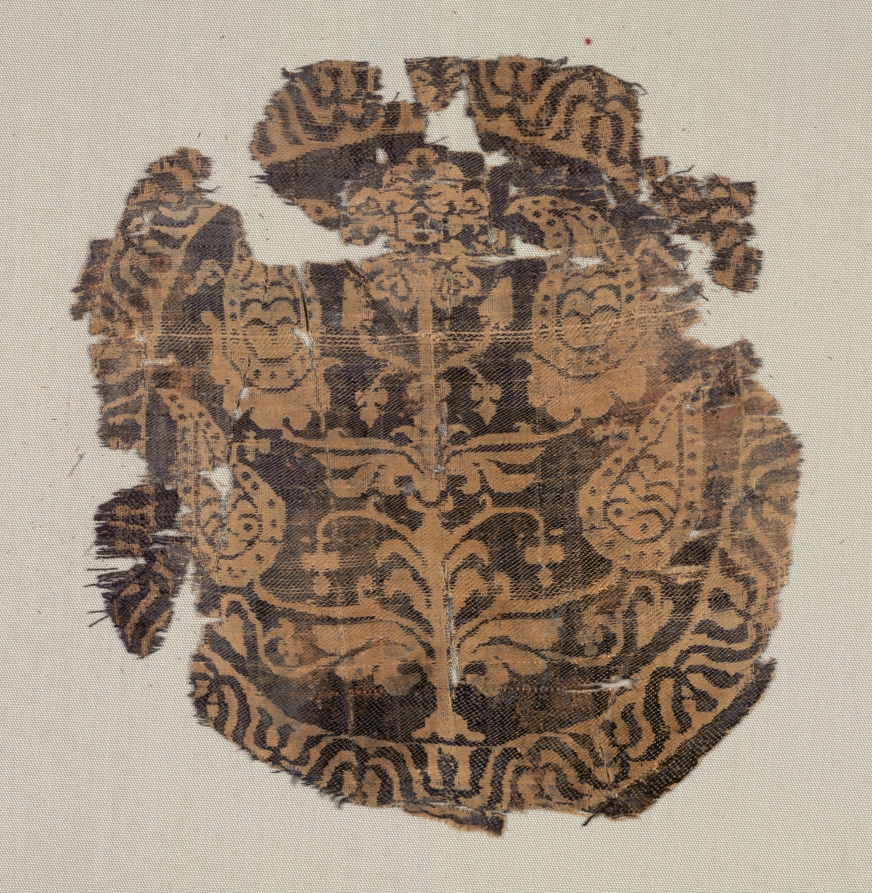
The Roundel with Curvilinear Palmette Tree: A Study in Imperial Silk Weaving and Its Enduring Legacy
Introduction: The Artifact as a Testament to Craft
The Roundel with curvilinear palmette tree, from a tunic, is not merely a fragment of textile history; it is a profound artifact of imperial ambition, technical mastery, and aesthetic evolution. Crafted from silk, this roundel—likely dating from the late Sasanian or early Islamic period (circa 6th–8th century CE)—embodies the sophisticated weaving traditions that flourished under imperial patronage. Its materiality, silk, is the very thread that connects the courts of Persia, Byzantium, and later, the workshops of Renaissance Italy and the bespoke ateliers of London’s Savile Row. As a Senior Heritage Specialist at the Lauren Fashion Heritage Lab, I present this artifact as a case study in how imperial silk weaving shaped not only the garments of antiquity but also the principles of luxury, durability, and design that define modern tailoring.
Materiality: Silk as a Medium of Power
Silk is the foundational element of this roundel. Originating in China and transmitted via the Silk Road, silk became the fabric of empires—its production guarded as a state secret, its trade a driver of diplomacy and conflict. The roundel’s silk, likely a compound weave (such as samite or taquete), demonstrates the technical prowess of imperial workshops. The fibers are fine, lustrous, and resilient, capable of holding intricate patterns without distortion. This materiality was not accidental; it was a deliberate choice by imperial patrons to project authority. Silk’s natural sheen catches light in a way that mimics the divine radiance of royal courts, while its strength ensures longevity—a metaphor for dynastic endurance.
For the modern scholar, the roundel’s silk offers clues to its provenance. The use of curvilinear palmette tree motifs, combined with the roundel’s symmetrical composition, suggests a synthesis of Sasanian and Byzantine influences. The Sasanian Empire (224–651 CE) perfected the art of silk weaving, often incorporating tree-of-life and palmette designs as symbols of fertility, immortality, and cosmic order. The curvilinear quality of the palmette tree—its sinuous branches and stylized leaves—reflects a departure from rigid geometric patterns, embracing a naturalistic flow that anticipates Islamic arabesques. This roundel, then, is a transitional piece, bridging the classical world and the medieval.
The Legacy of Imperial Silk Weaving: From Court to Commerce
Imperial silk weaving was not merely an art form; it was an instrument of statecraft. In the Sasanian court, silk garments were markers of rank, with specific patterns reserved for the shah and his inner circle. The roundel, likely sewn onto a tunic as an appliqué or woven directly into the fabric, would have signified the wearer’s proximity to power. This practice was adopted by Byzantine emperors, who established state-run silk workshops (gynaikia) to produce luxurious textiles for the court and as diplomatic gifts. The roundel’s design—a central tree flanked by symmetrical palmettes—echoes the hierarchical order of imperial ideology: the tree as the axis mundi, the palmettes as subordinate elements, all contained within a circular border that suggests eternity.
The legacy of this weaving tradition persisted long after the fall of these empires. During the Islamic Golden Age, Persian and Syrian weavers continued to produce silk textiles with palmette and tree motifs, which were then exported to Europe. By the 13th century, Italian city-states like Lucca and Venice had established their own silk industries, imitating and innovating upon these patterns. The curvilinear palmette tree, in particular, became a staple of Renaissance textiles, influencing everything from ecclesiastical vestments to secular garments. This cross-cultural transmission underscores the roundel’s role as a global artifact—a testament to the interconnectedness of imperial economies.
Savile Row: The Modern Heir to Imperial Silk
In the context of London’s Savile Row, the principles embodied by this roundel—precision, luxury, and enduring design—are not historical curiosities but living standards. Savile Row tailors, renowned for their bespoke suits, share a kinship with the imperial weavers of antiquity. Both prioritize materiality: just as the Sasanian weaver selected silk for its luster and strength, the Savile Row cutter chooses cloth for its drape, weight, and longevity. The roundel’s curvilinear palmette tree, with its balanced asymmetry and rhythmic repetition, mirrors the tailoring philosophy of “cutting to the cloth”—allowing the fabric’s inherent qualities to dictate the garment’s form.
Moreover, the roundel’s function as a decorative element on a tunic prefigures the modern use of patterned silks in luxury menswear. A Savile Row suit jacket might feature a silk lining with a palmette-inspired motif, or a pocket square woven with a tree-of-life design. These are not mere embellishments; they are continuations of a heritage that values ornamentation as a marker of identity and status. The roundel reminds us that luxury is not about excess but about intention—every thread, every curve, every color chosen with purpose.
Conservation and Interpretation: A Heritage Imperative
As a heritage artifact, the roundel presents both challenges and opportunities. Its silk, while durable, is susceptible to light, humidity, and handling. Conservation efforts must prioritize stabilizing the fibers while preserving the vibrancy of the dyes—likely derived from madder, indigo, or kermes. Digital imaging and spectral analysis can reveal details invisible to the naked eye, such as the direction of the weave or the presence of metallic threads. These techniques allow us to reconstruct the weaving process and, by extension, the labor and knowledge systems that produced it.
Interpretation, however, is equally critical. The roundel must be contextualized not as a static object but as a node in a network of exchange. Its curvilinear palmette tree may have been inspired by earlier Achaemenid motifs, which themselves drew from Mesopotamian and Egyptian sources. By tracing these influences, we can demonstrate how imperial silk weaving was a dynamic, adaptive practice—one that absorbed and transformed cultural elements. This narrative is essential for contemporary audiences, who often view heritage as fixed rather than fluid.
Conclusion: The Roundel as a Bridge Across Time
The Roundel with curvilinear palmette tree, from a tunic, is far more than a decorative fragment. It is a repository of imperial ambition, a testament to the technical genius of ancient weavers, and a precursor to the luxury traditions that define modern tailoring. Its silk materiality speaks to the enduring value of natural fibers, while its design—a tree of life encircled by palmettes—encapsulates the human desire to impose order on nature and time. For the Lauren Fashion Heritage Lab, this artifact serves as a reminder that heritage is not a relic but a resource. By studying the roundel, we learn not only about the past but about the principles that can guide the future of fashion: craftsmanship, sustainability, and the pursuit of beauty through precision.
In the spirit of Savile Row, where a single suit can take weeks to construct, the roundel invites us to slow down and appreciate the artistry embedded in every thread. It is a call to preserve not just the object but the knowledge it embodies—a knowledge that, like silk itself, is both fragile and enduring.