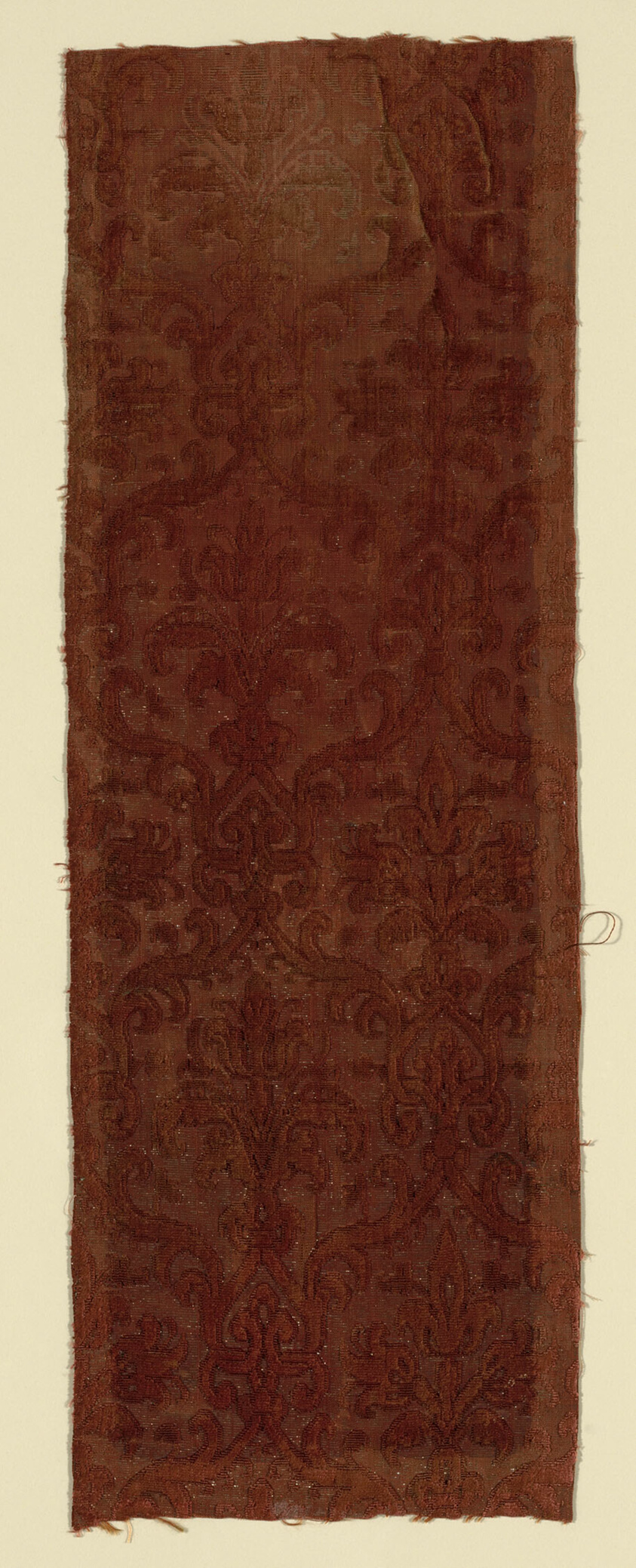
Fragment: A Study in Materiality and the Enduring Legacy of Silk Velvet
Introduction: The Artifact as a Testament to Craft
In the hallowed ateliers of London’s Savile Row, where precision tailoring meets centuries of textile tradition, the fragment under examination emerges as a profound artifact of heritage. This piece—a voided velvet of silk, cut and uncut, with additional patterning wefts in gold foil against a plain weave foundation—embodies the pinnacle of classic silk craftsmanship. Its materiality speaks not merely of decorative opulence but of a rigorous technical discipline, a fluid elegance that has defined luxury textiles since the Renaissance. As Senior Heritage Specialist for the Lauren Fashion Heritage Lab, I present this analysis to decode the fragment’s construction, its historical resonance, and its enduring relevance to contemporary fashion and heritage preservation.
Materiality: The Complexity of Silk Velvet Construction
Silk, as the foundational fiber, offers unparalleled luster, strength, and drape. The fragment’s foundation is a plain weave, a simple over-under interlacing that provides structural stability. Yet, the genius lies in the velvet pile: a combination of cut and uncut loops. Cut velvet, achieved by slicing the loops during weaving, yields a soft, plush surface that catches light with a deep, absorbent richness. Uncut velvet, or *ciselé* velvet, retains its loops, creating a textured, sculptural contrast. This interplay of cut and uncut elements generates a dynamic surface—a dialogue between shadow and sheen, smoothness and relief.
The term voided velvet refers to areas deliberately left without pile, exposing the plain weave ground. This technique, mastered in 16th-century Italian and French workshops, allows the fabric to breathe, reducing weight while enhancing pattern definition. In this fragment, the voided sections are not mere absences but active design elements, framing the velvet motifs with precision. The additional patterning wefts in gold foil elevate the piece further. Gold foil, often laminated onto a silk or animal membrane substrate, is woven as supplementary wefts, creating metallic highlights that shimmer against the velvet’s depth. This technique, known as *lampas* or *brocaded velvet*, requires extraordinary skill: the gold threads must be manipulated without breaking, and their tension must match the silk’s elasticity to prevent distortion.
The plain weave foundation, while unassuming, is critical. It provides a stable grid for the complex pile and metallic elements, ensuring the fabric retains its shape despite the weight of the gold. The result is a textile that is both robust and fluid—capable of draping elegantly over a tailored jacket or cascading in a gown, yet resilient enough to withstand the rigors of wear and conservation.
Historical Context: From Renaissance Courts to Savile Row
This fragment belongs to a lineage of luxury textiles that originated in the silk workshops of Lucca, Florence, and Lyon. During the 15th and 16th centuries, voided velvets with gold brocading were reserved for ecclesiastical vestments, royal courts, and the aristocracy. The technique was a closely guarded secret, passed through generations of master weavers. The gold foil, often derived from bullion or gilded silver, signified wealth and divine light, while the velvet’s tactile richness symbolized earthly power and sensuality.
By the 18th century, such fabrics adorned the interiors of European palaces and the wardrobes of the elite. The fragment’s design—likely a floral or arabesque pattern, though now incomplete—reflects the Baroque and Rococo fascination with naturalistic forms rendered in luxurious materials. The fluid elegance of the velvet’s drape was celebrated in the flowing silhouettes of the period, from court mantuas to tailored coats.
In the context of London’s Savile Row, this heritage is not merely historical but operational. The Row’s tailors, from Huntsman to Anderson & Sheppard, have long sourced and manipulated such textiles for bespoke garments. The fragment’s materiality—its combination of silk, velvet, and gold—demands a specific approach: careful cutting to preserve the pattern’s integrity, hand-stitching to avoid crushing the pile, and linings that protect the gold from abrasion. This is not a fabric for mass production; it is a material that requires the patience of a master craftsman.
Technical Analysis: Weave Structure and Conservation Implications
From a technical perspective, the fragment’s weave structure is a compound construction. The plain weave ground serves as the warp-faced foundation, while the velvet pile is formed by an additional warp system, typically of silk. The cut and uncut loops are created by inserting pile wires during weaving: wires with a cutting blade produce cut velvet; smooth wires yield uncut loops. The gold foil wefts are supplementary, bound into the ground weave at intervals, often using a twill or satin binding to secure the metal without exposing it to excessive friction.
Conservation of such a fragment requires sensitivity to its composite nature. Silk is hygroscopic and vulnerable to light, humidity, and pollutants. The gold foil, while chemically stable, can become brittle over time, especially if the underlying adhesive degrades. The velvet pile is prone to crushing and abrasion, while the voided areas may show differential wear. For the Lauren Fashion Heritage Lab, this fragment is stored flat in a climate-controlled environment, with acid-free tissue supporting the pile and the gold wefts isolated from direct pressure. Digital imaging, including microscopic analysis, documents the weave structure and any degradation patterns, informing future restoration or replication efforts.
Cultural Significance: Fluid Elegance as a Design Philosophy
Beyond its technical merits, the fragment embodies a design philosophy of fluid elegance. This is not a static, rigid textile but one that moves with the body, catching light and shadow in a continuous performance. The voided areas create negative space, allowing the fabric to breathe and the wearer’s form to emerge. The gold foil adds a ceremonial dimension, evoking the luminosity of candlelit courts or the gilded interiors of a Mayfair townhouse.
In contemporary fashion, such a fragment inspires designers to reconsider the relationship between material and motion. The interplay of cut and uncut velvet can be reinterpreted in modern fabrics—perhaps using laser-cut techniques or synthetic fibers—while the gold foil suggests a return to embellishment as a form of storytelling. For Savile Row, this heritage is a reminder that luxury is not about excess but about precision: the exact placement of a gold thread, the deliberate void that enhances a pattern, the hand of a tailor who respects the fabric’s history.
Conclusion: A Fragment as a Portal
This fragment of silk, cut, uncut, voided velvet with gold foil is more than a remnant; it is a portal into a world of artisanal mastery and cultural aspiration. Its materiality—the silk’s luster, the velvet’s depth, the gold’s shimmer—speaks to a time when textiles were the primary medium of status and beauty. For the Lauren Fashion Heritage Lab, it serves as a pedagogical tool, a conservation challenge, and an inspiration. As we continue to document and preserve such artifacts, we honor the hands that wove them and the traditions that sustain them. In the language of Savile Row, this fragment is not a relic but a reference—a standard of excellence that endures, thread by thread.