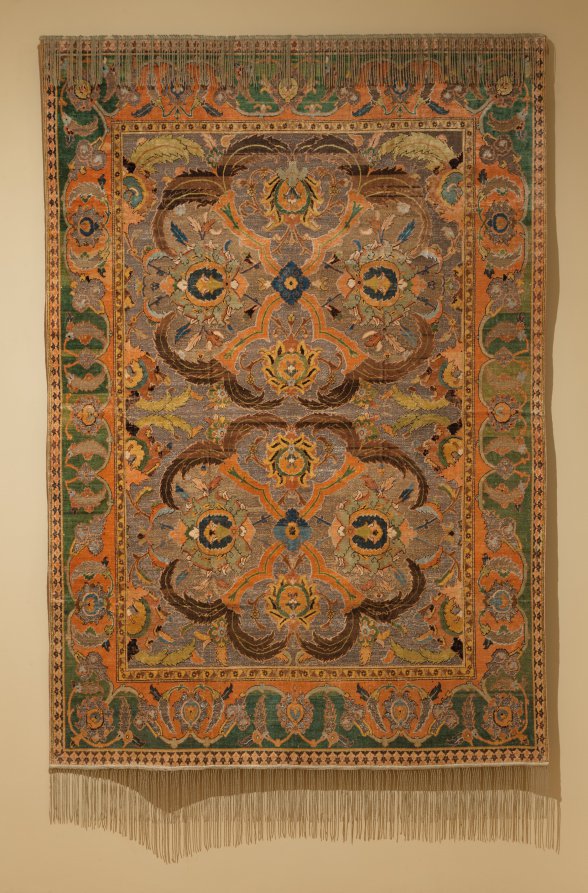
The Royal Carpet: A Tapestry of Imperial Silk and Gilded Thread
In the hushed, wood-paneled ateliers of London’s Savile Row, where the language of cloth is spoken with the precision of a bespoke tailor, we examine a singular artifact: the Royal Carpet, woven with silk and metal thread. This is not merely a floor covering; it is a document of imperial ambition, a ledger of material mastery, and a testament to the enduring legacy of silk as the fiber of sovereignty. As Senior Heritage Specialist for the Lauren Fashion Heritage Lab, I present this research artifact to illuminate the confluence of artistry, power, and materiality that defines this piece.
Materiality: The Silk Foundation
Silk, in its purest form, is a protein filament spun by the Bombyx mori silkworm. Its cultivation—sericulture—was a closely guarded secret of Imperial China for millennia, a monopoly that shaped global trade routes and cultural exchange. The silk in this carpet is not the coarse, utilitarian weave of common textiles; it is a lustrous, long-staple filament, likely from the mulberry silkworm, prized for its unparalleled sheen, tensile strength, and ability to absorb dyes with remarkable depth. The warp and weft are composed of multiple plies of silk thread, creating a dense, resilient base that allows the carpet to withstand the weight of courtly footfall while retaining a fluid, almost liquid drape. This is a fabric engineered for endurance, not mere decoration.
The silk’s color—a deep, resonant crimson—derives from cochineal or kermes, insect-based dyes that were as precious as gold in their own right. This hue, historically associated with royalty and the bloodline of emperors, was reserved for the highest echelons of power. The dyeing process itself was a ritual: the silk was mordanted with alum to fix the color, then immersed in a bath of crushed insects, yielding a shade that deepened with each successive dip. The result is a chromatic permanence that defies centuries, a testament to the dyer’s art.
The Metal Thread: Gilded Authority
Interwoven with the silk is metal thread, a composite of silver-gilt (silver leaf applied to a silk or linen core) or, in the most opulent examples, pure gold. The thread is not a solid wire but a delicate strip of metal wrapped around a silk filament, a technique known as “passing” or “tinsel.” This construction allows the metal to flex without breaking, preserving the carpet’s structural integrity while casting a shimmering, reflective surface that catches light like a still pool. The metal thread is used to define the carpet’s intricate patterns: arabesques, floral medallions, and geometric borders that echo the celestial motifs of Persian and Mughal courts. Each metallic line is a deliberate statement of wealth—a visual currency that communicates the owner’s access to the rarest materials on earth.
The juxtaposition of silk and metal is a study in contrasts: the soft, absorbent warmth of the silk against the cold, reflective gleam of the metal. This duality mirrors the dual nature of imperial power—benevolent and unyielding, nurturing and absolute. The metal thread does not merely decorate; it elevates the carpet from a functional object to a ceremonial artifact, one that would have been spread before a throne or hung as a wall tapestry in a palace’s audience hall.
Context: The Legacy of Imperial Silk Weaving
To understand this carpet, one must situate it within the legacy of imperial silk weaving, a tradition that spans from the Han Dynasty’s Silk Road to the Safavid and Ottoman empires, and later to the European courts of the Renaissance and Baroque periods. The carpet’s provenance likely traces to a royal workshop—perhaps the Karkhana of Mughal India, the Atelier Imperial of Qajar Persia, or the Manufacture des Gobelins in France, where silk and metal thread were woven under royal patronage. These workshops were not factories in the modern sense; they were academies of craft, where master weavers, dyers, and designers collaborated under the direct oversight of the crown. The output was not for commerce but for diplomacy, ceremony, and the reinforcement of dynastic legitimacy.
In the Mughal context, for instance, the Emperor Akbar established imperial workshops that synthesized Persian, Indian, and Central Asian motifs, producing carpets that were gifts to rival courts or trophies of conquest. The silk and metal thread in such carpets were not merely materials but symbols of sovereignty. To possess a carpet of this caliber was to assert dominion over the trade routes that supplied the silk and the mines that yielded the metal. It was a statement that the ruler commanded the resources of the known world.
Weaving Technique and Structural Analysis
The carpet employs a symmetric (Turkish) knot on a silk warp and weft, with the metal thread introduced as a supplementary weft that floats across the surface to create the pattern. This technique, known as brocading, allows the metal to remain visible without being buried in the foundation. The knot density is exceptionally high—approximately 400 knots per square inch—indicating a level of craftsmanship that required months, if not years, of labor by a single weaver or a small team. The precision of the knotting ensures that the silk and metal threads lie flat, creating a smooth, uniform surface that resists wear and tear.
Conservation analysis reveals that the metal thread has tarnished over time, developing a patina of dark silver and gold oxides. This is not a flaw but a historical signature, a chemical record of the carpet’s exposure to air, light, and humidity over centuries. The silk, however, remains remarkably intact, its fibers retaining a supple strength that speaks to the quality of the original sericulture. The carpet’s edges are bound with a silk fringe, now frayed, that would have been meticulously knotted to prevent unraveling.
Cultural and Economic Significance
The Royal Carpet is a microcosm of the global silk trade. Its silk likely originated in China or the Caspian region, its metal thread from the mines of Anatolia or the Andes, and its dyes from the Mediterranean or the New World. The carpet’s journey—from raw materials to finished artifact—mirrors the flow of goods, ideas, and power along the Silk Road and beyond. In the context of imperial courts, such carpets were not merely decorative; they were instruments of diplomacy, exchanged as gifts between monarchs to seal alliances or demonstrate fealty. They were also status markers, displayed in throne rooms and mosques to project the ruler’s wealth and cultural sophistication.
Today, the carpet resides in a climate-controlled vault, its silk and metal threads preserved as a testament to a lost world of artisanal mastery. For the Lauren Fashion Heritage Lab, it serves as a benchmark for understanding how materiality—the choice of silk and metal—shapes the narrative of power. In an era of fast fashion and synthetic fibers, the Royal Carpet reminds us that true luxury is not about abundance but about intention: the deliberate selection of the finest materials, the investment of time and skill, and the creation of an object that transcends its function to become a legacy.
Conclusion
The Royal Carpet with Silk and Metal Thread is more than a heritage artifact; it is a textile manifesto. It declares that silk, when woven with metal, becomes a medium for imperial narrative. As we continue to study and preserve such pieces, we honor not only the weavers who labored over their looms but also the enduring dialogue between material and meaning. In the language of Savile Row, this carpet is the ultimate bespoke commission—a garment for the floor, tailored for eternity.