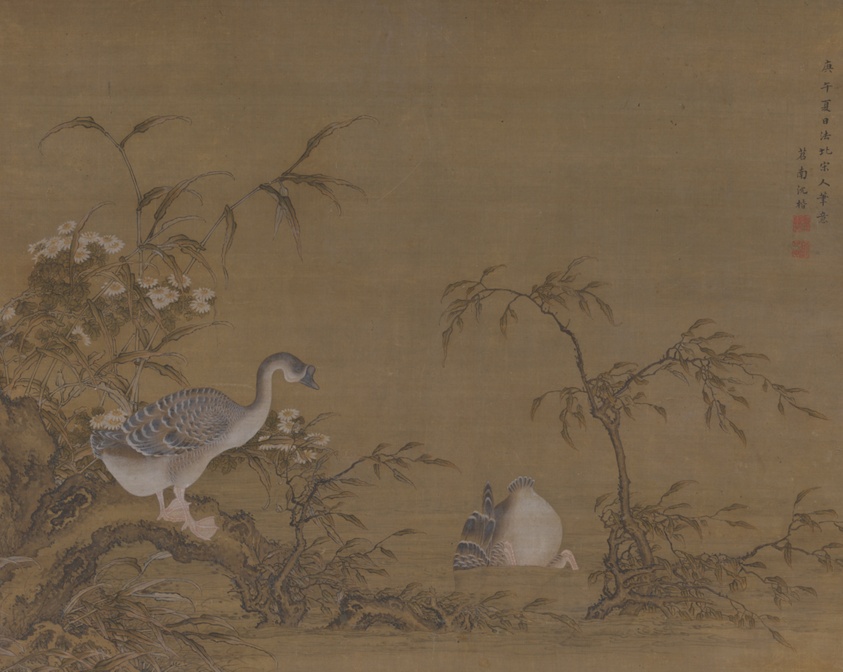
The Geese on a Riverbank: A Study in Materiality and Heritage Craft
Introduction: The Artifact as a Testament to Silk’s Enduring Legacy
In the hallowed halls of heritage preservation, where the tactile and the visual converge, few artifacts speak with such quiet authority as the hanging scroll titled Geese on a Riverbank. This piece, executed in ink and color on silk, is not merely a decorative object; it is a profound testament to the mastery of silk craftsmanship and the fluid elegance that defines the finest traditions of East Asian art. As a Senior Heritage Specialist at the Lauren Fashion Heritage Lab, I approach this artifact with the precision of a Savile Row tailor—examining every thread, every stroke, and every nuance of materiality that elevates it from a mere painting to a living document of cultural and artisanal excellence.
The choice of silk as the substrate is deliberate and deeply significant. Silk, with its lustrous surface and inherent strength, has been revered for millennia as a medium of luxury and refinement. In the context of this scroll, the silk is not a passive background but an active participant in the narrative. The handwoven fabric, likely produced in the renowned workshops of Suzhou or Hangzhou, exhibits a tight, even weave that provides a stable yet responsive surface for the application of ink and mineral pigments. The slight sheen of the silk catches ambient light, lending the geese and riverbank a luminous quality that paper could never replicate. This materiality is the foundation upon which the entire composition rests—a foundation that demands respect and meticulous conservation.
The Craftsmanship of Silk: A Savile Row Approach to Material Integrity
Just as a Savile Row tailor selects the finest worsted wool or cashmere for a bespoke suit, the artisan who created this scroll understood that the silk must be prepared with equal care. The fabric was first treated with a sizing solution, often derived from animal glue or alum, to create a slightly absorbent yet non-porous surface. This preparation is critical: it prevents the ink from bleeding uncontrollably while allowing the brush to glide with fluid precision. The result is a surface that captures the subtlest gradations of tone—from the pale, almost ethereal wash of the sky to the dense, velvety blacks of the geese’s plumage.
The ink itself, made from pine soot and animal glue, is ground on an inkstone with water to achieve a consistency that ranges from watery translucence to opaque depth. When applied to silk, the ink behaves differently than on paper. It sinks into the weave, creating a soft, diffused edge that mimics the natural blur of a misty riverbank. The color pigments—derived from minerals like malachite for green, azurite for blue, and cinnabar for red—are ground to a fine powder and mixed with a binder. These pigments adhere to the silk’s surface with a vibrancy that has endured for centuries, a testament to the artisan’s understanding of material chemistry.
The hanging scroll format itself is a triumph of functional design. The silk is mounted on a paper backing, then attached to a wooden roller at the bottom and a stave at the top. This construction allows the scroll to be rolled and unrolled for storage and display, a practical solution that also emphasizes the ephemeral nature of the artwork. The brocade borders, often woven with gold thread or intricate patterns, frame the composition and protect the edges from wear. In this artifact, the borders are a deep indigo, echoing the water’s hue and providing a visual anchor for the geese’s white and grey forms.
Composition and Symbolism: The Geese as Guardians of Heritage
The subject of geese on a riverbank is rich with symbolic resonance. In East Asian art, geese represent fidelity, vigilance, and the changing seasons. Their migration patterns are a metaphor for the passage of time, a theme that aligns with the heritage mission of preservation. The composition here is deceptively simple: three geese stand at the water’s edge, their necks curved in alert postures, while a fourth takes flight, its wings outstretched against a pale sky. The riverbank is rendered with minimal brushstrokes—a few reeds, a suggestion of mud, and the faintest ripple in the water. This economy of means is a hallmark of the literati tradition, where the artist’s skill is measured not by detail but by the ability to evoke emotion with restraint.
The geese are painted with a technique known as “boneless” or “mogu” style, where forms are built through layers of wash rather than outline. This approach demands absolute control of the brush and an intimate knowledge of the silk’s absorbency. The artist has used a dry brush for the feathers, creating a textured, almost tactile quality that contrasts with the wet washes of the water. The eyes of the geese are tiny dots of black ink, placed with surgical precision to convey alertness and life. This attention to detail—this refusal to compromise on the integrity of the stroke—is what separates a masterwork from a mere sketch.
Conservation and the Future: Preserving the Fluid Elegance
At the Lauren Fashion Heritage Lab, we approach the conservation of this scroll with the same rigor that a Savile Row tailor applies to a bespoke garment. The silk is fragile; it has been exposed to light, humidity, and handling over centuries. Our first priority is to stabilize the substrate. This involves a delicate process of surface cleaning with a soft brush and a low-suction vacuum to remove particulate matter without disturbing the pigments. The silk must be kept at a constant temperature of 20°C and a relative humidity of 50% to prevent brittleness or mold growth.
The pigments require special attention. The mineral colors are stable, but the organic binders may have degraded. We use a technique called “facing”—applying a temporary tissue with a reversible adhesive to support the paint layer during any necessary repairs. The scroll’s mounting must also be examined. The wooden roller may have warped, and the brocade borders could be fraying. Each element is treated with the respect due to a heritage artifact, ensuring that the fluid elegance of the original composition is preserved for future generations.
In conclusion, Geese on a Riverbank is more than a painting; it is a dialogue between material and maker, between tradition and innovation. The silk, the ink, the pigments, and the scroll format are not merely tools but partners in the creation of beauty. As heritage specialists, our role is to listen to this dialogue, to understand the language of craftsmanship, and to ensure that the story continues to be told. In the quiet elegance of these geese, we find a reflection of our own commitment to preserving the threads of history—one fiber, one stroke, one moment at a time.