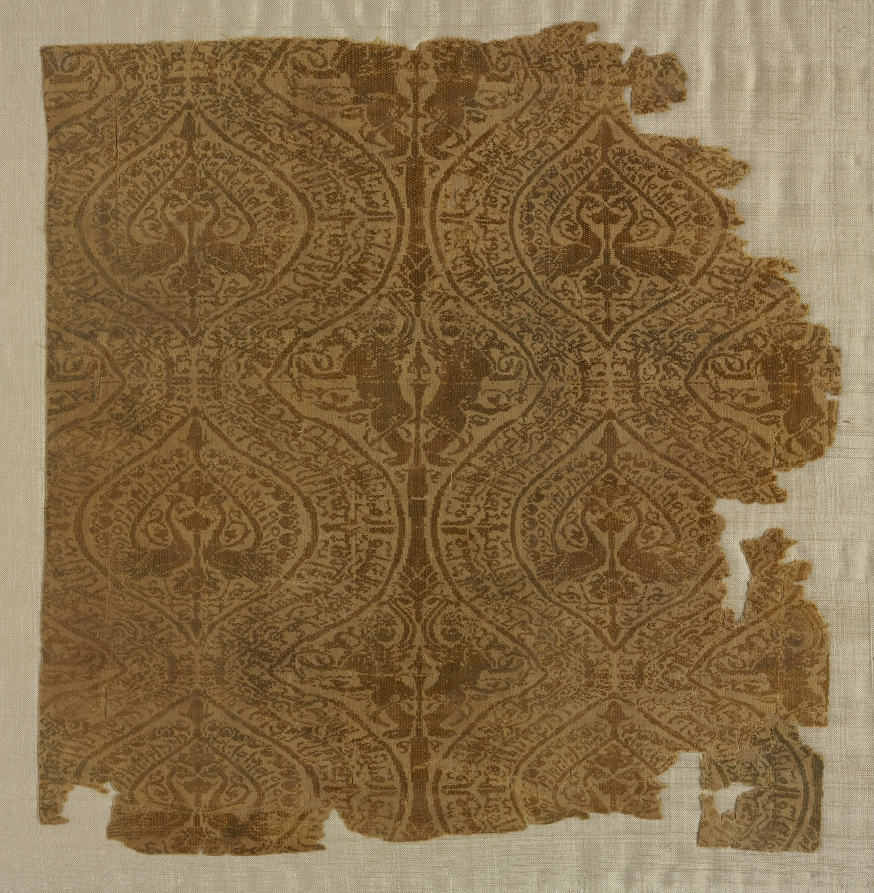
A Fragment of Empire: On the Peculiar Authority of Woven Peacocks
To consider the fragment—a mere swatch, one might say—is to engage in a particular form of sartorial archaeology. It demands a disciplined eye, one trained to perceive not merely the artefact before it, but the vast, silent machinery of culture, power, and technique that brought it into being. This specific fragment, a testament in silk, presents a field of peacocks arrayed within an ogival lattice. The material, first and foremost, declares its provenance: silk. Not as mere fabric, but as the historical currency of empires, the ultimate expression of terrestrial power rendered through the meticulous labour of the loom. The peacock, resplendent in its woven plumage, is no mere decorative motif; it is a heraldic beast of the highest order, a symbol of immortality, of watchfulness, and of regal vanity. Encased within the ogival—that pointed, architectural frame—it is elevated, presented as a jewel might be within a setting of white gold. This is not pattern; this is proclamation.
The Loom as Throne: The Imperial Context of Production
One must understand that silk of this calibre was never a commercial commodity in the common sense. It was, in its epoch, a direct instrument of state. Imperial silk workshops—whether in Byzantium, Damascus, or later, the formidable ateliers of the Ottoman Empire or the Chinese court—operated under a regime of secrecy and exclusivity that would make the most bespoke of Savile Row establishments appear positively democratic. The patterns, such as this ogival framework inhabited by sacred birds, were often decreed by the court itself, their dissemination controlled as rigorously as the movements of a state secret. The loom, therefore, was less a tool and more a throne from which aesthetic authority was woven into the very fibre of the social order. To wear or to display such silk was to announce one’s place within that order—a proximity to the imperial centre, a recipient of favour, a walking embodiment of the realm’s wealth and technical supremacy. The peacock’s eye, meticulously rendered in the weave, becomes a metaphor for the omnipresent gaze of the sovereign.
Decoding the Grammar: Ogival Frame and Avian Heraldry
The sophistication of the fragment lies in its symbiotic grammar. The ogival pattern, derived from Gothic architectural forms—the pointed arch—speaks of a transcultural dialogue. It suggests a moment where influences along the Silk Road coalesced, where Eastern iconography met Western form. The arch provides structure, a series of sacred gateways through which the peacock is perpetually processed. It imposes a rigid, mathematical order upon the naturalistic flourish of the bird’s tail. This tension between the geometric and the organic is the very heart of high craft.
Furthermore, the peacock is never merely a bird in this context. In Persian tradition, it was associated with the Tree of Life and cosmic guardianship. In Christian iconography, it symbolised the incorruptible soul. In numerous Eastern courts, it was an emblem of royalty itself. By enclosing it within the repeating ogive, the weaver achieves two masterful effects. First, he creates a sense of infinite regress, a tapestry that implies its own continuation beyond the fragment’s damaged edges—a metaphor for an empire without end. Second, he ritualises the image. Each peacock becomes a votive figure, a repeated affirmation of the values it embodies. The silk is not simply adorned with peacocks; it is consecrated by them.
The Legacy in the Thread: From Imperial Loom to Modern Archive
The fragment’s present state, divorced from its original garment or hanging, is itself eloquent. It speaks of time, of use, perhaps of careful preservation or of deliberate repurposing. It invites us to consider the lifecycle of such an object of power. Was it part of a ceremonial robe, now disintegrated? A fragment of a diplomatic gift, cut and stored as a record of exchange? This very fragmentation amplifies its aura. We are compelled to reconstruct, to imagine the whole from the part, much as a tailor must envision a suit from a length of cloth.
The legacy of this imperial silk weaving is a legacy of uncompromising standards. It established a taxonomy of quality—in the density of the weave, the complexity of the drawloom technology, the permanence and lustre of the dye—that remains the unspoken benchmark for all subsequent textile endeavours. The pursuit of that level of perfection, where material and motif are fused with such intentionality, echoes in the ethos of the modern atelier. It is the same pursuit that demands the finest Super 180s wool, that insists on a hand-rolled lapel, that understands a garment as a cohesive statement rather than an assemblage of parts.
In conclusion, this fragment of peacocks in ogival pattern is far more than a relic of decorative art. It is a compact treatise on power, articulated in the silent language of silk. It reminds us that true heritage in material form is never passive. It is an active, demanding presence. It sets a standard. It whispers of thrones and workshops, of decrees encoded in thread, and of a beauty so formidable it could only belong to an empire. To study it is to acknowledge that the most profound statements are often made not with words, but with warp and weft, and with the silent, splendid gaze of a woven peacock.