A Discreet Testament to Supremacy
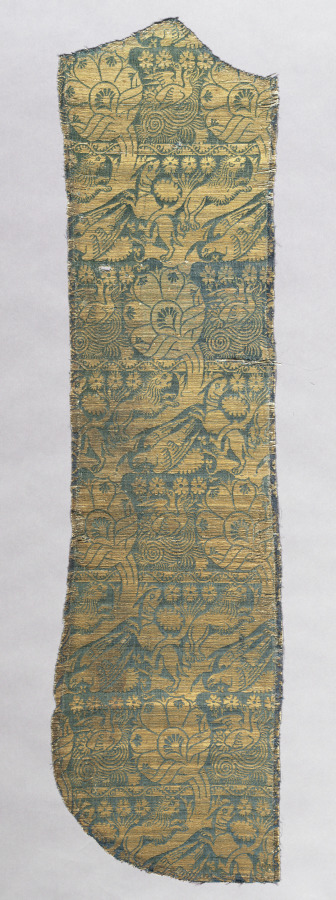
One does not, as a rule, encounter the menagerie within the vestments. Yet here, upon this fragment of ecclesiastical silk—a chasuble, one presumes, given the subtle curve of the cut—the natural world is rendered with an audacious fidelity that transcends mere ornament. The material, first and foremost, declares itself: a heavy, warp-faced silk, its hand cool and dense, the very embodiment of substance. The weave, upon minute inspection, reveals a technical mastery so complete as to become invisible; it is the foundation upon which the narrative is built, never clamouring for attention but providing the impeccable ground for the drama above. The legacy of imperial silk weaving is not a matter of historical footnote here; it is the essential precondition, the silent partner in this exercise of sublime authority.
The Grammar of Thread: A Language of Dominion
The imagery, ostensibly devotional in its final application, speaks a more ancient, terrestrial language. We observe not the stylised heraldic beasts of provincial looms, but creatures captured with a naturalist’s eye: a raptor, perhaps a falcon, its plumage delineated thread by thread, its gaze piercing and specific; a hound in mid-stride, its musculature taut beneath a pelt suggested by the clever modulation of weft. This is a realism earned not through artistic whim, but through technological sovereignty. It speaks of access to the finest design cartoni, translated by master weavers for whom complexity was a challenge to be met, not a barrier to be avoided.
This fragment, in its original splendour, would have been a product of the imperial workshop system—be it Byzantine, Sassanian, or later, the great ateliers of the Tang or the Islamic caliphates. These were not mere manufactories; they were instruments of state. The silk itself, a controlled commodity of immense value, was the first layer of exclusivity. The designs, often centrally ordained, disseminated a curated vision of the natural world, one that reflected the empire’s reach and its capacity to order, categorise, and possess. The realistic animal, in this context, is less a portrait of a creature than a statement of dominion over it, and over the means to reproduce its image with such breathtaking precision.
Material as Message: The Theology of Surface
To drape such a textile over the shoulders of a celebrant at the altar was to engage in a profound act of theatre. The chasuble, the garment of sacrifice, here becomes a field of creation. The spiritual symbolism is layered upon a foundation of immense temporal power. The silk communicates before a single word of the liturgy is uttered; it speaks of a church aligned with, and beneficiary of, the might of empire. Its richness is a theology in itself—a testament to a God deserving of the very finest that human ingenuity, marshalled by imperial will, can produce.
The weight of the silk is crucial. It would have moved not with a flutter, but with a deliberate, stately fall, its substance amplifying the gravity of the ritual. The colours, now faded to elegant remnants of crimson, gold, and azure, would have been derived from the most exclusive and costly dyes—another register of control over resources and trade routes. Every element, from the fibre to the final hue, was a link in a chain of command that stretched from the palace to the altar.
A Legacy Cut from Imperial Cloth
This fragment, therefore, is far more than a relic of textile history. It is a compacted archive of power relations. The realism of its animals is the end product of a vast, disciplined ecosystem: sericulture farms, dye masters, pattern archivists, loom engineers, and weavers of peerless skill—all operating within a hierarchy that culminated in the imperial court. The aesthetic achievement is inseparable from the administrative and economic machinery that made it possible.
From Sacristy to Savile Row: An Enduring Principle
While the empires that spawned such works have faded, the principle they embody remains pertinent to any discussion of enduring heritage. It is the principle of uncompromising provenance. Just as the finest silks were traced to specific imperial workshops, so too does a modern heritage of excellence demand a transparent and impeccable lineage. It is the principle of technical mastery in service of expression—where the method, however complex, never overwhelms the integrity of the design, but rather disappears into it. Finally, it is the understanding that material is not merely a medium, but the message itself; that the hand, the drape, the inherent quality of the cloth communicates value and intention before a single stitch is taken or a single symbol is decoded.
The chasuble fragment, with its realistic animals woven in imperial silk, stands as a silent, eloquent ancestor to this philosophy. It reminds us that true luxury—whether destined for the sacred or the sartorial—is never accidental. It is the culmination of will, wisdom, and a chain of custody over excellence that begins with the selection of the very finest thread. Its legacy is not one of ostentation, but of a deep, quiet assurance: the confidence that comes from possessing, and indeed being vested in, the very best that can be made. That, one might posit, is a heritage worth preserving.