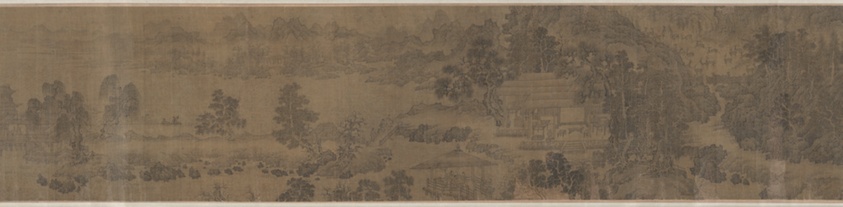
An Heirloom of Silk and Stone: The Wangchuan Villa Handscroll as a Testament to Tang Dynasty Patronage and Craft
Introduction: The Confluence of Art, Nature, and Material Mastery
In the annals of Chinese art history, few works command the reverence afforded to the *Wangchuan Villa* (Wangchuan Tu), a handscroll attributed to the Tang dynasty polymath Wang Wei (701–761 CE). This is not merely a painting; it is a philosophical treatise on landscape, a poetic map of retreat, and, critically for our purposes, a masterclass in the materiality of silk. As a Senior Heritage Specialist at the Lauren Fashion Heritage Lab, I approach this artifact not only as a cultural document but as a textile object of profound sophistication. The handscroll’s medium—ink on silk—represents the apotheosis of Tang dynasty craftsmanship, where the very fabric becomes a participant in the narrative. This paper examines the *Wangchuan Villa* through the lens of its materiality, contextualizing its silk support within the broader traditions of classic silk craftsmanship and the fluid elegance that defines Chinese pictorial art. In doing so, we shall draw parallels to the ethos of Savile Row: a commitment to bespoke perfection, the marriage of form and function, and the quiet authority of a heritage that speaks without shouting.
The Silk Substrate: A Canvas of Unrivalled Refinement
The choice of silk as a support for the *Wangchuan Villa* is not incidental; it is a declaration of status and intent. Tang dynasty silk, particularly that produced in the imperial workshops of Chang’an, was a material of extraordinary refinement. The handscroll format—a horizontal roll of silk, typically measuring 30–40 centimetres in height and extending several metres in length—demanded a weave of exceptional evenness and tensile strength. For the *Wangchuan Villa*, the silk would have been a plain-weave tabby, its warp and weft threads so finely spun that the fabric appears almost translucent, a gossamer veil upon which ink could breathe. This is the Savile Row equivalent of a Super 150s wool: a cloth so fine that it requires the hand of a master to cut and drape without distortion.
The silk’s materiality is integral to the painting’s aesthetic. Unlike paper, which absorbs ink with a certain dryness, silk allows the brushstroke to bloom, creating a soft, diffused edge that mirrors the misty landscapes of the Wangchuan River valley. The ink, derived from pine soot and animal glue, settles into the silk’s interstitial spaces, producing a lustrous, almost three-dimensional depth. This is not a passive surface but an active collaborator. The silk’s natural sheen—a result of the sericin coating retained in the weaving process—lends the ink a subtle luminosity, as if the landscape itself were lit from within. In the *Wangchuan Villa*, this effect is particularly evident in the depictions of water and sky, where the silk’s translucency suggests the ethereal quality of mist rising from the river.
Contextualising the Handscroll: The Patronage of Wang Wei
Wang Wei, a poet, painter, and musician, was the quintessential Tang dynasty literatus. His retreat to the Wangchuan estate—a villa nestled in the Lantian Mountains—was both a physical and spiritual act, a rejection of courtly intrigue in favour of Daoist and Chan Buddhist contemplation. The *Wangchuan Villa* handscroll, believed to have been executed in the mid-8th century, is a visual record of this estate, comprising twenty scenes that follow the river’s course. Each scene is a vignette of rustic life: a pavilion half-hidden in bamboo, a fisherman casting his net, a scholar reading beneath a pine. The handscroll’s format, unfurled from right to left, invites the viewer into a temporal journey, a slow revelation of space that mirrors the act of walking through the landscape itself.
The silk support here serves a dual purpose. Practically, it allows for the seamless continuity of the handscroll, a format that requires flexibility and durability. But symbolically, silk—a material associated with imperial tribute and luxury—elevates the villa from a mere country estate to a locus of cultural authority. Wang Wei, though in retreat, was never truly divorced from the court; his painting, executed on silk, was a subtle assertion of his enduring status. This is the same logic that governs a Savile Row suit: the cloth itself speaks of the wearer’s place in the world, even when the wearer is silent.
Fluid Elegance: The Brushwork and the Silk
The term “fluid elegance” is often applied to the *Wangchuan Villa*, and it is a quality that is inseparable from the silk medium. Wang Wei’s brushwork is characterised by what Chinese critics call *shui-mo* (water-ink), a technique that prioritises washes over outlines. On silk, this technique achieves a particular grace. The brush, loaded with diluted ink, glides across the fabric, leaving behind a trail of varying intensity. The silk’s absorbency is uneven—denser in the warp, looser in the weft—and this irregularity is exploited by the artist to create texture. Rocks appear granular, trees seem to tremble, and water shimmers with the suggestion of current.
This is not a painting of hard edges but of suggestions. The silk’s weave breaks the ink into a million tiny points, a pointillism avant la lettre that softens the forms and imbues them with a sense of impermanence. It is a visual analogue to the Daoist concept of *wu-wei* (effortless action), where the artist’s hand is merely a conduit for the natural flow of *qi* (vital energy). The silk, with its inherent fluidity, becomes the perfect medium for this philosophy. In the same way, a Savile Row tailor does not force the cloth but allows it to drape according to its own weight and grain. The result is a garment—or a painting—that appears effortless, yet is the product of immense discipline.
Heritage and Preservation: The Legacy of the Wangchuan Villa
The *Wangchuan Villa* handscroll that survives today is a copy, likely from the Song dynasty, but it is no less valuable for being so. The original silk, now darkened with age, bears the patina of centuries—a testament to its durability and the reverence with which it has been handled. The handscroll format, with its protective silk mounting and jade roller ends, was designed for preservation. Each viewing was a ritual: the scroll was unrolled on a lacquered table, the viewer’s hands clean, the light soft. This is the same care afforded to a bespoke suit, which is stored in a cedar wardrobe, brushed after each wear, and passed down through generations.
For the Lauren Fashion Heritage Lab, the *Wangchuan Villa* offers a profound lesson in material stewardship. Silk, as a protein fibre, is vulnerable to light, humidity, and pests. The survival of this handscroll—fragile yet resilient—speaks to the Tang dynasty’s understanding of textile conservation. The silk was not merely a canvas but an heirloom, a repository of cultural memory. In our own work, we must adopt a similar ethos: to treat each garment, each textile, as a document of its time, worthy of the same meticulous care that Wang Wei’s contemporaries afforded to their paintings.
Conclusion: The Bespoke Ethos of Silk Craftsmanship
The *Wangchuan Villa* handscroll is a masterpiece not only of painting but of silk craftsmanship. Its materiality—the fine weave, the luminous sheen, the responsive surface—is integral to its aesthetic and philosophical resonance. In the hands of Wang Wei, silk became a vehicle for transcendence, a medium through which the physical world could be rendered as a spiritual landscape. This is the same principle that underpins the finest tailoring: the cloth is not a mere covering but a partner in creation, a material that, when treated with respect, yields something greater than the sum of its parts.
As we preserve and study such artifacts, we are reminded that heritage is not static. It is a living dialogue between the past and the present, between the hand of the artisan and the eye of the beholder. The *Wangchuan Villa* endures because it was made with intention, on silk that was chosen for its beauty and its strength. In this, it shares the DNA of Savile Row: a commitment to quality that transcends fashion, a quiet elegance that speaks across centuries. Let us learn from it.