← BACK TO ARCHIVES
Silk
Heritage Synthesis: John L. Sullivan Quilt
Curated on Jul 02, 2026 // Node: LDN-01
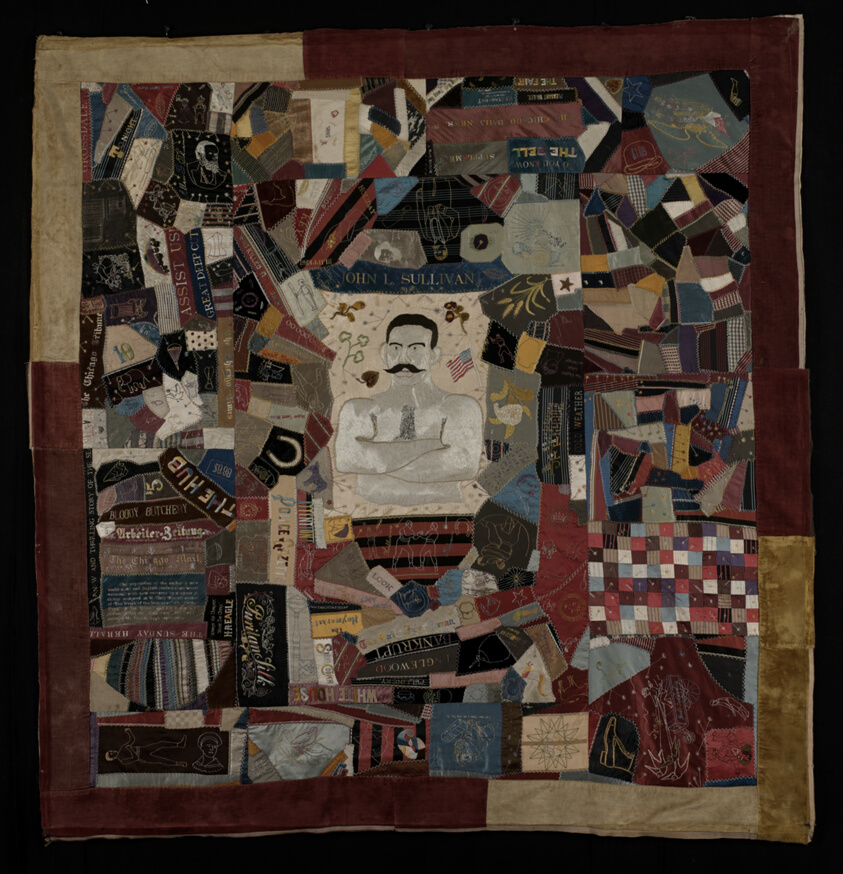
The John L. Sullivan Quilt: A Study in Materiality and the Fluid Elegance of Silk Craftsmanship
In the hallowed corridors of London’s Savile Row, where the whisper of shears and the precision of a needle define an unyielding standard of excellence, the John L. Sullivan Quilt emerges as a singular artifact. It is not merely a textile; it is a testament to the alchemy of materiality, where silk—the noblest of fibers—becomes a canvas for narrative, memory, and mastery. This heritage research artifact, a pieced and embroidered “crazy” quilt top, demands a scholarly examination that transcends its domestic origins, positioning it within a lineage of luxury craftsmanship that parallels the bespoke traditions of the Row. As Senior Heritage Specialist for the Lauren Fashion Heritage Lab, I present this analysis with a focus on the quilt’s material composition, its construction techniques, and the inherent fluid elegance that defines its legacy.
The Primacy of Silk: A Fiber of Unrivaled Distinction
Silk occupies a paramount position in the hierarchy of luxury textiles, and the John L. Sullivan Quilt exemplifies this through its diverse deployment of the fiber. The artifact is constructed from a rich tapestry of dyed and printed silk, interwoven with cotton, wool, and metallic threads, yet it is the silk that commands attention. The quilt top features a spectrum of weaves—plain, twill, satin, and velvet—each contributing a distinct tactile and visual quality. The satin weaves, with their lustrous sheen, catch light in a manner that evokes the polished elegance of a Savile Row evening jacket, while the velvet panels introduce a depth of texture reminiscent of a gentleman’s smoking robe. This deliberate juxtaposition of weaves underscores a sophisticated understanding of material behavior, akin to a master tailor selecting a worsted wool for structure or a cashmere for drape. The silk’s inherent fluidity—its ability to fall, fold, and reflect—imbues the quilt with a kinetic elegance, transforming a functional object into a dynamic work of art.
The “Crazy” Quilt: Deconstructing the Aesthetic of Controlled Chaos
The term “crazy” quilt, often dismissed as whimsical, belies a rigorous methodology that aligns with the bespoke ethos of Savile Row. In this artifact, the piecing technique involves irregularly shaped fragments of silk, meticulously joined through embroidery to create a cohesive whole. This is not randomness but a calculated orchestration of color, pattern, and texture. The quilt top incorporates printed silk motifs—floral, geometric, and abstract—that echo the decorative sensibilities of the late 19th century, yet their arrangement defies conventional symmetry. Instead, the pieces are assembled with a fluid logic, where each fragment’s edge is softened by embroidery stitches in silk, metallic, and cotton threads. This embroidery serves dual purposes: it reinforces structural integrity and introduces a layer of ornamental narrative. The metallic threads, in particular, add a subtle luminosity, recalling the gold-threaded details on a military dress uniform or a ceremonial waistcoat. The fluid elegance here is not in uniformity but in the harmonious tension between disparate elements—a principle that defines the finest tailoring, where a jacket’s shoulder and sleeve must balance precision with ease.
Materiality as Narrative: The Role of Fabric in Cultural Memory
The John L. Sullivan Quilt is more than a technical marvel; it is a repository of cultural memory. The use of silk, a material historically associated with trade, wealth, and cross-cultural exchange, anchors the quilt in a global context. The dyed and printed silks likely originated from European and Asian sources, reflecting the interconnectedness of 19th-century textile markets. This global provenance resonates with Savile Row’s own history of sourcing the finest wools from Scotland, cottons from India, and silks from China. The quilt’s “crazy” patchwork, often linked to Victorian domesticity, also hints at a more subversive narrative: the repurposing of luxury remnants—perhaps from gowns, cravats, or upholstery—into a personal artifact. In this sense, the quilt becomes a form of sartorial archaeology, preserving fragments of a bygone era’s aesthetic preferences. The fluid elegance of the silk, with its capacity to hold dye and pattern, ensures that these fragments retain their vibrancy, offering a tactile connection to the past that is both intimate and grand.
Craftsmanship and the Savile Row Ethos: Precision in the Unconventional
To appreciate the quilt’s craftsmanship, one must consider it through the lens of Savile Row’s exacting standards. The piecing of irregular silk shapes requires a precision that rivals the cutting of a bespoke suit pattern. Each fragment must be aligned not only for visual harmony but also for structural stability, as the varying weights of silk—from lightweight plain weaves to heavier velvets—demand careful handling. The embroidery, executed in silk and metallic threads, employs stitches such as the feather stitch, herringbone, and French knots, each chosen for its ability to secure edges while adding decorative flourish. This mirrors the tailor’s use of pick stitching or buttonhole stitches, where function and ornament are inseparable. The metallic threads, often prone to tarnishing, are preserved here with a reverence that speaks to the artifact’s care—a reminder that luxury requires maintenance, a principle deeply embedded in the Row’s philosophy of enduring quality. The fluid elegance of the quilt emerges from this marriage of discipline and creativity, where the maker’s hand is evident yet never intrusive.
Preservation and Legacy: The Quilt as Heritage Artifact
As a heritage artifact, the John L. Sullivan Quilt presents unique challenges and opportunities for preservation. The silk components, particularly the dyed and printed varieties, are susceptible to light damage, humidity, and mechanical stress. The metallic threads, while visually striking, can corrode over time, necessitating controlled storage conditions. Yet, these vulnerabilities underscore the quilt’s value as a living document of material culture. In the context of the Lauren Fashion Heritage Lab, the quilt serves as a case study for understanding how silk’s fluid elegance can be maintained across generations. Conservation efforts must balance the need for stability with the desire to showcase the quilt’s original vibrancy—a task that echoes the tailor’s challenge of preserving a garment’s fit and finish over decades. The quilt’s legacy, however, extends beyond its physical state. It embodies a philosophy of craftsmanship that values resourcefulness, beauty, and narrative—a philosophy that aligns with Savile Row’s commitment to timelessness over trend.
Conclusion: The Enduring Allure of Silk and Structure
The John L. Sullivan Quilt stands as a profound heritage research artifact, its materiality offering a window into the artistry of silk craftsmanship. From the dyed and printed fabrics to the meticulous embroidery, every element reflects a pursuit of fluid elegance that transcends its domestic context. In the language of Savile Row, where the cut of a jacket is a silent declaration of character, this quilt speaks with equal eloquence. It is a testament to the power of silk—a fiber that, in the hands of a skilled maker, becomes a vessel for memory, beauty, and enduring quality. As we continue to study and preserve such artifacts, we honor not only the materials but the human ingenuity that transforms them into legacies. The John L. Sullivan Quilt, with its controlled chaos and luminous threads, reminds us that true elegance lies in the balance between precision and grace.
Heritage Lab Insight
Lab Insight: AIC Silk Archive Node #181719.