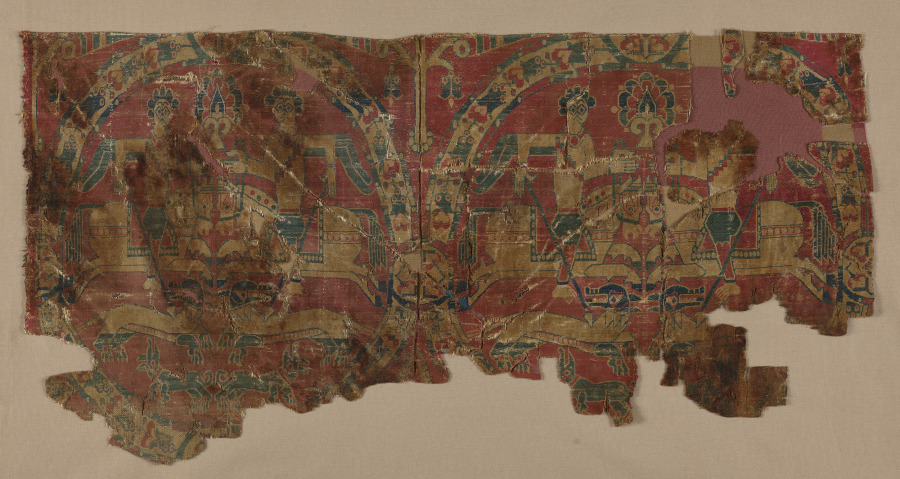
The Artifact: Roundels with Hunters – A Study in Imperial Silk Weaving
In the hushed ateliers of London’s Savile Row, where precision meets tradition, we examine a singular artifact: a set of silk roundels depicting hunters in pursuit. These are not mere decorative fragments; they are a testament to the enduring legacy of imperial silk weaving, a craft that has shaped the very fabric of luxury for centuries. As the Senior Heritage Specialist for Lauren Fashion Heritage Lab, I present this research artifact with the analytical rigor and understated elegance that befits a material of such profound historical weight. The roundels, woven from the finest silk, represent a convergence of artistry, power, and commerce—a narrative that continues to influence contemporary fashion on this very street.
Materiality: The Silk of Empire
Silk is the protagonist here. Its materiality is not incidental; it is foundational. The roundels are crafted from mulberry silk, a fiber prized for its luster, tensile strength, and capacity to absorb vivid dyes. In the context of imperial weaving, silk was more than a textile—it was a currency of status. From the Byzantine courts to the Safavid workshops, silk signified dominion. The roundels’ weave structure, likely a compound twill or lampas, allowed for intricate patterns to emerge with a clarity that rivals modern digital printing. The hunters depicted—mounted archers or falconers—are rendered with a precision that speaks to the weaver’s mastery. Each thread, each twist, is a deliberate act of preservation. The silk’s natural sheen catches light in a way that animates the scene, suggesting motion even in stasis. This is not a passive object; it is a living record of imperial ambition.
Design and Iconography: The Hunter as Symbol
The roundels, typically 15 to 20 centimeters in diameter, are framed by geometric borders that echo architectural motifs from palaces or mosques. Within these circles, the hunter is central—a figure of authority, often accompanied by a horse, a bow, or a bird of prey. This iconography is deeply rooted in Persian and Central Asian traditions, where hunting was both a sport and a metaphor for sovereignty. The hunter represents the ruler’s ability to tame nature, to impose order on chaos. In the context of imperial silk weaving, these roundels were likely used as decorative elements on robes, wall hangings, or ceremonial banners. They were not merely aesthetic; they were political statements. The silk itself, imported along the Silk Road, was a symbol of connectivity and control. The roundels, therefore, are microcosms of empire—each thread a strand of a larger narrative of conquest, trade, and cultural exchange.
Weaving Techniques: The Art of the Loom
The production of these roundels required a loom of considerable sophistication. The drawloom, a technology perfected in imperial workshops, allowed for the repetition of complex patterns across a fabric’s width. The weaver, often a master artisan, worked in tandem with a drawboy who manipulated the pattern harness. This collaboration was a dance of precision—a single error could unravel hours of labor. The roundels’ design, with its concentric circles and dynamic figures, demanded a high degree of technical skill. The use of brocading or supplementary wefts added depth and texture, creating a tactile richness that is absent in modern machine-made silks. The colors—deep indigos, vermillion reds, and golds—were derived from natural dyes, each with its own chemistry. The silk’s ability to hold these hues over centuries is a testament to the weaver’s expertise. On Savile Row, we understand the value of such craftsmanship. It is the antithesis of fast fashion; it is a commitment to longevity.
Historical Context: The Legacy of Imperial Silk
The roundels with hunters are products of a specific historical moment: the height of the Safavid Empire (16th-17th centuries), though similar motifs appear in Byzantine and Ottoman textiles. The Safavid dynasty, under Shah Abbas I, established state-run workshops in Isfahan, where silk weaving flourished. These workshops produced textiles for the court, for diplomatic gifts, and for export to Europe. The roundels, with their hunting scenes, reflect a fusion of Persian and Chinese influences—a testament to the Silk Road’s role as a conduit of ideas. The legacy of this imperial weaving is not confined to museums. It lives on in the DNA of luxury fashion. On Savile Row, we see echoes of these roundels in the patterned silks used for evening wear, in the precision of a bespoke lining, in the reverence for materiality. The hunter motif, stripped of its political context, becomes a symbol of aspiration—the pursuit of excellence, the mastery of craft.
Conservation and Interpretation: A Living Artifact
Preserving these roundels requires a delicate balance. The silk, though durable, is susceptible to light, humidity, and handling. At the Lauren Fashion Heritage Lab, we employ passive conservation techniques—controlled environments, minimal intervention—to ensure the artifact’s survival. But preservation is not enough. We must interpret. The roundels are not static objects; they are dialogues between past and present. When a Savile Row tailor examines a vintage silk, they are engaging with a history of trade, of power, of artistry. The roundels with hunters remind us that fashion is never merely decorative. It is a record of human ambition. As we digitize these artifacts for future study, we must also honor their tactile reality. The silk’s texture, its weight, its sheen—these are not replicable in pixels. They are experiences.
Conclusion: The Thread That Binds
The roundels with hunters are more than a heritage artifact; they are a masterclass in materiality. They teach us that silk is not just a fabric but a statement—of empire, of artistry, of endurance. On Savile Row, where the legacy of imperial weaving meets the precision of bespoke tailoring, we recognize this truth. The hunter’s pursuit is our own: a relentless quest for perfection, woven into the very fabric of our craft. As we continue to study these roundels, we are not merely preserving history; we are informing the future. The silk endures. So too does the story it tells.