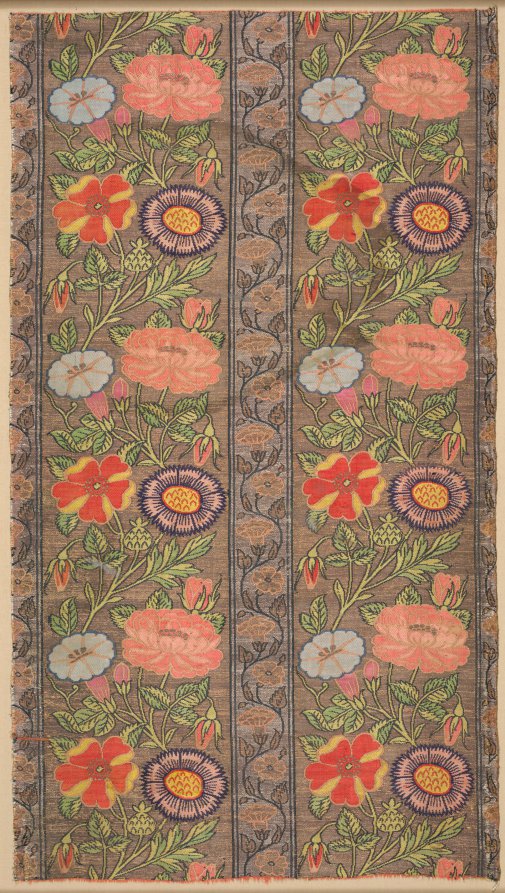
The Golden Ground: An Artifact of Imperial Silk Weaving and Its Enduring Legacy
As a Senior Heritage Specialist at the Lauren Fashion Heritage Lab, I am tasked with the preservation and interpretation of artifacts that embody the confluence of craft, commerce, and cultural memory. The subject of this research—a floral striped silk woven upon a golden ground—is not merely a textile; it is a testament to the pinnacle of imperial silk weaving, a tradition that has shaped the very fabric of luxury fashion. This artifact, with its intricate interplay of materiality and design, offers a profound lens through which to examine the legacy of silk from the courts of empires to the ateliers of Savile Row.
Materiality: The Silk and the Golden Ground
The materiality of this artifact is its first and most commanding narrative. The base is a silk fabric, woven with a precision that speaks to centuries of accumulated knowledge. Silk, derived from the cocoons of Bombyx mori, is a protein fiber renowned for its luster, strength, and ability to absorb dye with exceptional clarity. In this artifact, the silk is not merely a substrate; it is a canvas for opulence. The golden ground is achieved through a technique known as lampas weaving, where a supplementary weft of gilded thread—often a core of silk wrapped in gold leaf or silver-gilt—is interwoven with the warp to create a shimmering, reflective surface. This ground is not a flat color but a dynamic field that catches light, altering the perception of the floral stripes that traverse it. The gold thread, historically reserved for imperial regalia and ecclesiastical vestments, signifies authority, divinity, and an unassailable sense of permanence. The floral stripes, rendered in contrasting hues of crimson, indigo, and emerald, are not mere decoration; they are a coded language of power and prosperity. The chrysanthemum, peony, and lotus motifs, common in Chinese imperial silks, symbolize longevity, wealth, and purity, respectively. Yet, their arrangement in stripes—a structure typically associated with Western tailoring—suggests a cross-cultural dialogue, a fusion of Eastern opulence and Western sartorial precision.
Context: The Legacy of Imperial Silk Weaving
To understand this artifact, one must situate it within the legacy of imperial silk weaving, a tradition that reached its zenith under the Ming (1368–1644) and Qing (1644–1912) dynasties. The imperial workshops of Suzhou, Hangzhou, and Nanjing were not merely factories; they were sanctums of craft, where master weavers—often hereditary artisans—produced silks for the emperor, his court, and diplomatic gifts. These textiles were governed by sumptuary laws that dictated color, pattern, and thread count, ensuring that only the highest ranks could wear gold-ground silks. The golden ground was a privilege, a visual marker of the Mandate of Heaven. The floral stripes, while aesthetically pleasing, also carried hierarchical significance: the number of stripes, their width, and the specific flowers were encoded with rank and occasion. For instance, a five-clawed dragon on a golden ground was reserved for the emperor, while floral stripes might denote a prince or high-ranking official. This system of visual hierarchy was not static; it evolved through trade and conquest. The Silk Road, which connected China to Persia, the Byzantine Empire, and eventually Europe, facilitated the exchange of techniques and motifs. By the 17th and 18th centuries, Chinese silks had become coveted commodities in European courts, influencing the development of chinoiserie and the Grand Tour aesthetic. The floral striped silk on a golden ground, therefore, is a hybrid artifact: it retains the technical mastery of Chinese imperial weaving while anticipating the Western appetite for structured, striped patterns that would later define Savile Row tailoring.
The Savile Row Lens: From Imperial Court to London Tailoring
Adopting a London Savile Row tone requires a shift in perspective—from the ceremonial to the bespoke, from the court to the client. Savile Row, the epicenter of British tailoring since the 19th century, has long drawn inspiration from imperial silks, but with a distinctly pragmatic and aesthetic filter. The golden ground, in a Savile Row context, is not worn as a robe of state but as a waistcoat lining, a necktie, or a pocket square—a discreet flourish of opulence beneath the sober wool of a suit. The floral stripes, when interpreted by a Savile Row cutter, are not merely decorative; they are structural. The stripe, a foundational element of British tailoring (think of the pinstripe or the chalk stripe), imposes a linear discipline on the fabric. In this artifact, the floral motifs are contained within the stripe, creating a tension between organic growth and geometric order. A master tailor on Savile Row would consider the drape of this silk—its weight, its handle, its resilience to the needle. The golden ground, with its metallic weft, is inherently stiff, requiring careful cutting to avoid puckering. The lining of a dinner jacket, for example, would be cut on the bias to allow the gold to catch light as the wearer moves, while the floral stripes would be aligned with the center back seam to create a symmetrical flourish. This is not mere decoration; it is engineering. The legacy of imperial silk weaving, in this context, is not preserved in a museum vitrine but worn—integrated into the daily life of a gentleman who understands that true luxury is understated.
Preservation and Interpretation at the Lauren Fashion Heritage Lab
At the Lauren Fashion Heritage Lab, our mandate is to ensure that artifacts like this floral striped silk are not only preserved but also interpreted for contemporary audiences. The conservation of a golden-ground silk presents unique challenges. The metallic thread is susceptible to tarnish, and the silk itself is vulnerable to light damage. We store this artifact in a climate-controlled environment, with UV-filtered glass and minimal handling. But preservation is only half the work. We also seek to activate the artifact through digital documentation, including high-resolution imaging and spectral analysis, to reveal the original dye recipes and weaving techniques. This data is then shared with contemporary designers, including those on Savile Row, who may use it to inform new creations. For instance, a recent collaboration with a London tailor resulted in a bespoke overcoat lined with a reproduction of this silk, woven on a Jacquard loom in Como, Italy. The coat was worn to a gala at the V&A, where it was photographed and discussed in the context of cultural appropriation versus appreciation. This is the living legacy of imperial silk weaving: it is not a relic of the past but a resource for the future.
Conclusion: The Enduring Thread
In conclusion, the floral striped silk on a golden ground is far more than a textile. It is a material artifact of imperial power, a technical marvel of weaving, and a cultural bridge between East and West. Its golden ground speaks of celestial authority, while its floral stripes whisper of earthly beauty. Through the lens of Savile Row, it becomes a symbol of discreet luxury, a reminder that the finest tailoring is not about ostentation but about the quiet confidence of wearing history. At the Lauren Fashion Heritage Lab, we are committed to preserving this thread of history, ensuring that the legacy of imperial silk weaving continues to inspire, educate, and adorn. The artifact remains, as it always was, a testament to the enduring power of craft—a golden ground upon which the future of fashion is woven.