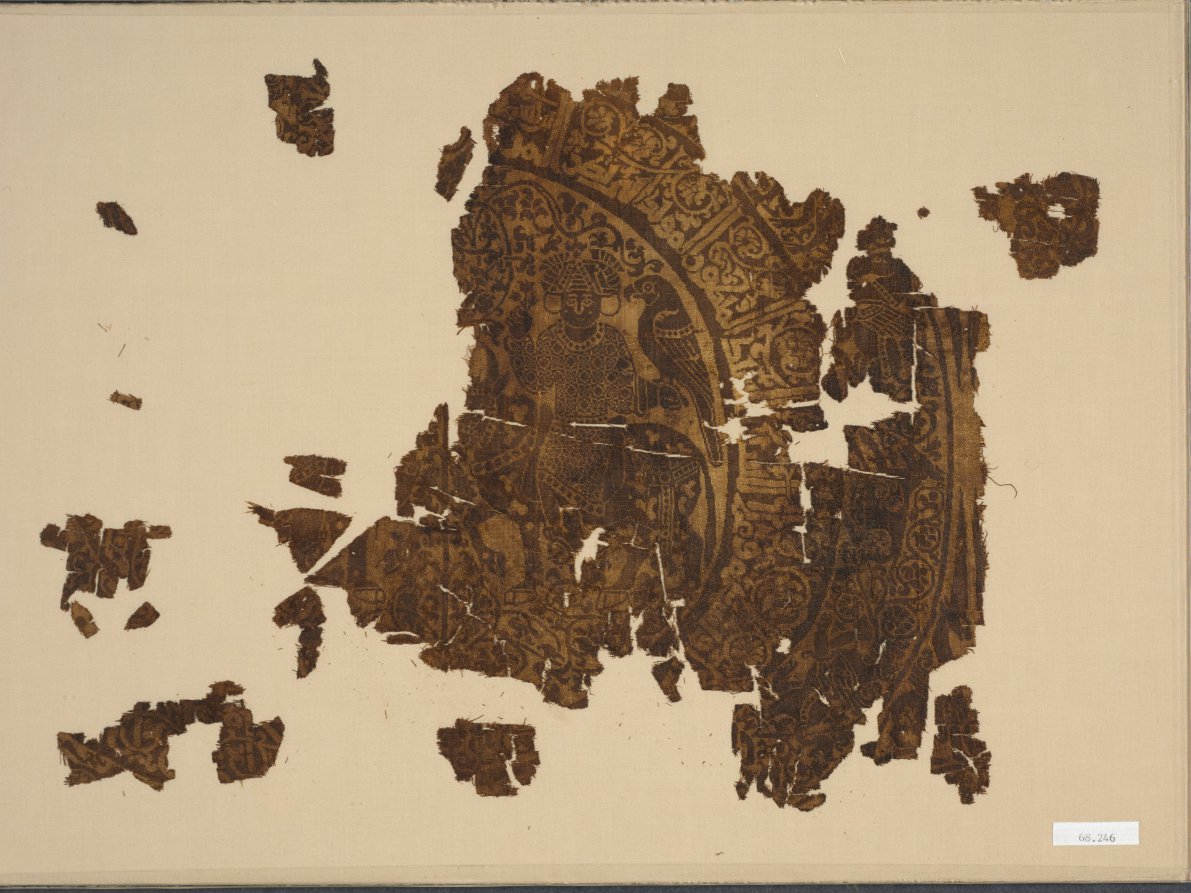
Heritage Artifact: Fragment with Falconer Riding a Bull in a Rondel
In the quiet, curated halls of the Lauren Fashion Heritage Lab, we pause before a fragment of silk that speaks volumes of a lost world. This is not merely a textile; it is a testament to the imperial silk weaving legacy, a whisper from a time when craftsmanship was the ultimate currency of power. The artifact in question—a fragment featuring a falconer riding a bull within a rondel—embodies the intersection of artistry, status, and the enduring allure of silk. As a Senior Heritage Specialist, I invite you to examine this piece with the discerning eye of a Savile Row tailor, where every thread tells a story of precision, heritage, and unyielding quality.
Materiality and Craftsmanship
The fragment is woven from silk, a material that has long been synonymous with luxury and imperial ambition. Silk’s natural sheen, tensile strength, and ability to hold vibrant dyes made it the fabric of choice for dynasties and courts across Eurasia. In this artifact, the silk’s weave is exceptionally fine, with a density that suggests a compound twill structure, likely produced on a drawloom. This technique, perfected in the imperial workshops of the Tang and Yuan dynasties, allowed for intricate patterns to be woven directly into the fabric, rather than embroidered or printed. The result is a surface that feels almost liquid to the touch, yet retains a structural integrity that has survived centuries.
The rondel—a circular medallion—frames the central motif with geometric precision. Such rondels were a hallmark of imperial silk design, often used to denote rank or allegiance. The falconer, mounted on a bull, is rendered with a stylized realism that balances naturalism with symbolic abstraction. The falconer’s posture is erect, his arm raised with a falcon perched, while the bull strides forward with a muscular, almost heraldic presence. The use of gold-wrapped silk threads in the falconer’s attire and the bull’s harness suggests this was a piece reserved for the highest echelons of society—perhaps a ceremonial robe or a diplomatic gift.
Symbolism and Cultural Context
The imagery of a falconer riding a bull is rich with layered meaning. In many steppe cultures, the falcon symbolized sovereignty and the hunt, while the bull represented strength and fertility. Together, they evoke a narrative of dominion over both air and earth—a visual metaphor for imperial power. This motif likely originated in the Persian or Central Asian textile traditions, which heavily influenced Chinese silk weaving during the Mongol Yuan dynasty (1271–1368). The Mongols, as patrons of transcontinental trade, facilitated the exchange of motifs between East and West, resulting in a hybrid aesthetic that defined the Silk Road’s golden age.
Within the context of imperial silk weaving, this fragment is a rare survivor of a tradition that prioritized technical innovation and cultural diplomacy. The imperial workshops, known as the Jinyuan in China, were state-controlled entities that produced silks for the court, religious institutions, and foreign dignitaries. The falconer-bull rondel may have been part of a larger textile used in a ceremonial tent or a court robe, where its visual impact would have been magnified by the interplay of light and silk. The choice of a bull—rather than a horse—is particularly intriguing, as it suggests a connection to agricultural rituals or the veneration of cattle in certain nomadic traditions.
Technical Analysis and Condition
Under magnification, the fragment reveals the weaver’s mastery. The warp threads are of untwisted silk, providing a smooth ground, while the weft threads are tightly packed to create the pattern. The rondel’s border is defined by a pearl-like beading effect, achieved through a supplementary weft technique. The colors—faded now to ochre, russet, and a muted indigo—were once vibrant, likely achieved with natural dyes from madder, woad, and pomegranate. The gold threads show signs of tarnishing, a testament to their metallic core, but the silk itself remains supple, a credit to the quality of the raw material and the weaving process.
Condition-wise, the fragment is incomplete, with frayed edges and a missing section of the rondel. However, this damage does not diminish its value; rather, it adds a layer of authenticity, reminding us of the fragility of heritage. The fragment measures approximately 30 cm by 20 cm, suggesting it was once part of a larger panel. The weave density, at over 100 threads per centimeter, indicates a highly specialized loom, likely operated by master weavers who spent decades perfecting their craft.
Legacy and Contemporary Relevance
The legacy of imperial silk weaving extends far beyond the artifact itself. It is a reminder that luxury is not merely about material richness, but about the story embedded in the making. For the modern connoisseur—whether on Savile Row or in a heritage lab—this fragment challenges us to reconsider the value of slow, deliberate craftsmanship. In an age of fast fashion and digital prints, the falconer-bull rondel stands as a counterpoint: a piece that demanded time, skill, and a deep understanding of materiality.
At the Lauren Fashion Heritage Lab, we view such artifacts as blueprints for excellence. The techniques used in this silk—the drawloom, the compound weave, the symbolic narrative—are not relics of the past but principles that can inform contemporary design. A Savile Row tailor, for instance, might draw inspiration from the rondel’s geometry for a lapel pattern, or from the falconer’s posture for a silhouette. The bull’s muscular form could influence the cut of a shoulder, while the silk’s sheen could dictate the choice of fabric for a bespoke suit.
In preserving and studying this fragment, we honor the imperial weavers who saw their work as a form of cultural dialogue. Their legacy is not just in the threads, but in the enduring idea that what we wear—and how it is made—can convey power, identity, and beauty across centuries. This fragment, with its falconer and bull, is a silent testament to that truth, waiting for those who have the patience to listen.