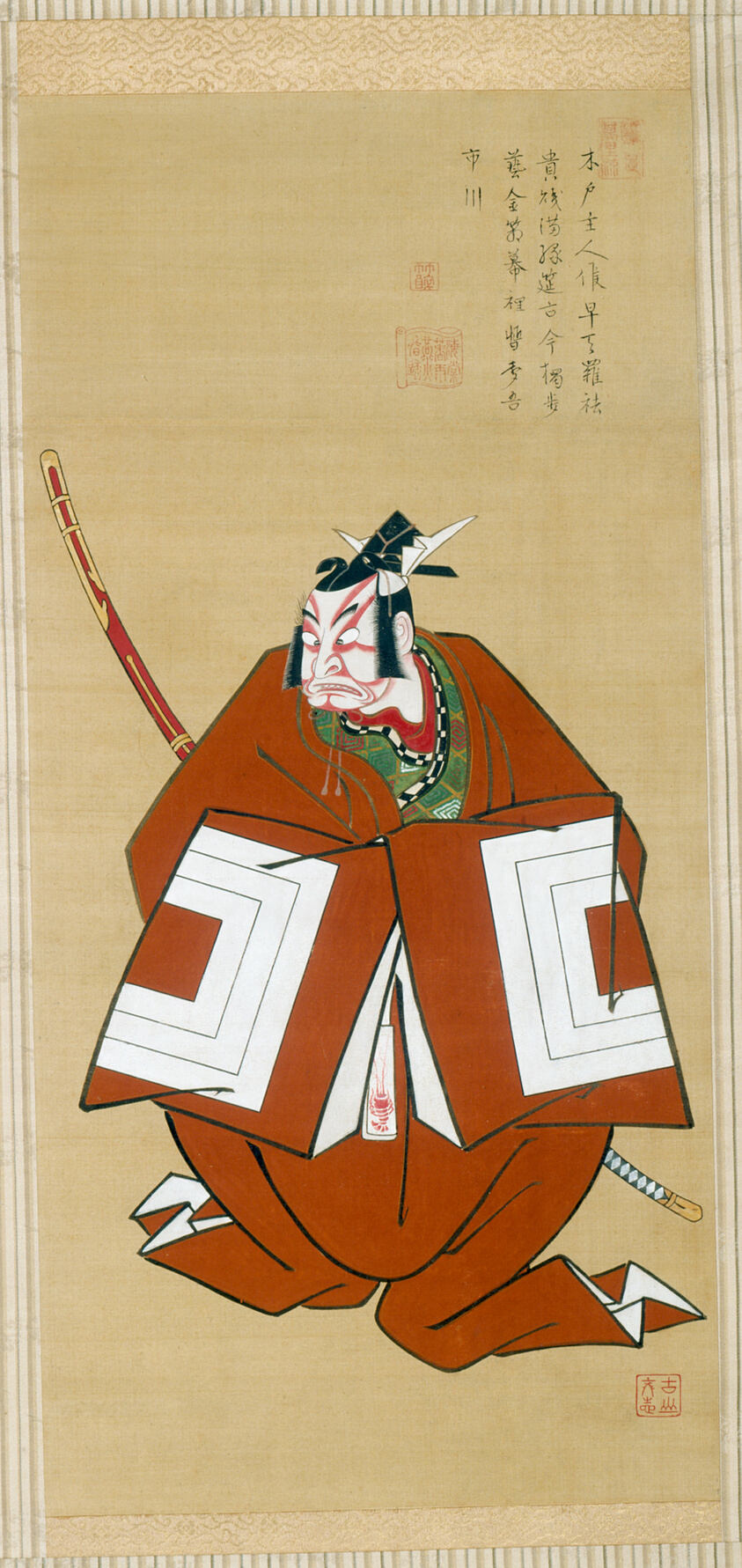
A Treatise on Lineage and Line: The Kamakura Gongorô Portrait as Sartorial Heirloom
To consider the Portrait of Ichikawa Danjūrō II as Kamakura no Gongorô is to engage not merely with an image, but with a profound statement of legacy rendered in the most exacting of mediums. It is, in the most refined sense, a bespoke garment for the immortal identity. The substrate—silk—is not a passive ground but the foundational cloth from which this permanence is cut. Like the canvases of a Savile Row master tailor, the silk here is selected not for mere serviceability, but for its inherent capacity to hold a line, to receive colour with a luminous depth impossible on lesser materials, and to drape with a gravity befitting its subject. This is the essence of true craftsmanship: the unshakeable understanding that heritage is built from the foundation upward.
The Ground: Silk as the Ultimate Basting
Before a single stroke of ink delineates the formidable brow of the aragoto hero, the silk itself establishes the parameters of excellence. Woven with a precision that speaks of generations of specialist knowledge, its surface possesses a tensile strength that allows for the meticulous application of pigment without warping, and a subtle, inherent sheen that breathes life into the flat image. This is analogous to the foundational canvassing and horsehair cloth used in the construction of a definitive morning coat; it is the unseen architecture that guarantees form, longevity, and a flawless hang. The silk’s role is one of silent, impeccable support—the first and most critical covenant between the artisan and the eternity he seeks to capture. To work upon it is to accept the discipline of a revered tradition.
The Drafting: Ink and Colour as the Master Cut
The rendering of Danjūrō II in this iconic role is an exercise in controlled power, a visual echo of the actor’s own stylized, muscular performance style. The lines, particularly those defining the sweeping kumadori makeup that radiates from eyes and brow, are executed with a decisive, unerring confidence. There is no hesitation, no revision. This is the sartorial equivalent of the master cutter’s chalk, marking the immutable lines of a pattern that has been perfected through iteration. The bold, rhythmic strokes of the makeup patterns are not mere decoration; they are the articulated skeleton of the character’s ferocious spirit, structured and intentional.
The application of colour, meanwhile, demonstrates a nuanced understanding of material interaction. The pigments—likely mineral-based and mixed with animal glue—sink into the silk’s fibres rather than sitting upon them, achieving a richness and saturation that is both intense and integral. The vivid vermillion of the hikeshi-banten (fireman’s coat) and the subtle gradations of the flesh tones showcase a palette that is at once dramatic and sophisticated. This is not gaudy display, but the considered deployment of hue for narrative and hierarchical purpose, much as a waistcoat in vibrant silk faille provides the necessary punctuation against the sober wool of a tailcoat.
The Drape: Fluid Elegance as the Finished Form
Context demands we note the “fluid elegance” of the piece, and this is where the confluence of subject, medium, and technique achieves its apotheosis. The silk, accepting the ink and colour, allows for a depiction of fabric and form that possesses a remarkable kinetic suggestion. The robes seem to fall with a real weight, their folds and ripples suggesting recent, heroic movement now arrested in a moment of potent stillness. The actor’s posture, one hand clasping the scroll of the Soga brothers’ vendetta, the other perhaps moments from grasping his sword, is imbued with a coiled, theatrical energy that the silk conveys without resistance.
This fluidity is the hallmark of a masterpiece in any discipline. It is the sense that the finished article—be it a portrait or a suit—exists in a state of dynamic perfection, without stiffness or artifice. The elegance is inherent to the execution, born from an absolute mastery over one’s materials to the point where they appear to move in concert with the artist’s will. The portrait does not fight its medium; it is liberated by it.
Conclusion: A Legacy in Weft and Weave
Ultimately, this portrait stands as a peerless artifact of intersecting heritages: the theatrical lineage of the Ichikawa Danjūrō line, the storied tradition of Japanese figure painting, and the ancient, supreme craft of silk cultivation and painting. Each is dependent on the other for its full expression. The actor’s immortalized prowess is given permanence by the silk; the silk’s luxurious potential is given profound meaning by the image it carries.
In the ateliers of Savile Row, one speaks of a garment that possesses “authority.” This portrait, in its material certainty, its uncompromising technique, and its embodiment of a timeless character, possesses authority in abundance. It is a testament to the principle that true heritage is not a static relic, but a living, breathing standard—a cut above, rendered on a ground worthy of its stature. The silk is its silent oath of permanence.