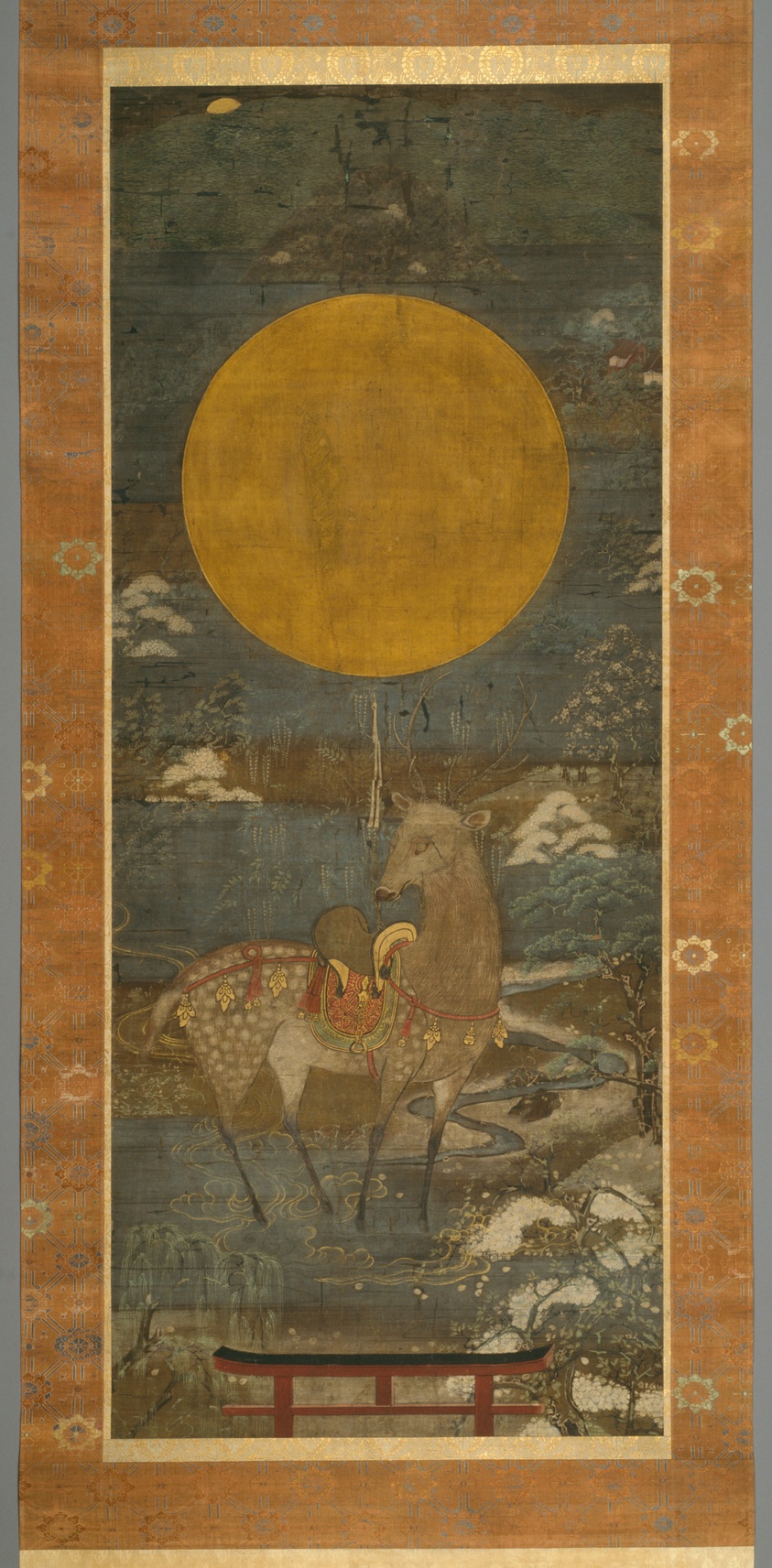
The Kasuga Deer Mandala: A Study in Materiality and Spiritual Cartography
In the rarefied world of heritage textiles, where the weave of history meets the warp of artistry, few artifacts command the reverence of the Kasuga Deer Mandala. This 14th-century Japanese treasure, executed in ink, colors, and gold on silk, is not merely a painting; it is a testament to the profound dialogue between materiality and metaphysics. As a Senior Heritage Specialist at the Lauren Fashion Heritage Lab, I approach this work with the precision of a Savile Row tailor—examining each thread, each pigment, each gesture of the brush as a deliberate, masterful construction. The silk support, the luminous gold, and the fluid elegance of the composition together form a heritage artifact that transcends its religious origins to speak to the enduring principles of craftsmanship, luxury, and narrative.
The Silk Canvas: A Foundation of Craftsmanship
Silk, the very substrate of this mandala, is a material of unparalleled significance in East Asian heritage. Its production, from the cultivation of silkworms to the delicate reeling of filaments, represents a lineage of artisanal knowledge that rivals the tailoring traditions of London’s finest houses. For the Kasuga Deer Mandala, the choice of silk is not arbitrary; it is a declaration of intent. The fabric’s natural sheen and supple texture provide a luminous ground that enhances the application of pigments and gold. Unlike paper or wood, silk absorbs and reflects light in a way that imbues the image with a living, breathing quality—a soft radiance that shifts with the viewer’s perspective. This is akin to the way a bespoke suit’s worsted wool catches the light, revealing the depth of its weave. The silk here is not a passive surface but an active participant in the visual experience, its fluid elegance echoing the deer’s graceful forms and the ethereal landscape they inhabit.
The craftsmanship of the silk itself—likely a fine, plain-weave habutae—required extraordinary skill. Artisans would have stretched the fabric taut on a frame, treating it with a sizing of alum and animal glue to prepare it for the meticulous application of mineral and organic pigments. This preparation is a silent prelude to the mandala’s creation, a foundation that ensures the longevity of the image. In the context of heritage preservation, we recognize that the silk’s condition—its patina, its subtle discolorations—tells a story of centuries of devotion, handling, and environmental exposure. Every crease, every faint stain is a historical document, much like the wear patterns on a vintage Savile Row jacket that speak to its owner’s life.
Pigments and Gold: The Palette of Devotion
The materiality of the Kasuga Deer Mandala extends beyond the silk to the very substances that define its iconography. The ink—a carbon-based sumi—provides the foundational outlines, executed with a calligraphic precision that mirrors the discipline of a master tailor’s chalk marks. These lines are not merely functional; they are expressive, capturing the deer’s poised alertness and the sinuous curves of the sacred Kasuga shrine’s architecture. The colors—vermillion from cinnabar, azurite blues, malachite greens, and orpiment yellows—are derived from ground minerals and organic sources, each pigment a precious commodity in medieval Japan. Their application is layered, with thin washes building depth and opacity, a technique that requires patience and a steady hand. This is the equivalent of a tailor’s hand-stitching: invisible to the casual observer but essential to the garment’s integrity.
The gold, however, is the mandala’s crowning material statement. Applied as kinpaku—thin sheets of beaten gold leaf—it illuminates the deer’s antlers, the shrine’s roof, and the celestial aura surrounding the central deity. The gold is not merely decorative; it is a spiritual technology, a means of capturing and reflecting divine light. In the context of luxury heritage, gold leaf represents the ultimate in material opulence—a non-corrosive, eternally luminous substance that defies time. Yet, its application is restrained, used to highlight rather than overwhelm. This restraint is a hallmark of refined taste, much like the subtle gold buttons on a Savile Row blazer or the discreet embroidery on a bespoke evening gown. The gold’s interaction with the silk’s texture creates a shimmering, almost holographic effect, as if the deer themselves are stepping out of the sacred narrative into the viewer’s presence.
Fluid Elegance: The Composition as a Tailored Narrative
The Kasuga Deer Mandala’s composition is a masterclass in fluid elegance. The deer, traditionally messengers of the Shinto deity Takemikazuchi-no-Mikoto, are arranged in a circular or mandalic pattern that guides the eye inward toward a central sacred space. This is not a static image but a dynamic journey—a visual pilgrimage. The deer’s bodies are rendered with a sinuous grace, their necks arched, their legs poised as if in mid-step. The silk’s pliability allows the artist to create sweeping, uninterrupted lines that echo the natural world’s rhythms: the curve of a mountain, the flow of a river, the arc of a branch. This fluidity is reminiscent of the drape of a perfectly cut garment, where fabric moves with the body rather than against it. The mandala’s spatial organization, with its careful balance of empty space and densely decorated areas, mirrors the principles of ma—the Japanese aesthetic of negative space that gives form to the void.
From a heritage perspective, the mandala’s elegance is a product of both artistic intent and material constraint. The silk’s fragility demanded a light touch; the pigments’ viscosity required precise control; the gold leaf’s delicacy necessitated a steady hand. These constraints, far from limiting creativity, fostered a discipline that elevated the work to a pinnacle of artistic achievement. In the same way, a Savile Row tailor works within the limits of fabric, cut, and client anatomy to produce a garment that feels both inevitable and extraordinary. The Kasuga Deer Mandala is thus a tailored narrative—a story of faith, nature, and artistry, stitched together with materials that speak across centuries.
Heritage Implications: Preservation and Interpretation
As a heritage artifact, the Kasuga Deer Mandala demands a conservation approach that respects its material complexity. The silk’s sensitivity to light, humidity, and temperature requires controlled environments—much like the archival storage of rare textiles in London’s ateliers. The gold leaf, while durable, can flake if handled improperly; the pigments may fade or shift over time. Our role at the Lauren Fashion Heritage Lab is to document these materials with scientific rigor—using multispectral imaging to reveal underdrawings, X-ray fluorescence to identify pigment composition, and microscopic analysis to assess fiber degradation. This data informs not only preservation strategies but also our understanding of the mandala’s creation and use.
Moreover, the Kasuga Deer Mandala offers a profound lesson in the intersection of materiality and meaning. In an era of fast fashion and digital reproduction, this artifact reminds us that true luxury is born from patience, skill, and a deep respect for materials. The silk, the ink, the gold—each element is a thread in a larger tapestry of cultural heritage. As we study this mandala, we are not merely analyzing an object; we are engaging with a philosophy of making that values quality over quantity, permanence over transience. This philosophy resonates with the ethos of Savile Row, where a single garment can take weeks to complete and is designed to last a lifetime—or longer.
In conclusion, the Kasuga Deer Mandala is a heritage research artifact of extraordinary depth. Its materiality—ink, colors, and gold on silk—is not a mere support for imagery but an integral part of its spiritual and aesthetic power. The fluid elegance of its composition, the craftsmanship of its silk, and the luminosity of its gold together create a work that transcends time and culture. For the scholar, the collector, or the connoisseur, it stands as a benchmark of excellence—a reminder that the finest art, like the finest tailoring, is always a dialogue between the hand, the material, and the soul.