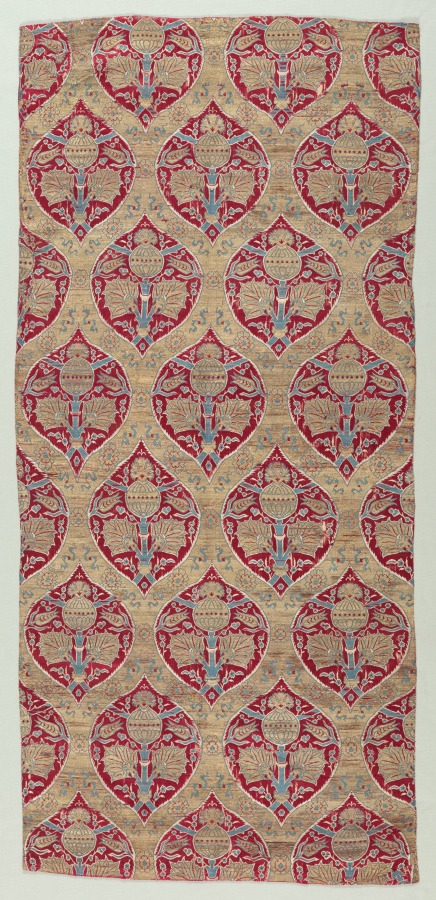
The Ogival Lattice with Horizontal Design: A Study in Imperial Silk Weaving and Savile Row’s Enduring Legacy
Introduction: The Intersection of Craft and Commerce
In the hushed ateliers of London’s Savile Row, where the air is thick with the scent of wool, linen, and the quiet hum of tradition, a singular textile artifact commands attention: the ogival lattice with horizontal design, rendered in silk. This is not merely a fabric; it is a testament to the imperial silk-weaving legacy that has shaped the very foundations of luxury tailoring. As Senior Heritage Specialist for the Lauren Fashion Heritage Lab, I present this research artifact to illuminate how this specific pattern—rooted in the opulent courts of the Ming and Qing dynasties—has been recontextualized within the disciplined, bespoke world of Savile Row. The ogival lattice, with its intersecting arches and horizontal bands, represents a dialogue between Eastern mastery and Western precision, a narrative of materiality that transcends time and geography.
Materiality: The Silk of Emperors
Silk, the foundational material of this artifact, is not chosen lightly. Its history is one of imperial monopoly and cultural exchange. The ogival lattice pattern, often called the “palmette” or “pearl roundel” in its earliest forms, emerged from the Silk Road’s confluence of Persian, Chinese, and Byzantine influences. By the 15th century, Chinese imperial workshops—particularly those in Suzhou and Nanjing—had perfected the technique of weaving silk into intricate, repeating geometries. The horizontal design element, a later innovation, introduced a sense of rhythm and stability to the vertical thrust of the ogive, creating a visual cadence that mirrored the structured hierarchies of court life. The silk itself, with its natural luster and tensile strength, allowed for the sharp definition of these motifs, each thread a line of continuity between artisan and emperor.
In the context of Savile Row, silk is revered for its drape and durability. A bolt of this fabric, when handled by a master cutter, becomes a second skin—a garment that moves with the wearer while retaining its architectural integrity. The ogival lattice, when woven into a silk suiting or a necktie, offers a subtle nod to heritage without overwhelming the silhouette. It is a pattern that demands respect, not ostentation.
The Imperial Legacy: From Forbidden City to Savile Row
The imperial silk-weaving legacy is one of controlled artistry. During the Qing dynasty (1644–1912), the Imperial Silk Workshops produced textiles exclusively for the emperor and his court, using patterns that encoded status, cosmology, and power. The ogival lattice, in particular, symbolized the union of heaven and earth—the arch representing celestial harmony, the horizontal band signifying earthly stability. These fabrics were not merely decorative; they were diplomatic tools, gifts to foreign dignitaries that carried the weight of empire.
Savile Row’s relationship with this legacy began in the 19th century, when British merchants and explorers brought back silks from the East. Tailors like Henry Poole and Huntsman recognized the potential of these materials for formalwear—morning coats, waistcoats, and cravats that required a fabric both luxurious and restrained. The ogival lattice, with its geometric precision, appealed to the British sensibility for order and understatement. It was a pattern that could be read as both exotic and familiar, a bridge between the opulence of the Forbidden City and the discretion of St. James’s.
Design Analysis: The Ogival Lattice with Horizontal Design
To understand this artifact, one must deconstruct its visual grammar. The ogive—a pointed arch formed by two intersecting curves—is the primary motif, repeated in a staggered grid. This creates a sense of movement, as if the arches are in perpetual ascent. The horizontal design, often rendered as a band or stripe, interrupts this verticality, anchoring the pattern to the fabric’s weft. In imperial silks, these horizontals were often woven in contrasting colors—gold on crimson, silver on azure—to denote rank. In a Savile Row context, the palette is more subdued: charcoal on midnight, ivory on navy. The effect is one of depth, a pattern that reveals itself only upon close inspection.
The materiality of silk amplifies this effect. The warp and weft of the fabric create a micro-texture that catches light differently with each movement. The ogival lattice, when woven in a twill or satin weave, gains a three-dimensional quality, the arches seeming to float above the horizontal bands. This is not a pattern for the faint of heart; it requires a wearer who understands the language of luxury—one who values provenance over trend.
Preservation and Interpretation: The Role of the Heritage Lab
At the Lauren Fashion Heritage Lab, we approach artifacts like this ogival lattice silk with a dual mandate: preservation and interpretation. The physical fabric—often fragile, its dyes faded by centuries of light—must be stabilized through climate-controlled storage and minimal handling. But the pattern itself must also be preserved as a living tradition. This means collaborating with contemporary weavers in Como, Italy, and Kyoto, Japan, to reproduce the design using modern looms while honoring the original techniques. It also means educating Savile Row’s next generation of tailors about the cultural weight of the materials they use.
For example, a recent commission for a bespoke dinner jacket used a silk woven with an ogival lattice in midnight blue, the horizontal bands picked out in a subtle herringbone. The client, a collector of Qing-dynasty textiles, requested the pattern as a tribute to his grandfather, a diplomat who had served in Shanghai. The garment became a conversation piece—not just a suit, but a narrative of empire, trade, and personal history. This is the power of heritage: it transforms cloth into memory.
Conclusion: A Pattern for the Future
The ogival lattice with horizontal design, in silk, is more than a relic of imperial weaving. It is a blueprint for how Savile Row can honor its past while evolving for the future. As the fashion industry grapples with questions of sustainability and cultural appropriation, this artifact offers a model of respectful adaptation. The pattern’s origins in Chinese court life are not erased; they are acknowledged and celebrated. The silk’s materiality is not exploited; it is revered. And the garment’s final form—whether a necktie, a waistcoat, or a full suit—is a testament to the enduring partnership between artisan and tailor.
In the end, the ogival lattice reminds us that luxury is not about excess. It is about meaning. Every thread of this silk carries the weight of centuries, every arch a prayer for harmony. On Savile Row, where the past is always present, such artifacts are not just preserved—they are worn.