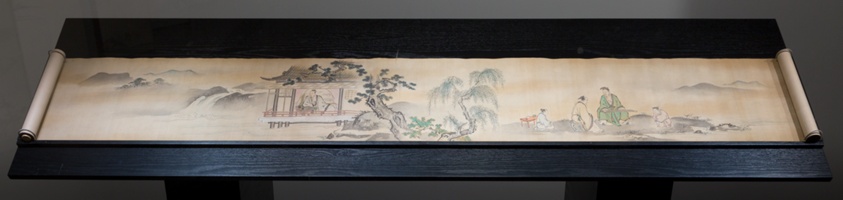
The Four Accomplishments: A Study in Materiality and Cultural Legacy
Introduction: The Art of Silk as a Canvas for Heritage
In the rarefied world of luxury heritage, few materials command the reverence of silk. Its luminous surface, tactile fluidity, and historical resonance have long positioned it as the quintessential medium for artistic expression and cultural storytelling. At Lauren Fashion Heritage Lab, we examine the Four Accomplishments—a classical East Asian motif depicting music, chess, calligraphy, and painting—rendered in ink and colors on silk. This artifact, a testament to the interplay between craftsmanship and intellectual refinement, offers a profound lens through which to explore the materiality of silk and its role in preserving heritage. The piece, executed with the precision of a Savile Row tailor’s stitch, embodies a legacy of elegance that transcends time and geography.
The Materiality of Silk: A Foundation of Craftsmanship
Silk, as a substrate, is not merely a passive canvas but an active participant in the artistic process. Its natural sheen and absorbency demand a mastery of technique akin to the bespoke tailoring of London’s Savile Row, where fabric dictates cut and drape. The Four Accomplishments artifact, likely produced during the Ming or Qing dynasty, leverages the unique properties of silk to achieve a fluid elegance that paper cannot replicate. The ink, applied with a brush of animal hair, seeps into the silk’s fibers, creating gradients of tone that mimic the subtlety of watercolor. The colors—vermilion, indigo, and ochre—are derived from mineral and organic pigments, each layer building depth without obscuring the fabric’s inherent luminosity. This synergy between material and medium reflects a philosophy of restraint and precision, where every stroke is deliberate, much like the hand-stitching of a bespoke suit.
The craftsmanship involved in preparing the silk is equally rigorous. The fabric is first degummed to remove sericin, a protein that gives raw silk its stiffness, resulting in a soft, drapable surface. This process, akin to the careful washing of wool for a tailored jacket, ensures the silk’s fluidity without compromising its strength. The artist then stretches the silk onto a frame, tensioning it evenly to prevent warping—a step that parallels the blocking of a garment on a tailor’s dummy. The result is a surface that responds to the brush with a responsive, almost organic, quality, allowing the Four Accomplishments to breathe with life.
The Four Accomplishments: Symbolism and Cultural Resonance
The motif itself—the Four Accomplishments—is a cornerstone of classical Chinese culture, representing the cultivated scholar’s pursuit of harmony through art and intellect. Music, symbolized by the qin (zither), evokes discipline and emotional balance; chess, or weiqi (Go), signifies strategic thinking; calligraphy embodies the unity of form and meaning; and painting captures the essence of nature and philosophy. Together, they form a holistic ideal of refinement, much like the Savile Row ethos of tailoring, where each garment is a composite of precise measurements, fabric choice, and hand-finishing.
In this artifact, the composition is arranged with a balanced asymmetry that mirrors the principles of Chinese landscape painting. A scholar plays the qin beneath a pine tree, its branches curving like the lapels of a well-cut coat. Nearby, two figures engage in a game of Go, their postures relaxed yet focused, echoing the poised stillness of a tailor’s fitting. Calligraphy scrolls hang from a bamboo screen, their characters flowing with the rhythm of a master’s hand. The painting, a small landscape, sits on an easel, its mountains and mist rendered in washes of ink that seem to float on the silk’s surface. The entire scene is unified by a palette of muted earth tones, punctuated by accents of red and blue, creating a visual harmony that is both serene and dynamic.
Fluid Elegance: The Aesthetic of Silk in Motion
The term “fluid elegance” is central to understanding this artifact’s appeal. Silk, by its nature, is a fabric of movement; it catches light and shifts with air currents, lending a kinetic quality to static images. The Four Accomplishments exploits this property through the use of fine, unbroken lines and soft washes that mimic the flow of water or the drift of clouds. The ink, applied in varying dilutions, creates a sense of depth that changes with the viewer’s angle, much like the subtle sheen of a silk tie or the drape of a gown. This is not a passive object but an active experience, one that invites contemplation and rewards close observation.
From a conservation perspective, the artifact’s materiality poses unique challenges. Silk is hygroscopic, meaning it absorbs moisture from the air, which can cause pigments to bleed or the fabric to degrade over time. The use of mineral pigments, however, offers resilience; vermilion, derived from cinnabar, retains its vibrancy for centuries, while indigo, from the indigofera plant, fades gracefully. The ink, carbon-based, is stable but requires careful handling to avoid smudging. These considerations underscore the importance of preservation techniques that mirror the precision of the original craft—a lesson that resonates with the heritage of Savile Row, where garments are stored in acid-free tissue and climate-controlled environments.
Conclusion: A Legacy of Craft and Culture
The Four Accomplishments on silk is more than a decorative artifact; it is a testament to the enduring power of materiality and cultural narrative. Its ink and colors, applied with the discipline of a master artisan, transform silk into a living document of intellectual and artistic achievement. For Lauren Fashion Heritage Lab, this piece serves as a reminder that heritage is not static but fluid, evolving through the hands of those who understand its language. In the spirit of Savile Row, where tradition meets innovation, we honor this artifact as a benchmark of excellence—a silk-bound legacy of elegance that continues to inspire the future of fashion and beyond.