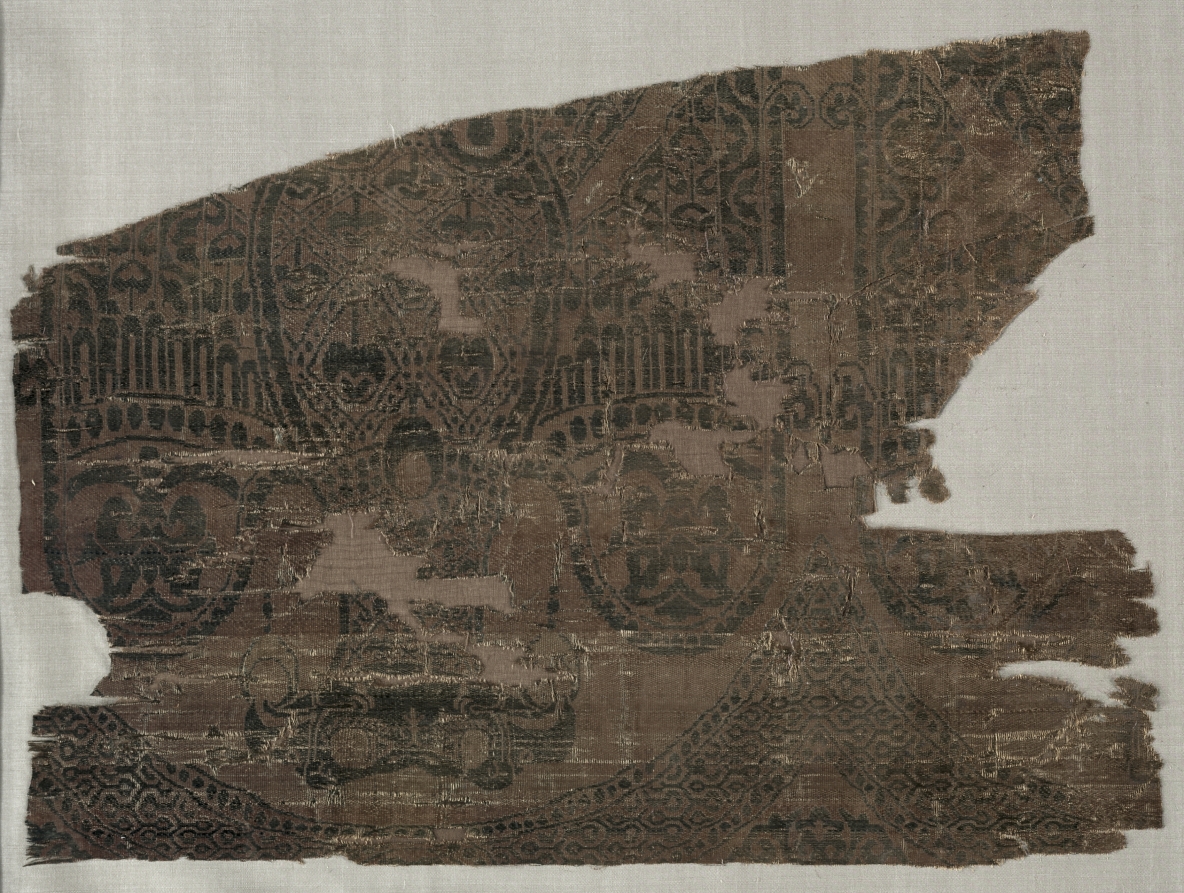
A Discreet Assertion of Epochs: Samite Fragments from the Tomb of Saint Bernard Calvo
To consider these fragments—these remnants of samite silk, unearthed from the sepulchral quiet of a thirteenth-century bishop’s tomb—is to engage in a dialogue with a legacy of unparalleled authority. The material, silk itself, is the foundational text. Its very presence in the Pyrenean see of Vich speaks not of provincialism, but of a connectivity that transcends geography. This is not mere fabric; it is the physical manifestation of a supply chain of power, a commodity whose journey from worm to loom to vestment traced the most exalted trade routes of the medieval world. The weave, the samite, is a complex twill, a technical accomplishment that produces a surface of subdued sheen, a luminosity that holds the light rather than flaunts it. It is, in its essence, the quietest form of opulence, understood only by those acquainted with the grammar of quality.
The Grammar of the Loom: Imperial Syntax in Thread
The legacy of imperial silk weaving, from which these fragments descend, is one of administered magnificence. It is a legacy born in the gynaecea of the late Roman world, refined in the regimented workshops of Byzantium, and later adopted and adapted by the Islamic caliphates and the emergent city-states of Italy. This was not an industry left to chance; it was a state secret, a guarded technology as strategic as any siege engine. The double-headed eagle motif woven into these very fragments is the ultimate expression of this imperial syntax. It is a heraldic sentence, declaring a sovereignty that looks both east and west, claiming a duality of heritage—Roman and Christian, temporal and spiritual. The motif’s execution in silk samite is the critical point: the message is inseparable from the medium. Only in the resilient, luminous medium of silk could such a symbol carry its full weight through centuries, buried in a tomb, to speak to us now. The weave carries the ideology as much as the dye.
A Bishop’s Acquired Authority: The Patina of Provenance
The context of discovery—the tomb of Saint Bernard Calvo, Bishop of Vich from 1233 to 1243—adds a layer of profound narrative depth. Bernard was no mere ecclesiastic; he was a jurist, a diplomat, a key figure in the reconquest and repopulation of Catalonia under the Crown of Aragon. His was a career enacted at the intersection of spiritual duty and royal service. The presence of this specific silk in his tomb is a calculated statement. It is unlikely to be a product of local Iberian manufacture at that time; rather, it is an import, a gift, or a trophy. Perhaps it arrived via the mercantile networks of Genoa or Pisa, channels through which the luxury goods of the East flowed into the courts and cathedrals of the West. Perhaps it was a papal gift, or an acquisition from a crusader context. Its use as a funerary vestment or pall transforms the fragment. The bishop, in death, wraps himself in the symbol of supreme temporal authority, subsuming it into the eternal authority of the Church. He drapes his mortality in an emblem of dual-headed empire, aligning his episcopal legacy with a lineage of power that stretches back to Constantinople and Rome. The silk becomes the interface between his soul’s journey and his worldly stature.
The Silent Testimony of the Fragment: A Study in Permanence
Now, we must attend to the fragments themselves in their present state. They are, by necessity, a study in partial revelation. The ravages of time—the attrition of soil, the chemical dialogue with mortality, the sheer weight of years—have rendered them fragile. The crimson, once a violent and expensive proclamation dyed with kermes, has softened to a muted blood-rust. The gold-wrapped thread, which would have caused the eagle to gleam with a metallic assertiveness, is tarnished, its brilliance now a whisper. Yet, herein lies the true power of the artifact. This patina is not a diminishment, but an acquisition. It is the finish of history. The wear speaks of use, of ceremony, of interment, of rediscovery. It authenticates the object in a way pristine preservation never could. Each broken thread at the border hints at the whole garment; each faint, persistent gleam of the samite weave confirms the technical mastery of its origin. The double-headed eagle, though perhaps incomplete, remains legible—its message of sovereign duality has survived the dissolution of the very empires it represented. The fragment, therefore, is not a ruined whole, but a complete and eloquent ruin.
Conclusion: An Enduring Lineage of Craft and Power
To conclude, these samite fragments from the tomb of Saint Bernard Calvo represent a confluence of streams that define the heritage of the pre-modern world: the relentless pursuit of technical excellence in the silk loom, the deployment of symbol as an instrument of statecraft, and the personal agency of a significant historical figure in curating his own legacy. They remind us that luxury, in its most elevated form, is never merely decorative. It is communicative, political, and spiritual. The silk carries within its very fibres the memory of the mulberry leaf, the skill of the weaver, the ambition of the emperor, and the piety of the bishop. It is a discreet assertion, surviving not in bolts of cloth, but in these honoured, fractured whispers. They stand as a testament to a simple, enduring truth: that the most powerful legacies are often those woven with the greatest care, designed to endure far beyond the span of a single life, and speaking with a quiet authority that millennia cannot mute.