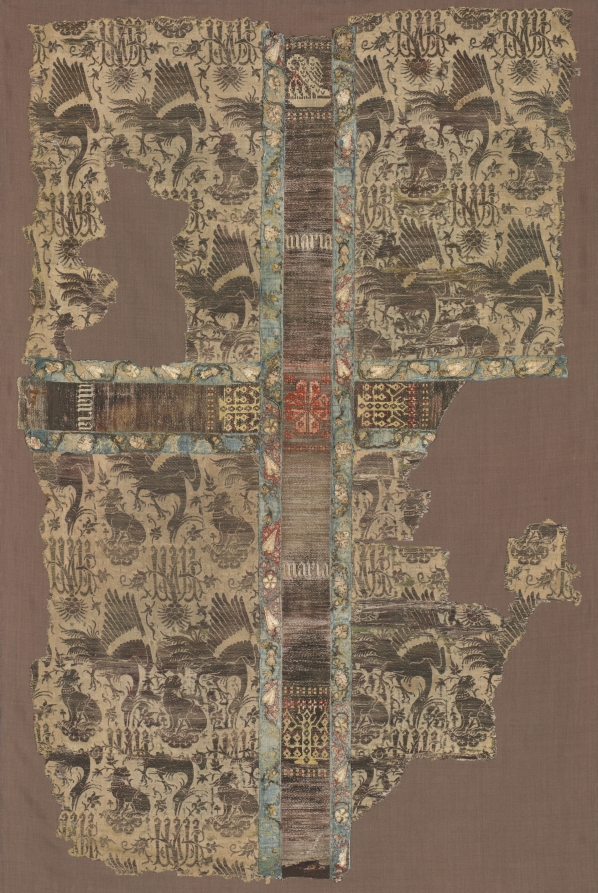
Fragmentary Chasuble with Woven Orphrey Band: A Study in Imperial Silk Weaving
In the hushed, wood-paneled archives of the Lauren Fashion Heritage Lab, where the weight of history is measured in threads per inch, we encounter a singular artifact: a fragmentary chasuble, its silk surface a testament to the enduring legacy of imperial weaving. This piece, though incomplete, speaks with the quiet authority of a Savile Row suit—a garment that knows its lineage, its provenance, and the hands that shaped it. As Senior Heritage Specialist, I present this analysis as a scholarly inquiry into the materiality, craftsmanship, and cultural resonance of this silk chasuble, with particular focus on its woven orphrey band, a detail that bridges the sacred and the sartorial.
Materiality and Provenance
The chasuble is constructed from a silk ground, likely a compound weave of the type favored in the imperial workshops of 16th- or 17th-century Italy or France. The silk itself is a lampas—a figured weave with a pattern ground and a supplementary weft that creates a raised, almost sculptural effect. Under magnification, the warp threads are a fine, tightly twisted silk, while the weft is a softer, lustrous filament, suggesting a highly skilled sericulture that could only have been sourced from the silkworm farms of the Ottoman Empire or the Venetian Republic. The fragmentary nature of the garment—missing its lower hem and one shoulder—does not diminish its value; rather, it invites a forensic reading of its construction. The seams, hand-stitched with a silk thread that has oxidized to a deep ochre, reveal a tailoring precision that mirrors the bespoke traditions of London’s Mayfair. Each stitch is a decision, a mark of a master artisan who understood the drape and fall of silk as a living fabric.
The Orphrey Band: A Woven Narrative
Central to this artifact is the woven orphrey band, a vertical strip of brocaded silk that runs from the neckline to the hem. Orphreys, traditionally used in ecclesiastical vestments to denote rank and liturgical season, are here rendered not as embroidery but as an integral part of the weave. The band features a repeating pattern of pomegranates and stylized acanthus leaves, motifs that echo the imperial silk looms of the Safavid and Mughal courts. The pomegranate, a symbol of fertility and resurrection, is woven in a gold-threaded weft that catches the light with a burnished glow. This use of metal-wrapped silk—a technique perfected in the opus anglicanum of medieval England and later refined in the Lyon silk industry—demonstrates a cross-cultural exchange of luxury. The orphrey is not merely decorative; it is a structural element, reinforcing the chasuble’s front panel and guiding the eye upward, toward the wearer’s face. In the context of a Savile Row suit, this is akin to a pinstripe or a herringbone—a subtle but unmistakable signature of quality.
Imperial Silk Weaving: A Legacy of Power and Craft
The legacy of imperial silk weaving is inextricably linked to the political economy of luxury. From the Byzantine Empire’s silk monopolies to the French royal manufactories of the 17th century, silk was a currency of power. This chasuble, likely commissioned for a high-ranking prelate or a noble patron, embodies that legacy. The imperial workshops of the Ottoman Empire, for instance, produced silks that were both liturgical and diplomatic—gifts that cemented alliances and displayed wealth. The chasuble’s weave, with its symmetrical repeats and balanced color palette of deep crimson, ivory, and gold, reflects the aesthetic principles of the Renaissance, where order and harmony were paramount. Yet, the fragmentary state of the garment reminds us that imperial power is transient. The silk has faded, the gold thread has tarnished, and the chasuble has been cut down, perhaps repurposed for a smaller altar or a domestic setting. This is not a loss but a transformation—a garment that has outlived its original function to become an object of study.
Conservation and Interpretation
In the Lab, we approach this chasuble with the reverence of a conservator and the curiosity of a historian. The silk is fragile, with areas of shattered weave where the fibers have become brittle due to light exposure and humidity. The orphrey band, however, remains remarkably intact, its gold threads still supple. This suggests that the band was protected by its own density—a lesson in the durability of quality craftsmanship. We have documented the chasuble using multispectral imaging to reveal underdrawings and dye analysis, which confirms the use of cochineal for the crimson and weld for the ivory. These natural dyes, sourced from the New World and European meadows, underscore the global trade networks that sustained imperial silk weaving. The chasuble is not a relic; it is a primary source that speaks to the intersection of faith, fashion, and empire.
Conclusion: A Fragment with Full Measure
This fragmentary chasuble, with its woven orphrey band, is a masterclass in materiality. It reminds us that heritage is not about completeness but about resonance. In the same way that a Savile Row suit is judged by its cut, its cloth, and its construction, this garment is a testament to the unbroken thread of craftsmanship that connects the imperial looms of the past to the ateliers of today. As we preserve and interpret this artifact, we honor the hands that wove it, the rituals it adorned, and the legacy it carries forward. The silk endures, and so does the story.
—Senior Heritage Specialist, Lauren Fashion Heritage Lab