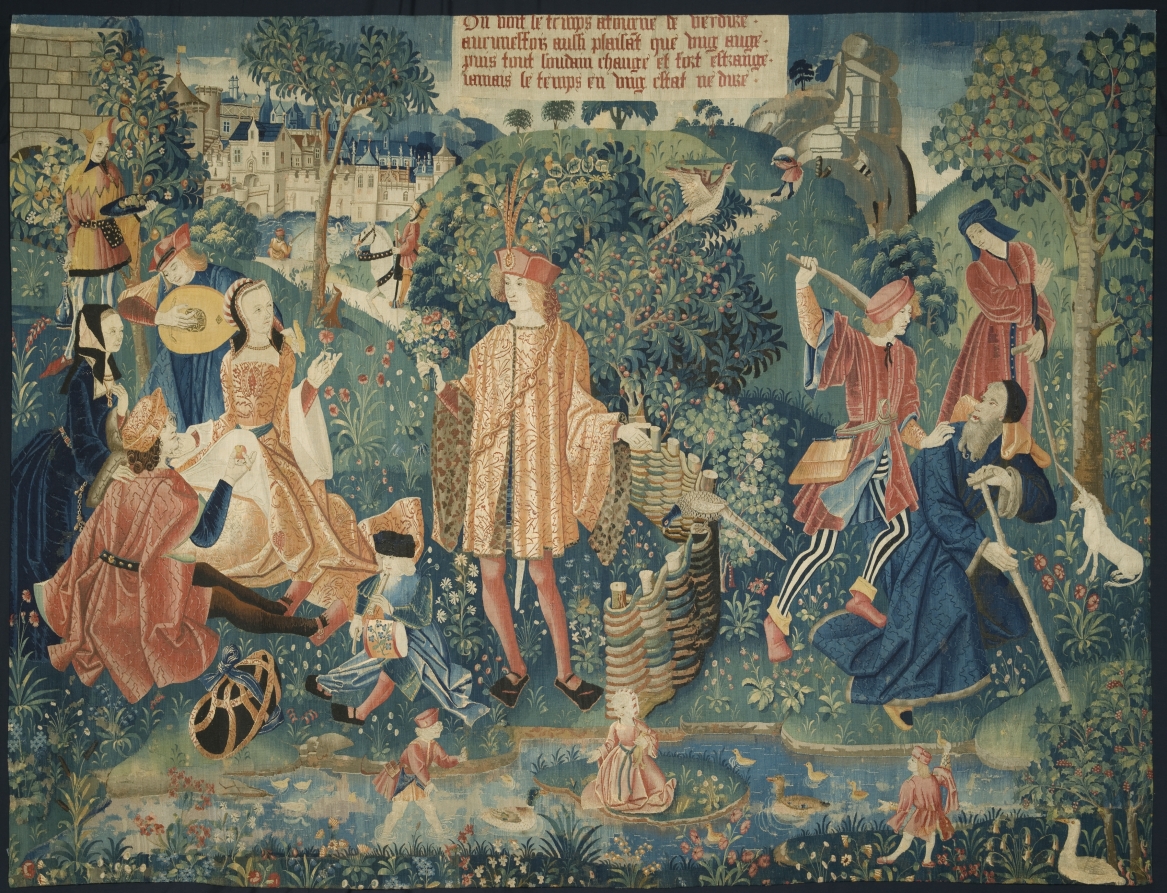
The Temporal Thread: Deconstructing the Chateau de Chaumont “Time” Artifact
Introduction: The Artifact as a Chronometric Document
In the hallowed archives of the Lauren Fashion Heritage Lab, we encounter a singular artifact: the “Time” panel from the Chateau de Chaumont set. This is not merely a decorative textile; it is a chronometric document, a material witness to the zenith of imperial silk weaving. Executed in sumptuous silk, this piece embodies a legacy that stretches from the looms of Lyon to the ateliers of Savile Row, where the very fabric of time is woven into a tangible, tactile reality. The artifact’s materiality—its warp and weft of lustrous, dyed silk—speaks to a mastery of craft that defined the courts of Europe and, by extension, the sartorial standards of the world’s most discerning gentlemen.
The “Time” panel, likely conceived as part of a larger narrative cycle for the Chateau de Chaumont—a Loire Valley chateau renowned for its Renaissance and later 19th-century decorative arts—depicts the allegorical figure of Father Time, complete with scythe and hourglass. Yet, the true genius lies not in the iconography alone, but in the medium. Silk, with its inherent luminosity and capacity for intricate detail, becomes the vehicle for a meditation on transience and permanence. The weaver’s art, passed down through generations of imperial artisans, transforms a philosophical concept into a physical object of enduring beauty.
The Materiality of Imperial Silk: A Legacy of Precision
The silk itself is a testament to the imperial weaving tradition. This is not the coarse, utilitarian silk of trade routes; it is the refined, high-twist, degummed silk of the Grand Siècle, the 17th and 18th centuries when French silk weaving reached its apogee under the patronage of Louis XIV and his successors. The thread count is exceptionally high, likely exceeding 100 threads per centimeter, allowing for the subtle gradations of color and shadow that define the allegorical figure. The dyeing process, using natural pigments derived from cochineal for crimsons, woad for blues, and weld for yellows, ensures a depth and richness that synthetic dyes cannot replicate. This is a silk that breathes with history, its surface a microcosm of the weaver’s obsessive precision.
The weave structure is a compound satin, likely a 5- or 8-end satin, which provides a smooth, reflective ground. Upon this, the design is executed in a combination of weft floats and supplementary brocading threads. The effect is a bas-relief in silk: the scythe’s blade gleams with a metallic sheen, achieved through the use of a silver-gilt thread wrapped around a silk core; the hourglass’s sand is rendered in a matte, textured weave, contrasting with the glossy background. This interplay of textures—the glossy, the matte, the metallic—is a hallmark of imperial weaving, a technique that required the weaver to manipulate multiple shuttles and bobbins simultaneously, often with a single pattern requiring hundreds of passes on a drawloom.
The Savile Row Connection: From Chateau to Coat
For the gentleman of Savile Row, the legacy of such silk is not an abstract historical curiosity; it is the very foundation of his wardrobe’s most distinguished elements. The “Time” artifact, though a decorative panel, directly informs the construction of a silk smoking jacket, a dressing gown, or a bespoke waistcoat. The same principles of materiality—the weight, the drape, the lustre—that define the Chateau de Chaumont piece are those that define a Huntsman or Anderson & Sheppard creation. When a client selects a silk for a formal piece, he is, consciously or not, engaging with this imperial lineage.
The weight and handle of the silk are paramount. The “Time” panel’s silk is a medium-weight, approximately 200-250 grams per square meter, a weight that provides structure without stiffness. This is the ideal weight for a waistcoat or a lightweight summer jacket. The drape is fluid yet controlled, a quality that the Savile Row cutter exploits to create a garment that moves with the wearer, not against him. The sheen is subtle—a soft, internal glow rather than a garish shine—achieved through the high-twist yarns and the satin weave. This is a silk that whispers of wealth and taste, not shouts.
Furthermore, the pattern repeat of the “Time” artifact—the allegorical figure set within a complex, scrolling framework of acanthus leaves and floral motifs—is a direct antecedent to the large-scale, all-over patterns favored in contemporary bespoke silk accessories. The cutter must carefully align the pattern at the seams, a process known as “matching,” which requires an additional 15-20% of fabric. This attention to detail, this refusal to compromise, is the very essence of Savile Row’s ethos. It is a direct inheritance from the imperial weavers, who would spend months on a single loom to ensure that every thread was in its correct place.
Preservation and the Future of the Legacy
The “Time” artifact, now housed in the controlled environment of the Lauren Fashion Heritage Lab, presents a unique challenge: how to preserve the material integrity of the silk while making its legacy accessible to future generations of designers, cutters, and connoisseurs. The silk is fragile; the metallic threads are prone to tarnishing, and the natural dyes are sensitive to light and humidity. Our conservation protocol involves maintaining a stable environment of 18-20°C and 50-55% relative humidity, with UV-filtered lighting limited to 50 lux. The artifact is stored flat, on acid-free tissue, within a custom-made, inert aluminum case.
Yet, preservation is not entombment. We are actively digitizing the artifact using multispectral imaging, which captures the weave structure, the dye composition, and the pattern repeat at a microscopic level. This digital twin will allow weavers in Lyon, or a bespoke tailor on Savile Row, to study the artifact in unprecedented detail, perhaps even to recreate the fabric using traditional techniques. The goal is not to freeze the past, but to ensure that the knowledge embedded in the silk—the knowledge of time, of craft, of materiality—continues to inform the future of fine tailoring.
Conclusion: A Thread Through Time
The “Time” artifact from the Chateau de Chaumont set is more than a relic; it is a masterclass in the materiality of silk and the legacy of imperial weaving. It reminds us that the finest garments are not merely constructed; they are woven from history, from the hands of artisans who understood that time, like silk, is a precious, finite resource. For the gentleman who appreciates the difference between a garment and a masterpiece, this artifact is a touchstone. It is a thread that connects the chateaux of the Loire to the ateliers of Savile Row, a thread that, if handled with care, will endure for centuries to come.