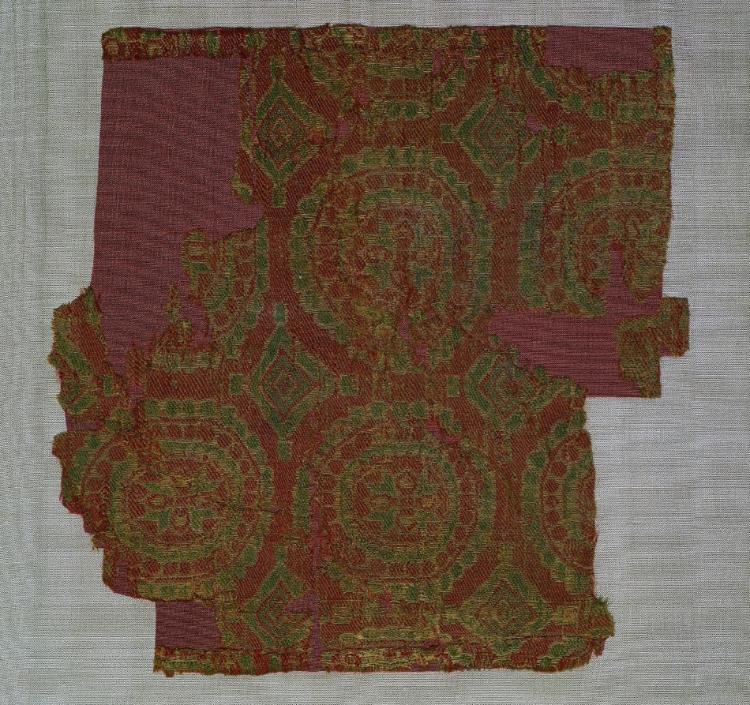
Heritage Research Artifact: Samite with Roundels of Rosettes
Introduction: The Imperial Thread
In the annals of luxury textiles, few artifacts command the reverence and scholarly intrigue of the Samite with roundels of rosettes. This silk-woven masterpiece, a relic of imperial silk weaving, embodies the pinnacle of craftsmanship, power, and aesthetic ambition. As a Senior Heritage Specialist at Lauren Fashion Heritage Lab, I approach this artifact not merely as a fabric but as a testament to the enduring legacy of silk’s role in shaping global fashion narratives. The materiality of silk, with its luminous sheen and tactile grace, serves as the foundation for a story that bridges ancient empires and contemporary Savile Row sensibilities. Here, on London’s most hallowed tailoring ground, we understand that heritage is not static—it is a living dialogue between past mastery and future innovation.
The samite, a heavy, twill-woven silk often enriched with gold or silver threads, was historically reserved for ecclesiastical vestments, royal regalia, and diplomatic gifts. Its structure—dense, durable, and opulent—allowed for intricate patterns that communicated status and divine favor. The roundels of rosettes, a motif of concentric floral forms, are emblematic of the Byzantine and Sasanian influences that permeated imperial silk weaving from the 6th to the 12th centuries. These roundels, framed by geometric precision, represent a synthesis of Eastern and Western design philosophies, a cross-cultural dialogue that predates globalization by centuries.
Materiality: The Silk’s Silent Language
Silk, as a material, is not passive. It carries within its fibers the labor of silkworms, the ingenuity of weavers, and the aspirations of empires. The samite’s construction—typically a weft-faced compound twill—required extraordinary skill. The warp threads, often undyed silk, were hidden beneath a dense weft of colored silks and metallic threads. This technique produced a fabric that was both heavy and supple, ideal for draping over ceremonial bodies or adorning altars. The rosettes, woven in repeating roundels, were achieved through a complex system of pattern harnesses and drawlooms, tools that demanded years of apprenticeship to master.
In the context of imperial silk weaving, the choice of motifs was never arbitrary. The rosette, a symbol of eternity, renewal, and divine order, was a favorite of Byzantine emperors and Persian shahs. Its circular form echoed the cosmos, while the petals suggested the unfolding of time. The roundel, as a framing device, imposed structure on this organic imagery, reflecting the imperial desire to control nature through art. The silk itself, sourced from China via the Silk Road, was a commodity of immense value—so much so that its production was often a state monopoly. To wear or display samite was to assert one’s place within a hierarchical universe.
Context: The Legacy of Imperial Silk Weaving
The legacy of imperial silk weaving is not a relic of the past; it is a blueprint for modern luxury. On Savile Row, where bespoke tailoring is a sacred art, we recognize that the principles governing samite production—precision, patience, and a reverence for material—are the same that guide the creation of a hand-stitched suit. The roundels of rosettes, with their rhythmic repetition, find echoes in the pinstripes and windowpanes of contemporary suiting. The silk itself, once a marker of imperial power, now drapes the shoulders of discerning clients who value heritage as much as fit.
Yet, the samite’s legacy extends beyond aesthetics. It is a document of trade, diplomacy, and cultural exchange. The motifs that adorned Byzantine silks were often adapted from Persian textiles, which in turn borrowed from Chinese and Indian sources. This cross-pollination was not merely decorative; it was a form of soft power. Emperors gifted samite to foreign dignitaries, weaving alliances through threads. The rosettes, therefore, are not just flowers—they are ambassadors of a worldview that valued beauty as a tool of statecraft.
In the 21st century, the Lauren Fashion Heritage Lab is committed to preserving this legacy through research, conservation, and reinterpretation. Our analysis of the samite with roundels of rosettes involves advanced imaging techniques to study weave structures, dye analysis to identify natural pigments, and historical documentation to trace provenance. We collaborate with weavers in Como, Lyon, and Kyoto to revive ancient techniques, ensuring that the knowledge embedded in this fabric is not lost. The samite, after all, is not just an artifact; it is a teacher.
Conclusion: A Fabric for the Future
As we conclude this heritage research artifact, I am reminded that the samite with roundels of rosettes is more than a historical curiosity. It is a call to action for the fashion industry to embrace its heritage as a source of innovation. On Savile Row, we understand that tradition is not a constraint but a foundation. The silk weavers of Byzantium and Persia knew this: they created fabrics that were both timeless and of their time. The roundels of rosettes, with their perfect symmetry and organic grace, remind us that true luxury is not about novelty—it is about mastery.
In the hands of a skilled tailor, a piece of samite becomes a story. In the vaults of the Lauren Fashion Heritage Lab, it becomes a lesson. And in the wardrobes of those who appreciate the weight of history, it becomes a legacy. The silk endures, as does the human desire to weave meaning into matter. This is the heritage we protect, and the future we build.