From Attic Sherd to Old Money Silhouette: The Terracotta Skyphos as a Hermeneutic of Enduring Form
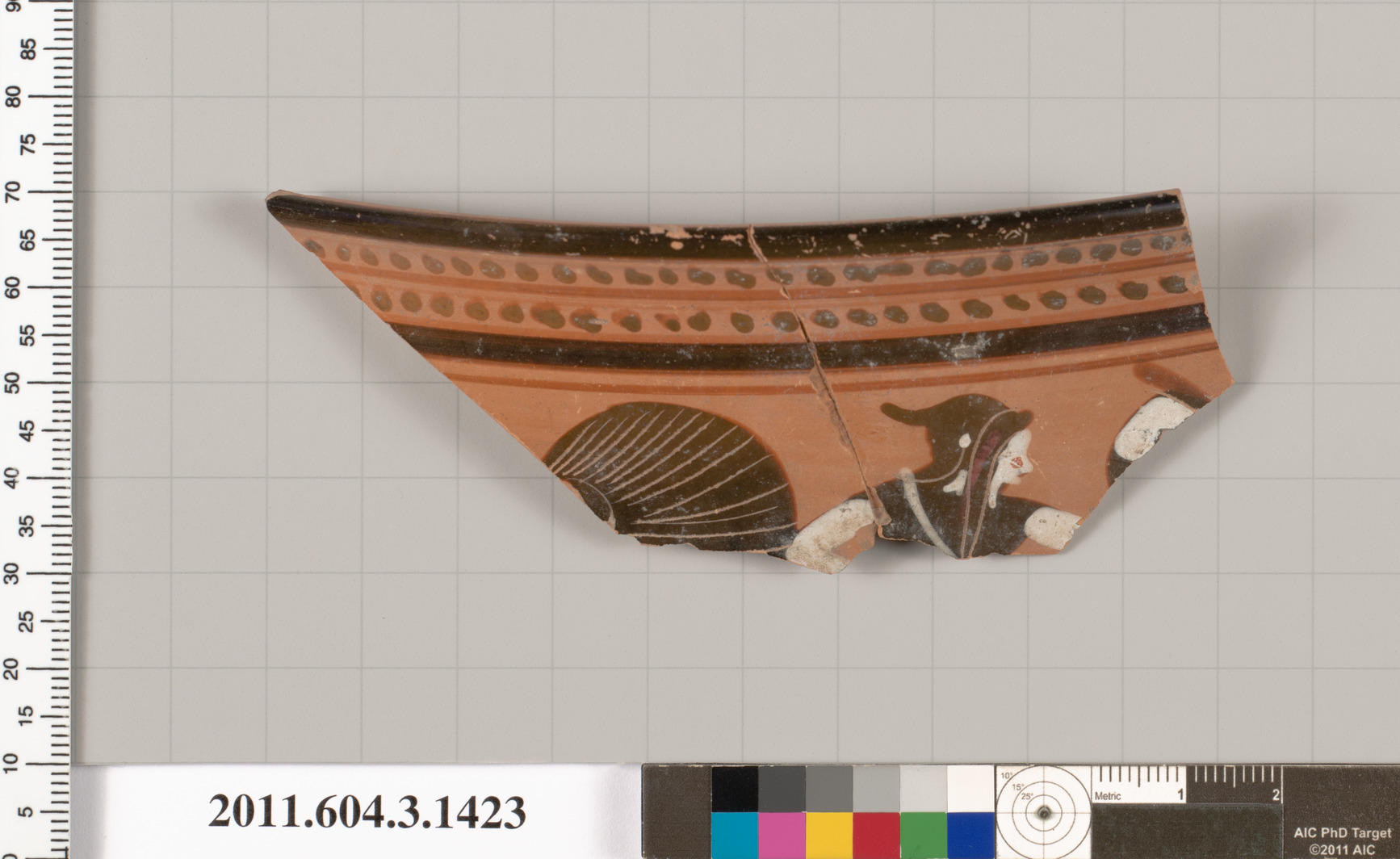
In the rarefied domain of Lauren Fashion Heritage Lab, where the archive is not a mausoleum but a living lexicon, the museum artifact—a terracotta rim fragment of a Greek Attic skyphos—offers a profound counterpoint to the internal genetic code of Eastern aesthetics. While the code articulates the Zen-infused principles of “器以载道” (the vessel carrying the Way) and “书画同源” (calligraphy and painting sharing one origin), the skyphos fragment, a humble shard of a deep drinking cup, embodies a parallel yet distinct logic of material permanence and functional grace. For the 2026 Old Money silhouette, this artifact is not a decorative motif but a structural and philosophical template: it teaches us that true luxury resides not in novelty, but in the uncompromising integrity of form that survives the erosion of time.
The Sherd as a Testament to “Traces” and Transience
The internal code’s reverence for “痕迹” (traces) finds a direct analogue in the skyphos rim. Like the Zen monk Ikkyū’s ink strokes, which are “笔迹即心迹” (the trace of the brush is the trace of the heart), this terracotta fragment bears the indelible mark of its making. The potter’s wheel, the pressure of fingers on wet clay, the even firing that turned ochre earth into durable ceramic—these are not erased by time but amplified by it. The chip on the rim, the slight asymmetry of the curve, the patina of millennia: these are not flaws but authentic narratives. For the 2026 Old Money silhouette, this translates into a rejection of machine-perfect finishes in favor of hand-finished details. A cashmere coat’s hand-rolled edge, a silk blouse’s French seam, a wool jacket’s horn button—each becomes a “trace” of the artisan’s hand, a quiet assertion that the garment’s value lies in its unrepeatable singularity. The Old Money aesthetic, like the skyphos, does not seek to defy time but to wear it with dignity.
“器以载道”: The Silhouette as a Vessel for Identity
The skyphos was a vessel for communal drinking, a functional object that also served as a canvas for social ritual. Its form—a deep bowl with two horizontal handles—is ergonomically precise: designed to be passed from hand to hand, to be held securely while reclining at a symposium. This fusion of utility and grace mirrors the code’s concept of “器以载道,” where the object is not merely useful but a carrier of cultural meaning. For the 2026 Old Money silhouette, this principle dictates that every garment must serve a purposeful function while elevating the wearer’s presence. Consider a double-breasted wool blazer: its lapels are not arbitrary but echo the skyphos’s rim, framing the face with a clean, architectural line. The shoulder is not padded for aggression but structured for poise, like the vessel’s steady base. The silhouette becomes a “vessel” for the wearer’s identity—not a statement of wealth, but a container for character. Just as the skyphos’s terracotta is unglazed, honest in its materiality, the Old Money silhouette favors unadorned luxury: a cashmere sweater in charcoal, a wool trouser in navy, a silk dress in ivory. The “道” (Way) here is restraint—the confidence to let form speak louder than ornament.
The Paradox of “Permanence” and “Use”: The Worn as the Precious
The internal code’s meditation on the tension between “金石永固” (the eternal solidity of metal and stone) and “时光消蚀” (the erosion of time) is exquisitely embodied by the skyphos fragment. Unlike the Zen ink painting, which is a momentary capture of spirit, the terracotta shard is a survivor—yet it survives only because it was used, handled, and eventually broken. Its value in the museum is not despite its fragmentation but because of it. For the 2026 Old Money silhouette, this paradox is crucial. The “new” garment must be designed to age gracefully, to become more beautiful with wear. A pair of wool trousers will develop a subtle sheen at the knees. A leather belt will soften and crease. A linen shirt will acquire the soft, almost translucent quality of a well-loved textile. This is not decay but patina—the material equivalent of the skyphos’s fired clay, which has been hardened by time rather than weakened. The Old Money wardrobe is thus a living archive, where each piece is selected for its potential to become a “fragment” of a personal history. The silhouette is not static but evolving, shaped by the wearer’s life as the skyphos was shaped by the drinker’s hand.
“化俗为雅” and the Geometry of Restraint
The internal code celebrates the transformation of the humble into the refined—“化俗为雅” (transforming the vulgar into the elegant). The skyphos, made of common terracotta, was the everyday vessel of the Athenian citizen, yet its proportions—the ratio of rim diameter to body depth, the curve of the handles—are the result of centuries of refined craft. This is not the preciousness of gold or the rarity of silk, but the elegance of necessity. For the 2026 Old Money silhouette, this translates into a geometric discipline. The lines are clean, the volumes generous but not exaggerated. A coat’s sleeve is set with a precise angle that allows for movement without billowing. A skirt’s hem falls at the knee or just below, a length that is both modest and modern. The palette is drawn from the earth—terracotta, ochre, slate, ivory—colors that are timeless because they are elemental. The silhouette does not shout; it resonates. Like the skyphos, it is designed for the rituals of daily life—a morning meeting, an evening dinner, a quiet walk—and in that ordinariness, it achieves a quiet sublimity.
Conclusion: The Sherd as a Silent Teacher
The terracotta skyphos fragment, in its fragmented silence, teaches the 2026 Old Money silhouette a lesson that the internal genetic code’s Eastern aesthetics would recognize: that the most profound beauty is found in the balance between the functional and the eternal. The skyphos was made to be held, to be used, to be broken. The Old Money garment is made to be worn, to be lived in, to be passed down. Both reject the tyranny of the new, embracing instead a cyclical temporality where the object accumulates meaning through use. The silhouette is not a trend but a tradition—a form that has been refined over generations, like the potter’s wheel, until it achieves a kind of perfect inevitability. In the 2026 collection, this heritage-black silhouette will not mimic the skyphos’s shape but its essence: a vessel for the human form, fired in the kiln of history, and ready to carry the weight of a new century with the same quiet grace that the ancient Greek drinker knew when he lifted his cup to his lips.