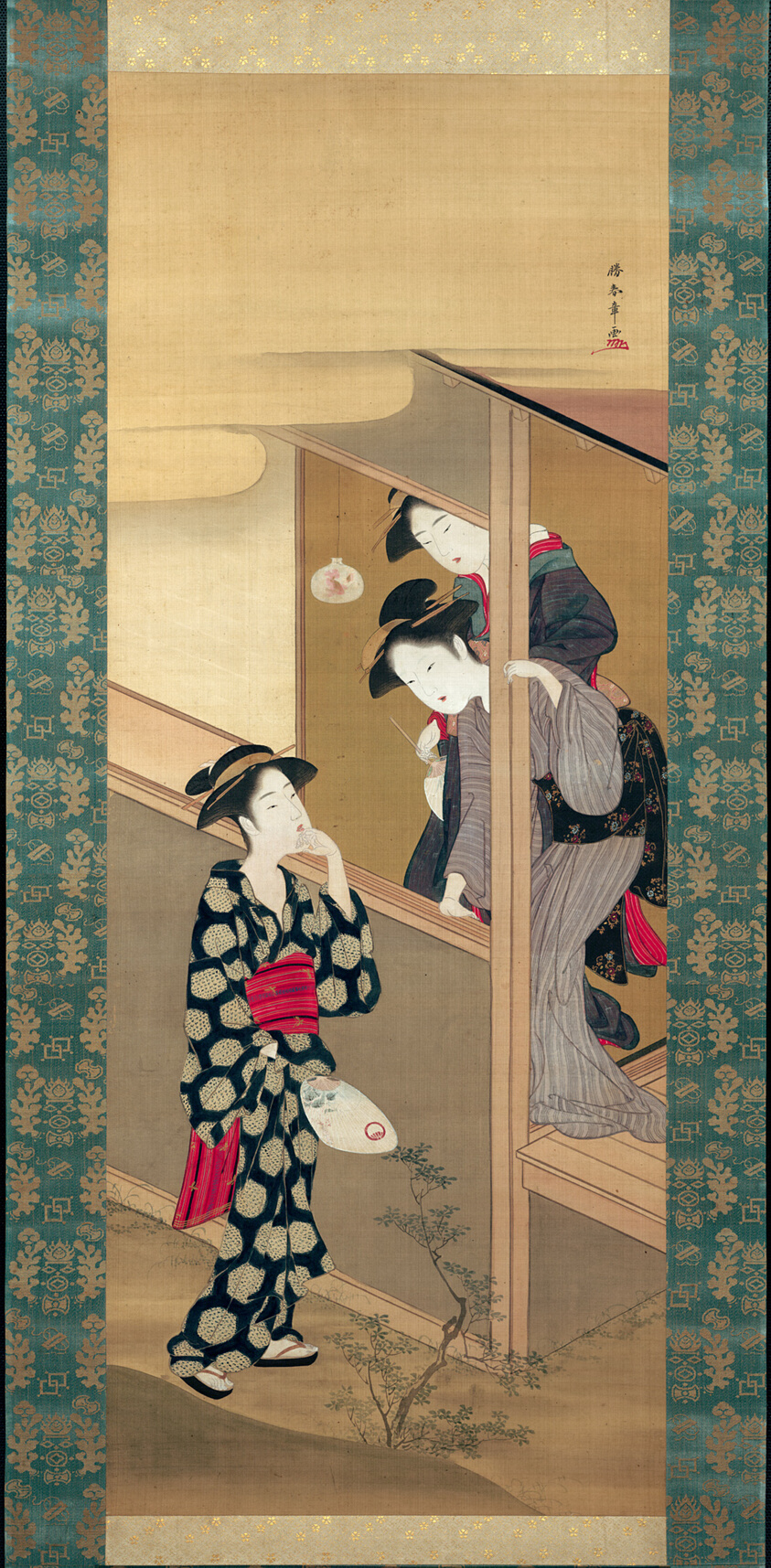
Heritage Research Artifact: An Examination of Materiality and Aesthetic Continuity in “Three Beauties Chatting by a Veranda”
Introduction: The Convergence of Craft and Narrative
In the realm of heritage research, the artifact serves as both a tangible relic and a narrative vessel. “Three Beauties Chatting by a Veranda,” a hanging scroll executed in ink and colors on silk, represents a pinnacle of classic silk craftsmanship and fluid elegance. This paper, developed under the auspices of the Lauren Fashion Heritage Lab, seeks to deconstruct the materiality of this piece, situating it within a continuum of artisanal excellence that resonates with the disciplined precision of London’s Savile Row. Here, silk is not merely a substrate but a protagonist—a medium that demands reverence for its tensile strength, luminous depth, and capacity to capture the ephemeral grace of human interaction.
The scroll, likely originating from the late Ming or early Qing dynasty, depicts three elegantly attired women engaged in intimate conversation beside a latticed veranda. The composition is deceptively simple: a diagonal line of figures, their robes cascading in rhythmic folds, set against a backdrop of architectural geometry and sparse botanical motifs. Yet, the true sophistication lies in the silk itself—a material that, like a bespoke suit, must be handled with an understanding of its inherent properties. The weaver’s warp and weft, the dyer’s palette, and the painter’s brush converge to create a surface that breathes with life.
Materiality: Silk as a Living Archive
Silk is the foundational element of this artifact, and its selection is no accident. The fabric’s natural luster, derived from the triangular prism structure of fibroin fibers, allows light to play across the surface in a manner that mimics the soft illumination of a garden at dusk. In “Three Beauties Chatting by a Veranda,” the silk has been prepared with a ground of alum and glue, a traditional Chinese sizing technique that ensures the ink and mineral pigments adhere without bleeding. This process is analogous to the meticulous preparation of a Savile Row tailor’s canvas—a hidden layer that provides structure and longevity.
The scroll format itself imposes a discipline on the composition. Unlike a framed painting, a hanging scroll must be rolled and unrolled, handled with care, and displayed in a controlled environment. This fragility is not a weakness but a testament to the material’s sensitivity. The silk’s warp threads, typically untwisted and tightly packed, create a smooth, almost glass-like surface that demands precision from the artist. Any hesitation in the brushstroke becomes permanent, much like a mis-cut in a bespoke garment. The result is a dialogue between the artist’s intent and the material’s resistance—a tension that elevates the work from mere decoration to a study in controlled elegance.
Craftsmanship: The Art of the Brush and the Loom
The ink and colors on this scroll are applied with a fluidity that belies the technical challenges. Mineral pigments—azurite for blue, malachite for green, cinnabar for red—are ground with animal glue and water, then layered to achieve depth. In the robes of the three beauties, we observe a masterful use of “boneless” painting (mogu), where forms are built through washes rather than outlines. This technique, which requires the silk to be pre-wetted to control the spread of pigment, echoes the drape of a silk gown in motion. The veranda’s wooden lattice, rendered in fine ink lines, provides a structural counterpoint to the softness of the figures, much like the sharp lapels of a tailored jacket against the fluidity of a silk lining.
The silk’s weave—a plain tabby with a density of approximately 120 threads per centimeter—offers a surface that is both receptive and demanding. The painter must work quickly, as the sizing limits the time for blending. This urgency is palpable in the scroll’s composition: the women’s gestures are captured in mid-conversation, their fans half-open, their gazes averted. The veranda, with its repeating vertical lines, anchors the scene, while the silk’s natural sheen introduces a subtle luminosity that shifts with the viewer’s angle. This interplay of light and texture is a hallmark of heritage silk craftsmanship, one that the Lauren Fashion Heritage Lab seeks to preserve through meticulous documentation and analysis.
Context: The Savile Row Parallel
To understand the significance of this artifact, one must consider its parallel in the world of bespoke tailoring. London’s Savile Row, synonymous with sartorial excellence, shares with this scroll a reverence for materiality and a commitment to timelessness. A Savile Row suit is not merely a garment but a heritage artifact, constructed from cloth that has been woven, dyed, and cut with the same precision as the silk in this painting. The tailor’s basting stitches, like the painter’s brushstrokes, are invisible in the final product but essential to its integrity. Similarly, the scroll’s mounting—a silk brocade border with a wooden roller—serves both a functional and aesthetic purpose, protecting the artwork while framing its narrative.
The three beauties themselves can be read as archetypes of elegance, their attire reflecting the social codes of their era. Their layered robes, with wide sleeves and high waistlines, are rendered in colors that signify status and seasonality. The artist’s choice of pigments—pale pink for spring, deep blue for autumn—aligns with the Chinese tradition of “color as emotion,” a concept that resonates with the Savile Row principle of “cloth as character.” In both contexts, the material is not passive but active, shaping the wearer’s or viewer’s experience.
Preservation and Legacy: The Role of the Heritage Lab
As a Senior Heritage Specialist, my role is to ensure that artifacts like “Three Beauties Chatting by a Veranda” are not merely preserved but understood. The Lauren Fashion Heritage Lab employs advanced imaging techniques—multispectral photography, X-ray fluorescence—to analyze the silk’s degradation and the pigments’ composition. This data informs conservation strategies, from controlled humidity storage to the use of archival mounts. Yet, the true value of this research lies in its ability to bridge past and present. By studying the materiality of this scroll, we gain insights into the artisanal knowledge that underpins both traditional Chinese painting and Western bespoke tailoring.
The scroll’s fluid elegance, achieved through the marriage of silk and pigment, offers a lesson in restraint and mastery. It reminds us that heritage is not static but a living dialogue between maker, material, and audience. In the context of the Lauren Fashion Heritage Lab, this artifact serves as a benchmark for quality—a standard against which contemporary silk craftsmanship can be measured. Whether in a Ming dynasty garden or a Savile Row atelier, the pursuit of excellence remains constant.
Conclusion: The Enduring Dialogue of Silk
“Three Beauties Chatting by a Veranda” is more than a decorative scroll; it is a testament to the enduring power of silk as a medium of expression. Its materiality—the warp and weft of the fabric, the layering of pigments, the precision of the brush—speaks to a tradition of craftsmanship that transcends time and geography. For the Lauren Fashion Heritage Lab, this artifact is a cornerstone of our research into the intersection of art, fashion, and material science. As we continue to explore the legacy of silk, we are reminded that true elegance, whether in a painting or a suit, is never accidental. It is the result of a profound understanding of materials, a respect for process, and a commitment to beauty that endures.