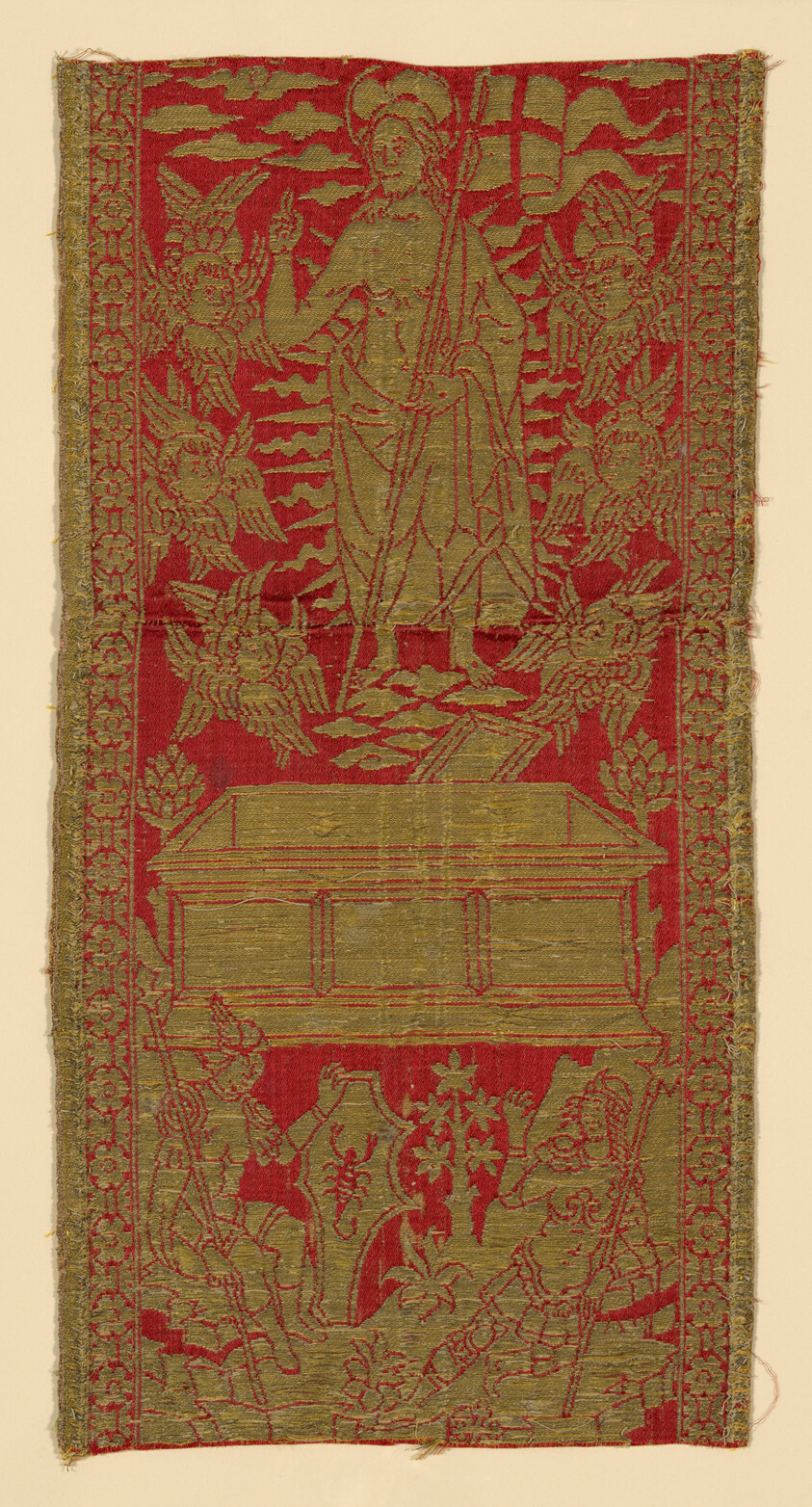
Heritage Research Artifact: Fragment (From an Orphrey Band)
Materiality and Provenance
This fragment, excised from an orphrey band—a decorative strip adorning ecclesiastical vestments—represents a pinnacle of medieval silk craftsmanship. The materiality is defined by silk and gilt-animal-substrate-wrapped linen, a composite that speaks to both opulence and structural integrity. The weave structure is a warp-float faced 4:1 satin weave, a technique that prioritizes a lustrous, fluid surface by allowing warp threads to dominate the face, interrupted only by twill interlacings of secondary binding warps. These interlacings, paired with supplementary patterning wefts, introduce geometric and figural motifs, creating a tactile interplay of light and shadow. The gilt-animal-substrate wrapping—likely gold leaf adhered to a membrane derived from animal gut or parchment—wound around linen cores, imparts a metallic sheen that has endured centuries, albeit with subtle tarnishing that reveals the organic base beneath.
Such fragments, often recovered from burial sites or cathedral treasuries, were integral to liturgical garments like chasubles or copes. The orphrey band, typically positioned along the center or edges, served as a visual anchor, framing the wearer’s form with hierarchical symbolism. This particular fragment, with its refined satin ground and restrained palette of crimson, gold, and ivory, suggests a late Gothic or early Renaissance provenance, possibly from Italian or Iberian workshops where silk weaving flourished under guild patronage. The fluid elegance of the satin weave, combined with the rigid precision of the twill bindings, mirrors the duality of ecclesiastical authority: divine grace channeled through earthly craft.
Technical Execution and Craftsmanship
The warp-float faced 4:1 satin weave is a masterclass in tension management. In a standard satin, warp threads float over four wefts before interlacing, creating a smooth, unbroken surface. Here, the secondary binding warps introduce a twill structure—a diagonal ribbing—that stabilizes the fabric without compromising its sheen. This hybrid technique, known as lampas or taqueté in historical texts, allowed weavers to embed complex patterns while maintaining drape. The supplementary patterning wefts, often of thicker silk or gilt thread, were inserted manually, requiring precise coordination between the loom’s harnesses and the weaver’s hand. The result is a textile that feels both weighty and airy, a paradox achieved through the interplay of dense warps and selective weft floats.
From a conservation perspective, the gilt-animal-substrate-wrapped linen presents unique challenges. The substrate, typically vellum or fish bladder, is hygroscopic, expanding and contracting with humidity. Over time, this can cause the gilt layer to flake, exposing the linen core. The silk, meanwhile, is susceptible to photodegradation, losing its tensile strength if exposed to ultraviolet light. This fragment’s survival suggests careful storage—perhaps in a reliquary or dark sacristy—where temperature and light were controlled. The twill interlacings, while structurally robust, have created localized wear where the binding warps intersect, forming subtle ridges that now serve as tactile evidence of the original weaving process.
Historical and Cultural Context
Orphrey bands were not merely decorative; they were narrative devices. In ecclesiastical settings, they depicted saints, biblical scenes, or heraldic symbols, reinforcing the liturgy’s didactic purpose. This fragment, though devoid of figural imagery due to its partial state, retains a geometric border—possibly a stylized vine or interlace—that echoes Romanesque manuscript illumination. The fluid elegance of the satin ground, however, suggests a shift toward the naturalism of the Gothic period, where textiles began to emulate the drape of classical drapery. This tension between rigid pattern and organic flow reflects broader cultural currents: the Church’s embrace of sensory richness as a conduit for spiritual transcendence, even as it condemned worldly excess.
In the context of Savile Row, where tailoring is an exercise in restraint and precision, this fragment offers a counterpoint. The orphrey band’s function was to ornament, not to construct; it was applied as a finishing touch, much like a bespoke lapel or pocket square. Yet its materiality—the gilt thread, the satin weave—demands the same reverence for technique that defines a Huntsman jacket or a Dege & Skinner morning coat. The weaver’s mastery of tension, the dyer’s control of color, the conservator’s stewardship of decay: these are the unspoken dialogues between artisan and artifact.
Preservation and Legacy
Today, this fragment resides in a climate-controlled archive, mounted on a pH-neutral backing to prevent further degradation. Its warp-float faced 4:1 satin weave is studied by textile historians and conservators alike, who use it as a benchmark for understanding medieval weaving technologies. The gilt-animal-substrate wrapping, once a symbol of divine light, now serves as a marker of material science—a reminder that even the most sacred objects are subject to entropy. For the Lauren Fashion Heritage Lab, this fragment is not a relic but a resource: it informs the development of sustainable silk alternatives, the revival of historical weave structures, and the training of artisans in techniques that predate industrialization.
In the lexicon of Savile Row, where heritage is both a commodity and a creed, this fragment embodies the fluid elegance that transcends time. It is a testament to the fact that true craftsmanship, whether in a 14th-century orphrey or a 21st-century two-piece suit, lies in the marriage of material and intent. The silk may fray, the gilt may tarnish, but the weave—the logic of the loom—endures as a blueprint for excellence.