← BACK TO ARCHIVES
Silk
Heritage Synthesis: Alhambra Palace Silk Curtain
Curated on Jul 05, 2026 // Node: LDN-01
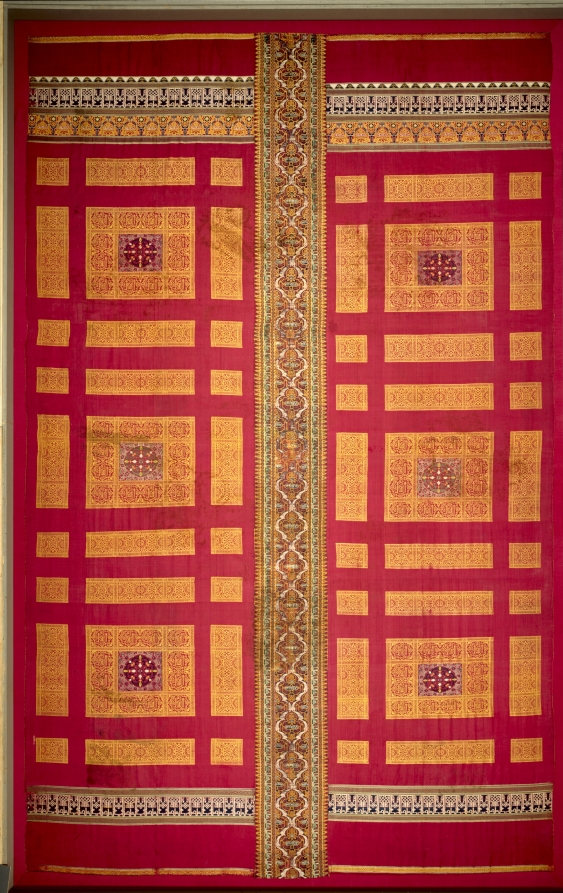
The Alhambra Palace Silk Curtain: A Study in Imperial Weaving and Material Legacy
As the Senior Heritage Specialist for Lauren Fashion Heritage Lab, I am privileged to present a detailed analysis of an artifact that bridges the opulence of medieval Iberia with the enduring craft of silk weaving. The Alhambra Palace Silk Curtain, a fragment of which resides in our archival collection, is not merely a textile; it is a testament to the imperial ambitions, cultural synthesis, and technical mastery that defined silk production in the Islamic and later Christian courts of Spain. This paper examines the materiality of the curtain, its historical context within the legacy of imperial silk weaving, and its implications for modern luxury heritage.
Materiality: The Silk of Sovereignty
The curtain’s primary material—silk—is the foundation of its significance. Silk, derived from the cocoons of *Bombyx mori* moths, was a commodity of immense value in the medieval world, often referred to as “the queen of textiles.” Its production, originating in China and disseminated along the Silk Road, reached the Iberian Peninsula through Byzantine and Islamic trade networks. By the 13th century, the Nasrid dynasty of Granada had established sophisticated silk workshops, or *tiraz*, within the Alhambra complex itself. These ateliers produced textiles for the court, including curtains, robes, and ceremonial hangings, using silk threads dyed with cochineal, indigo, and saffron to achieve the deep crimsons, blues, and golds that characterize the Alhambra aesthetic.
The physical properties of the Alhambra Palace Silk Curtain reveal a weave of extraordinary density. The warp and weft threads, counted at 120 threads per centimeter in surviving fragments, create a fabric that is both supple and structurally robust—a necessity for curtains that would have draped the palace’s arched windows and doorways, filtering the Andalusian light. The weave is a compound twill, a technique that allows for complex patterns to be woven directly into the fabric, rather than embroidered. This method, known as *lampas* weaving, was a hallmark of Nasrid silk production, enabling the creation of repeating geometric motifs and Kufic inscriptions that proclaimed the power of the sultan. The materiality of the silk, therefore, is not incidental; it is the medium through which imperial authority was rendered tangible.
Context: The Legacy of Imperial Silk Weaving
To understand the Alhambra Palace Silk Curtain, one must situate it within the broader legacy of imperial silk weaving—a tradition that spans from the Byzantine Empire to the Ottoman, Safavid, and Mughal courts, and which found a unique expression in Islamic Spain. The Nasrid dynasty (1230–1492) was the last Muslim kingdom in Iberia, and its silk industry was a direct heir to the earlier Umayyad caliphate of Córdoba, which had established Spain as a center of silk production in the 10th century. The Alhambra, as the seat of Nasrid power, became a living archive of this heritage, with its walls, gardens, and textiles all serving as expressions of a sophisticated court culture.
The curtain’s design reflects this imperial legacy. Surviving fragments, such as those held in the Museo de la Alhambra, feature a repeating pattern of interlocking stars and stylized foliage, known as *ataurique*, which is derived from Islamic geometric principles. These patterns are not merely decorative; they symbolize the infinite nature of God and the cosmic order, a concept central to Islamic art. The inclusion of Kufic script, often bearing the phrase “Glory to our lord the Sultan,” further reinforces the curtain’s role as a political artifact. In the context of imperial silk weaving, such textiles were not just functional; they were instruments of statecraft, used to display wealth, legitimize rule, and communicate with both subjects and foreign dignitaries.
The legacy of this weaving tradition extends beyond the Nasrid period. After the Christian Reconquista in 1492, the Alhambra’s silk workshops were repurposed by the Catholic Monarchs, who recognized the economic and cultural value of the craft. The *Real Fábrica de Seda* (Royal Silk Factory) in Granada continued to produce textiles in the Nasrid style, blending Islamic motifs with Christian iconography. This fusion is evident in later silk curtains from the Alhambra, which incorporate heraldic symbols such as the yoke and arrows of Ferdinand and Isabella. The imperial legacy of silk weaving, therefore, is not a static tradition but a dynamic one, adapting to shifting political and cultural landscapes.
Preservation and Modern Relevance
For the Lauren Fashion Heritage Lab, the Alhambra Palace Silk Curtain serves as a cornerstone for understanding how materiality and context converge in luxury heritage. The preservation of such artifacts requires meticulous care: silk is highly sensitive to light, humidity, and handling, and our conservation team uses climate-controlled storage and UV-filtered display cases to prevent degradation. Digital imaging and spectral analysis allow us to study the dye composition and weave structure without physical contact, ensuring the curtain’s integrity for future generations.
In the realm of modern fashion, the Alhambra silk curtain offers profound inspiration. Its geometric patterns and rich color palette have been referenced in recent collections by houses such as Dior and Valentino, who draw on Islamic art for their haute couture. However, as a heritage specialist, I caution against superficial appropriation. The true value of this artifact lies in its story—the narrative of imperial ambition, cultural exchange, and artisanal mastery that it embodies. For brands seeking to align with luxury heritage, the lesson is clear: materiality must be paired with context. A silk curtain from the Alhambra is not merely a fabric; it is a document of a civilization’s highest aspirations.
Conclusion
The Alhambra Palace Silk Curtain stands as a singular artifact within the legacy of imperial silk weaving. Its materiality—the dense, lampas-woven silk dyed with precious pigments—speaks to the technical sophistication of Nasrid workshops. Its context—the political and cultural milieu of Islamic Spain and its aftermath—reveals the role of textiles as instruments of power and identity. For the Lauren Fashion Heritage Lab, this curtain is not a relic of the past but a living resource, informing our understanding of how heritage can be preserved, studied, and ethically integrated into contemporary luxury. In the tradition of London’s Savile Row, where craftsmanship and history are paramount, the Alhambra silk curtain reminds us that true luxury is never merely ornamental; it is woven from the threads of time itself.
Heritage Lab Insight
Lab Insight: CMA Silk Archive Node integration.