An Examination of Avian Motifs in Imperial Silk Weaving
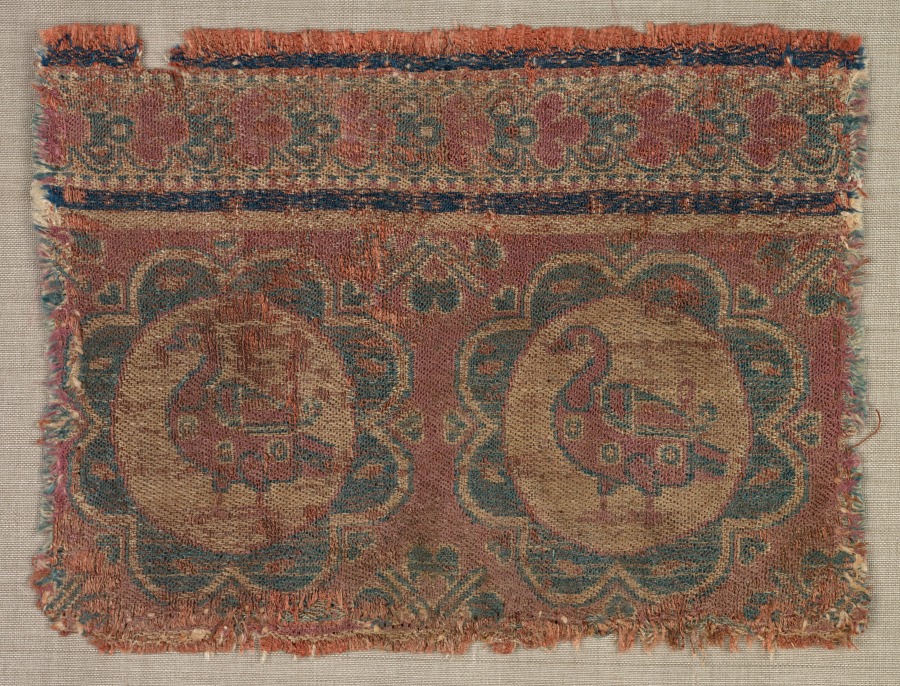
One must approach this fragment with the same considered discernment applied to the cut of a bespoke jacket. Here, the cloth is not English broadcloth, but a silk of formidable technical accomplishment; the pattern not a discreet Glen check, but a declaration of imperial authority and cosmological order. The artefact in question—a silk fragment featuring roundels enclosing ducks—presents not merely as a textile, but as a concentrated essay in material, technique, and symbolic language. Its very existence speaks of a supply chain of the most rarefied kind: state-controlled sericulture, elite ateliers, and a distribution network reserved for the court and its diplomatic largesse. This is, in the purest sense, the power loom of empire made manifest.
The Architecture of the Roundel: Framing the Natural World
The roundel, or medallion, is the foundational grammar of this design. It is a formal device of containment and focus, a conceptual aperture through which the natural world is viewed, ordered, and elevated to the level of emblem. Unlike the fluid, scrolling vines of later aesthetic movements, the roundel imposes a strict geometry. Its circular boundary—often rendered in a linked pearl motif—creates a microcosm, a self-contained universe within the broader field of the cloth. Within this disciplined frame, the pair of ducks is presented not as creatures in random flight, but as a heraldic composition. Their symmetry is deliberate, their poses stylised, transforming ornithological observation into a fixed and repeatable icon. The effect is one of controlled harmony, mirroring the imperial ideal of a well-ordered realm where all elements, including nature, occupy their designated place.
Materiality & Technique: The Uncompromising Substrate
The medium, as ever, is inseparable from the message. The use of silk—specifically, a finely woven compound weave structure, likely a samite or a later lampas—represents the apex of contemporary technology. This was not a fabric born of cottage industry; it was the product of complex draw-looms, operated by teams of highly specialised weavers whose knowledge was a closely guarded state asset. The density of the weave, the precision of the pattern alignment, and the potential introduction of metallic threads within the roundels speak to an operation where time and cost were secondary concerns to the achievement of a flawless, luminous surface. The tactile weight, the subtle sheen that catches the light differently with each movement—these are qualities that immediately communicated status. To wear or bestow such a fabric was to align oneself with the very machinery of state power. It was, in essence, the ultimate luxury fabric, its value intrinsic and unmistakable.
Symbolism of the Duck: A Lexicon of Courtly Virtue
The choice of the duck motif is far from pastoral whimsy. In the symbolic lexicon of the imperial courts from which such silks emanated—be they Byzantine, Sassanian, or Tang Chinese—the duck carried profound connotations. As a creature that navigates seamlessly between the elements of water and air, it often symbolised marital fidelity, conjugal bliss, and prosperous union. Presented in pairs, as they invariably are within these roundels, they become a potent emblem of harmonious partnership, a virtue paramount to dynastic continuity and courtly decorum. Furthermore, in certain contexts, the Mandarin duck in particular became a shorthand for literary refinement and the cultivated appreciation of nature’s beauty—a requisite trait for the enlightened ruler or courtier. Thus, the pattern transcends mere decoration; it weaves a narrative of virtuous governance, personal fidelity, and refined taste directly into the garment’s fibre.
The Legacy in the Modern Atelier
While the imperial workshops are consigned to history, the principles they embodied resonate within the contemporary atelier of the highest calibre. The relentless pursuit of technical perfection in the weave finds its parallel in the precision of a hand-rolled lapel or the invisible integrity of a bespoke buttonhole. The symbolic language, though transformed, persists: a discreet crest, a carefully chosen lining, a specific cloth from a specific mill—all communicate belonging, values, and identity without a word being spoken. The silk fragment teaches us that true luxury lies in this confluence of material integrity, technical mastery, and layered meaning. It reminds the modern purveyor of style that a pattern is never just a pattern; it is a heritage encoded, a statement of intent, and a benchmark of quality that, centuries later, remains impeccably cut.
In conclusion, this fragment of silk, with its roundels of ducks, stands as a testament to a system where aesthetics were inextricably linked to authority. It is a document of controlled beauty, a product of unparalleled technical infrastructure, and a carrier of a sophisticated visual language. To study it is to understand that the most enduring statements in fabric are those where every thread, every motif, and every colour is deployed with deliberate purpose. The legacy of imperial silk weaving is, therefore, not merely one of historical textile production; it is the legacy of understanding cloth as a primary medium for communicating power, order, and identity—a principle that any serious house of style, in any age, would do well to heed.