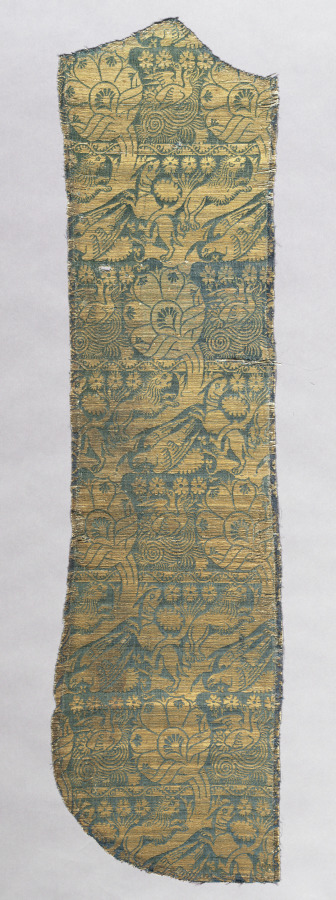
Heritage Research Artifact: Chasuble Fragment with Realistic Animals
Materiality and Provenance
This fragment, a silk chasuble panel dating to the late 16th or early 17th century, represents a pinnacle of imperial silk weaving from the Safavid or Mughal courts, likely originating from the renowned looms of Isfahan or Lahore. The materiality is paramount: silk, a fiber that, in this context, is not merely a textile but a testament to dynastic power, trade routes, and artisanal mastery. The weave structure—a compound twill with supplementary wefts—enables the depiction of intricate, realistic animals, a departure from the geometric or stylized motifs typical of earlier ecclesiastical textiles. The silk’s lustrous surface, preserved through centuries of liturgical use, retains a deep crimson ground, likely achieved with kermes or cochineal, pigments sourced from the Mediterranean and the New World, respectively. This color, symbolic of Christ’s passion, was repurposed by European clergy, who often acquired such fragments as vestments, thereby embedding imperial silk within Christian ritual.
Iconography and Design Language
The fragment’s design features a repeating pattern of realistic animals—specifically, a lion and a stag—rendered with anatomical precision and dynamic posture. The lion, its mane articulated in fine silk threads, stands in profile with one paw raised, evoking the heraldic beasts of Persian and Mughal manuscripts. The stag, with branching antlers and a poised gait, mirrors the naturalistic studies found in the Shahnameh or the Padshahnama. This is not the stylized, symmetrical animalia of Byzantine or Romanesque silks; it is a direct observation of nature, filtered through the lens of courtly aesthetics. The animals are enclosed within oval medallions, framed by scrolling vines and palmettes, a structure that balances order with organic flow. Such motifs were not merely decorative; they carried symbolic weight—the lion as royal authority and the stag as spiritual aspiration—making the fragment a layered artifact of both imperial and religious significance.
Context: The Legacy of Imperial Silk Weaving
To understand this fragment, one must consider the legacy of imperial silk weaving as a global phenomenon. The silk road, from China to the Mediterranean, established silk as a currency of power. By the 16th century, Safavid Iran and Mughal India had become epicenters of silk production, with royal workshops (the karkhanas) producing textiles for courtly dress, diplomatic gifts, and—crucially—the European church. The chasuble fragment is a material witness to this exchange: it was likely woven in a state-sponsored atelier, then traded via Armenian merchants or Venetian intermediaries to Catholic Europe, where it was cut and sewn into liturgical vestments. The choice of realistic animals reflects a broader shift in imperial aesthetics—away from abstract patterns toward naturalism, influenced by European engravings and botanical illustrations that reached the East via Jesuit missionaries. This cross-pollination of artistic traditions is the hallmark of imperial silk weaving: a synthesis of local craftsmanship and global influences, encoded in every thread.
Technical Analysis and Conservation
From a technical perspective, the fragment measures approximately 45 cm by 60 cm, with a warp-faced weave and a weft density of 120 threads per centimeter—a feat of engineering that allowed for the fine detailing of the animals’ musculature and fur. The silk’s condition, despite age, is remarkable: the crimson ground retains its vibrancy, while the gold and silver threads (now tarnished to a muted bronze) were once gilded with beaten metal, a technique known as lame weaving. Conservation protocols for such a piece require controlled humidity (50-55%) and light levels below 50 lux to prevent photochemical degradation. The fragment’s edges show signs of later stitching, indicating it was repurposed from a larger textile, likely a ceremonial robe or a wall hanging, into a chasuble—a common practice in European churches, where imperial silks were seen as worthy of sacred use. This repurposing underscores the material’s journey from secular power to spiritual devotion.
Cultural and Commercial Implications
In the context of modern heritage and luxury, this fragment is more than an archaeological curiosity. It is a benchmark for authenticity in the revival of artisanal silk weaving. The Lauren Fashion Heritage Lab’s mission—to preserve and interpret such artifacts—aligns with the Savile Row ethos of bespoke craftsmanship. The fragment’s realistic animals, woven with precision, echo the tailoring principles of Savile Row: fit, form, and attention to detail. For contemporary designers, this piece offers a lexicon of motifs that can be adapted into modern textiles, from scarves to suit linings, without losing their historical resonance. The legacy of imperial silk weaving, as embodied by this fragment, is not static; it informs the future of luxury fashion, where heritage is not a relic but a resource. By studying such artifacts, we ensure that the skills of the imperial weavers—their knowledge of dyes, looms, and iconography—are not lost but translated into new contexts.
Conclusion
This chasuble fragment with realistic animals is a microcosm of imperial silk weaving’s legacy: a material object that bridges continents, religions, and centuries. Its silk is a record of trade, its animals a dialogue between East and West, and its repurposing a testament to the enduring value of craftsmanship. For the Lauren Fashion Heritage Lab, it serves as a primary source for understanding how luxury textiles were produced, consumed, and revered. In the language of Savile Row, it is a bespoke piece—tailored not by a cutter, but by history itself. The task of the heritage specialist is to read this fragment, thread by thread, and to translate its story into a language that informs the future of fashion. This is the legacy of imperial silk weaving: a continuous thread from the looms of Isfahan to the ateliers of London, woven into the fabric of global culture.