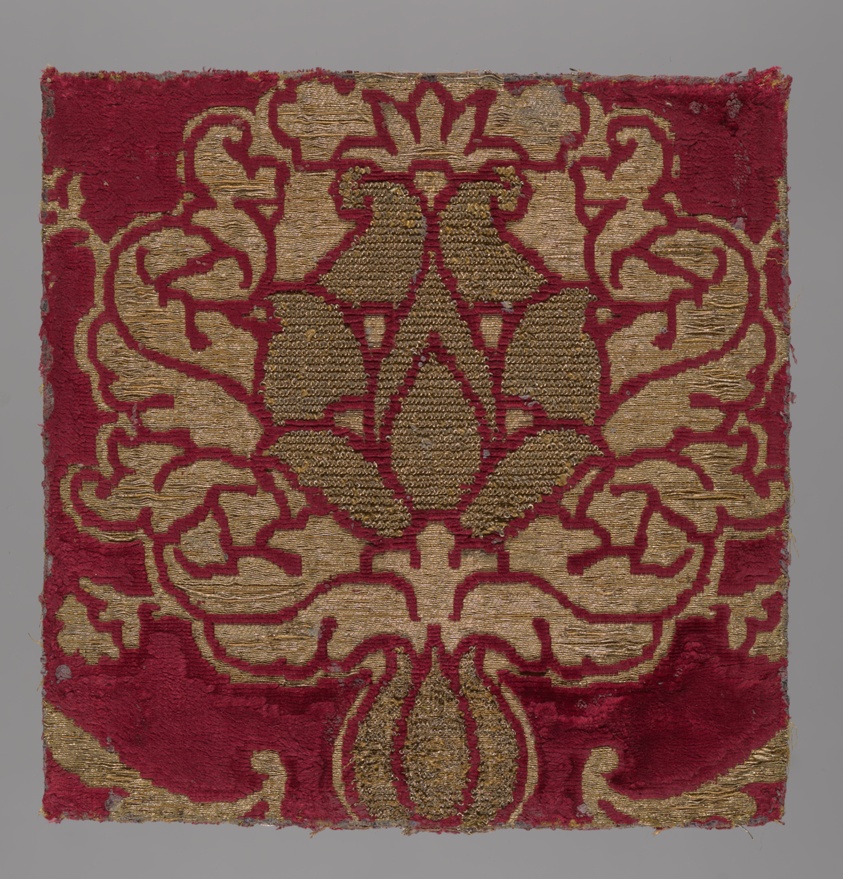
Heritage Research Artifact: Fragment of Velvet
Materiality and Technical Mastery
The fragment under examination represents a pinnacle of Classic silk craftsmanship, embodying the fluid elegance that defines the most refined textile traditions. Its materiality is a testament to the sophisticated engineering of historical looms, where each thread serves a precise aesthetic and structural purpose. The base weave is a silk warp-float faced 3:1 twill, a foundation that provides a subtle, diagonal ribbing and a lustrous surface. This is interlocked with a weft-float faced 1:3 twill, created by secondary binding warps that introduce a contrasting texture and depth. The interplay of these two twill structures is not merely decorative; it is a functional dialogue that stabilizes the fabric while allowing for dramatic surface variation.
The velvet pile is achieved through supplementary warps that rise from the ground weave, forming a pile-on-pile cut velvet technique. This method involves cutting loops of different heights, creating a sculpted, three-dimensional pattern that catches light with a shimmering, almost liquid quality. The gilt-metal-strip-wrapped silk supplementary facing wefts are a hallmark of luxury, introducing a metallic brilliance that contrasts with the matte silk. These wefts are not merely woven in; they are brocaded into the fabric, meaning they are introduced only where needed, adding weight and opulence without compromising the drape. In areas where the velvet is voided—where the pile is absent—the ground weave is exposed, and supplementary brocading wefts form delicate weft loops. These loops, reminiscent of tiny, unclipped pile, create a textural counterpoint, a whisper of velvet’s presence even in its absence.
Context of Craftsmanship and Elegance
This fragment is a relic of a time when silk was not merely a fabric but a medium of artistic expression. The Classic silk craftsmanship evident here speaks to a lineage of weavers who understood that true luxury lies in the unseen—the tension of the warp, the precision of the cut, the weight of the metal. The fluid elegance is not accidental; it is engineered through the balance of contrasting weaves and the strategic use of voided areas, which allow the fabric to move and breathe. The gilt-metal strips, wrapped around silk cores, are a nod to the opulence of Renaissance and Baroque courts, where such textiles adorned ceremonial vestments and aristocratic interiors. Yet, the fragment’s restraint—its refusal to overwhelm with excessive ornament—aligns it with the principles of Savile Row tailoring: understated, impeccable, and timeless.
The pile-on-pile technique, with its varying heights, creates a chiaroscuro effect, a play of light and shadow that shifts with movement. This is not a static fabric; it is a living surface that responds to the wearer. The weft loops in the voided areas add a tactile surprise, a moment of intimacy for the hand that touches it. This attention to sensory detail is what elevates the fragment from mere textile to heritage artifact. It is a document of a lost art, where the weaver’s hand and the loom’s rhythm were in perfect synchrony.
Savile Row Tone: The Bespoke Parallel
In the language of London Savile Row, this fragment would be described as a bespoke cloth—a fabric cut and constructed to the exact specifications of a discerning client. The Classic silk craftsmanship mirrors the Row’s commitment to hand-finishing, where every stitch is a signature. The fluid elegance is akin to the drape of a well-cut suit, where the fabric follows the body’s contours without clinging. The gilt-metal strips are the equivalent of a mother-of-pearl button or a silk lining—details that are invisible to the casual observer but essential to the connoisseur.
The fragment’s technical complexity—the interplay of twill weaves, the pile-on-pile velvet, the brocaded wefts—would be appreciated by a Savile Row cutter as a challenge to be met with precision. The voided areas, where the velvet is absent, are akin to the negative space in a tailored garment, where the cut and construction create a silhouette. The weft loops are the equivalent of a hand-rolled lapel—a subtle, almost secret sign of quality. This fragment is not just a piece of fabric; it is a lesson in restraint and mastery, a reminder that true elegance is never loud but always felt.
Conclusion: A Legacy of Material Poetry
This Fragment of Velvet is more than a historical curiosity; it is a living testament to the enduring power of Classic silk craftsmanship and fluid elegance. Its materiality—silk, twill, velvet, metal—is a vocabulary of luxury, and its construction is a syntax of sophistication. For the heritage specialist, it offers a window into the technical and artistic achievements of past generations. For the Savile Row tailor, it is a benchmark of quality, a standard to aspire to. In its threads, we find the poetry of material, the rhythm of the loom, and the timeless allure of silk. This fragment, though small, holds the weight of centuries—a whisper of elegance that continues to inspire.