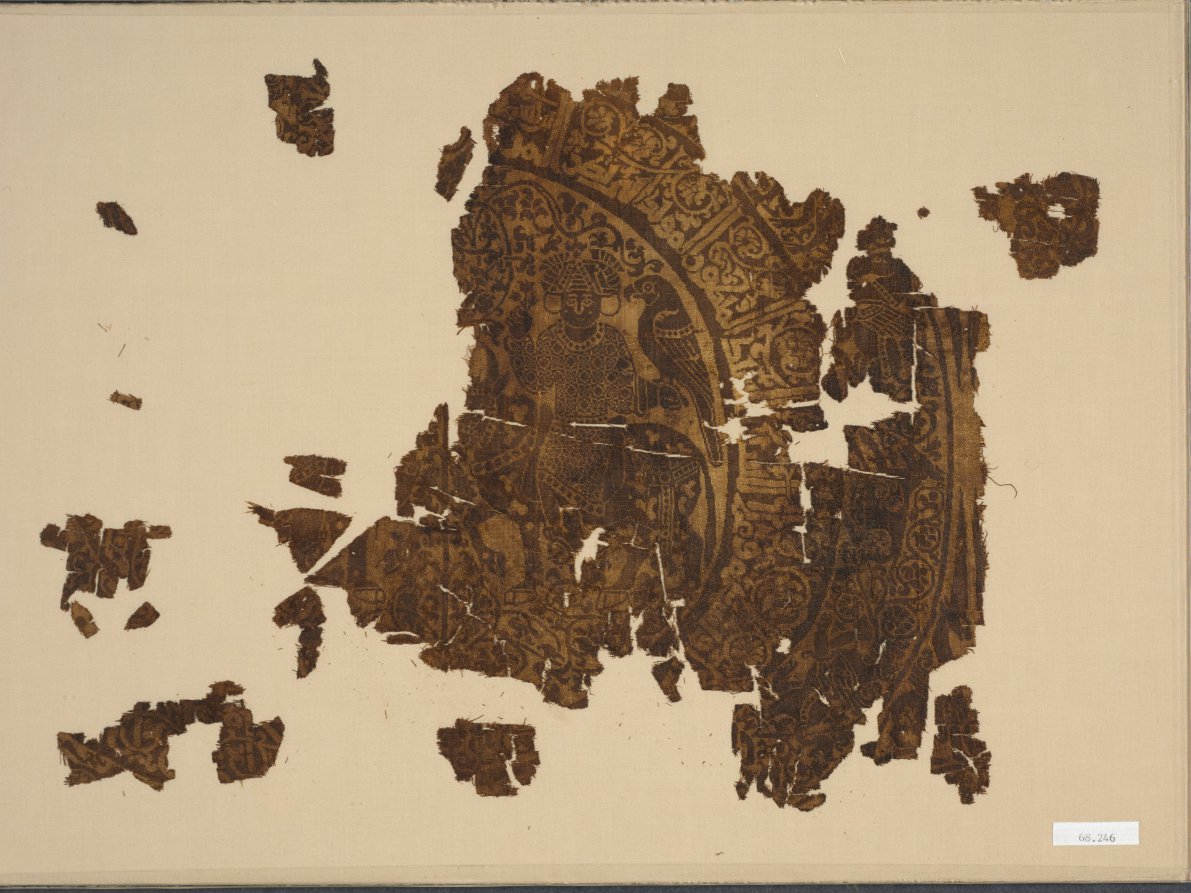
The Fragment with Falconer Riding a Bull in a Rondel: A Study in Imperial Silk Weaving
Introduction: The Artifact as a Testament to Craft
In the hushed corridors of heritage, where threads of history are woven into the very fabric of civilization, the Fragment with falconer riding a bull in a rondel emerges as a singular artifact. This silk fragment, dating from the medieval Islamic period, likely originating from the esteemed looms of the Byzantine or Sassanian-influenced empires, is not merely a textile; it is a narrative of power, trade, and the enduring legacy of imperial silk weaving. As a Senior Heritage Specialist at Lauren Fashion Heritage Lab, I approach this piece with the discerning eye of a Savile Row tailor—where every stitch, every hue, and every motif speaks to a lineage of excellence. The materiality of silk, with its lustrous sheen and tactile resilience, underscores the artifact’s role as a luxury commodity, a diplomatic gift, and a symbol of sovereignty.
Materiality: The Silk and Its Significance
The fragment’s foundation is silk, a material that has long been synonymous with opulence and technical mastery. In the context of imperial weaving, silk was not merely a fabric but a currency of influence. The warp and weft of this fragment reveal a compound weave structure, likely a lampas or taquete technique, which allowed for intricate patterns to be rendered with precision. The silk threads, dyed with natural pigments such as madder for reds and indigo for blues, retain a depth of color that speaks to the artisan’s skill. The fragment’s condition—a partial rondel, or circular medallion—suggests it was once part of a larger textile, perhaps a ceremonial robe, a wall hanging, or a saddle cloth. The rondel itself, a motif common in Islamic and Byzantine art, frames the central figure: a falconer riding a bull. This juxtaposition of predator and prey, of human mastery over nature, is a hallmark of imperial iconography, where the falcon represents nobility and the bull symbolizes strength and fertility.
Context: The Legacy of Imperial Silk Weaving
To understand this fragment, one must situate it within the legacy of imperial silk weaving, a tradition that spanned from the Silk Road to the courts of Constantinople, Baghdad, and beyond. The production of such textiles was a state-sponsored endeavor, with workshops—often referred to as tiraz in the Islamic world—operating under royal patronage. These workshops were centers of innovation, where weavers, dyers, and designers collaborated to produce textiles that were both functional and symbolic. The falconer motif, for instance, is not arbitrary; it reflects the hunting culture of the elite, where falconry was a pastime reserved for kings and nobles. The bull, meanwhile, may reference zodiacal or astrological themes, as the bull (Taurus) was a symbol of earthly power and renewal. The integration of these elements within a rondel suggests a cosmological order, where the ruler’s authority is aligned with celestial forces.
The silk trade itself was a driver of cultural exchange. This fragment likely traveled along the Silk Road, from the looms of Central Asia or Persia to the courts of Europe or the Levant. The use of silk as a diplomatic gift is well-documented; emperors and caliphs would present such textiles to allies and vassals as tokens of esteem. The fragment’s survival, albeit in a partial state, is a testament to the value placed on these objects. They were often repurposed, sewn into ecclesiastical vestments or reliquary covers, thereby extending their life and meaning. In this sense, the fragment is not a static relic but a dynamic participant in history, adapting to new contexts while retaining its original aura.
Technical Analysis: Weaving the Narrative
From a technical standpoint, the fragment’s weave structure is a marvel of engineering. The compound weave allowed for multiple colors and patterns to be integrated without compromising the fabric’s integrity. The warp threads, typically silk, were arranged in a tight grid, while the weft threads were introduced in contrasting colors to create the design. The rondel itself was likely woven using a drawloom, a sophisticated device that enabled the weaver to control individual warp threads, producing curvilinear motifs with remarkable accuracy. The falconer’s posture—seated astride the bull, with a falcon perched on his arm—is rendered with a stylized naturalism that is characteristic of the period. The bull’s musculature is suggested through subtle shading, while the falconer’s robes are adorned with geometric patterns, echoing the broader aesthetic of Islamic art.
The fragment’s color palette further enhances its narrative. The deep red of the background, likely derived from kermes or lac, evokes the richness of royal blood. The gold or yellow threads, which may have been gilded, highlight the falconer’s crown or headdress, reinforcing his status. The blue accents, perhaps from lapis lazuli or woad, add a celestial dimension, linking the earthly scene to the heavens. This chromatic harmony is not accidental; it reflects a deep understanding of color theory and symbolism, where each hue carries specific connotations. In imperial contexts, such textiles were not merely decorative but communicative, conveying messages of power, piety, and prestige.
Heritage and Contemporary Relevance
For Lauren Fashion Heritage Lab, this fragment serves as a research artifact that bridges the past and present. The legacy of imperial silk weaving is not confined to museums; it informs contemporary fashion, particularly in the bespoke tailoring of Savile Row. The principles of craftsmanship—precision, material integrity, and narrative depth—are as relevant today as they were centuries ago. By studying this fragment, we gain insights into the techniques and aesthetics that have shaped luxury textiles. The falconer motif, for instance, can be reinterpreted in modern designs, offering a dialogue between tradition and innovation. Moreover, the fragment’s materiality underscores the importance of sustainable practices; silk, as a natural fiber, reminds us of the value of slow fashion and artisanal production.
Conclusion: A Thread of Continuity
The Fragment with falconer riding a bull in a rondel is more than a relic; it is a thread of continuity in the vast tapestry of human creativity. Its silk weave, its imperial context, and its symbolic richness invite us to reflect on the enduring power of textiles to convey identity and authority. As we preserve and study such artifacts, we honor the artisans who wove them and the cultures that cherished them. In the spirit of Savile Row, where every garment tells a story, this fragment reminds us that heritage is not static—it is a living legacy, waiting to be rewoven into the future.