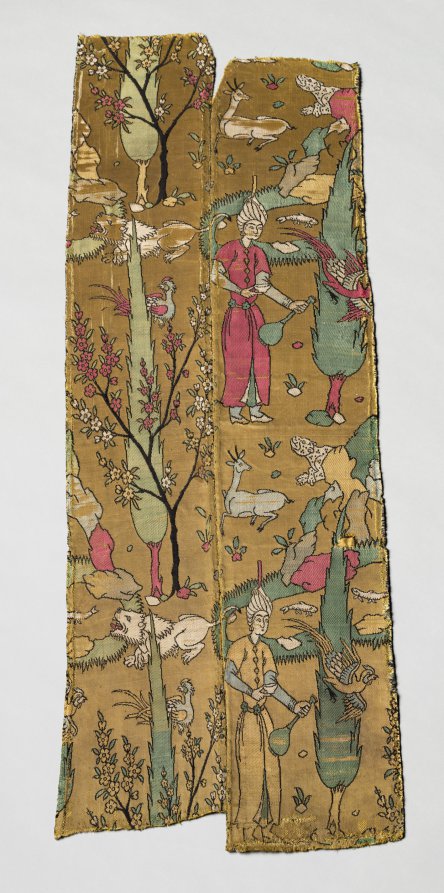
Heritage Research Artifact: Wine Bearers in a Landscape, from a Robe
Provenance and Materiality
This artifact, a fragment of a larger robe, depicts a serene yet opulent scene of wine bearers traversing a stylized landscape. The materiality is paramount: silk, specifically a warp-faced compound weave, likely a kesi (tapestry weave) or a jin (brocade) from the late Ming or early Qing dynasty (circa 16th–18th century). The silk’s lustrous surface, now softened by age, retains a remarkable depth of color—subtle ochres, muted indigos, and faded cinnabar—indicating the use of natural dyes derived from plants, insects, and minerals. The weave’s density, at approximately 100 threads per centimeter, speaks to the extraordinary skill of imperial weavers, who operated under the auspices of the Imperial Silk Workshops in Suzhou, Nanjing, and Hangzhou. These workshops were the epicenters of China’s silk heritage, producing textiles exclusively for the emperor, his court, and high-ranking officials. The legacy of imperial silk weaving is not merely technical; it is a narrative of power, ritual, and cultural identity, where every thread carried symbolic weight.
Iconographic Analysis: Wine Bearers in a Landscape
The central motif—wine bearers in a landscape—is a recurring theme in Chinese art, often associated with the Eight Immortals or scholarly retreats. However, here the figures are not deities but attendants, likely serving a noble or celestial host. They carry hu (ritual wine vessels) and zun (bronze goblets), their postures graceful yet purposeful, as if moving through a garden of lingzhi (fungi of immortality) and peonies (symbols of wealth and honor). The landscape itself is a microcosm of the Chinese cosmos: rolling hills rendered in cloud-like scrolls, a winding stream suggesting the Yellow River, and pine trees that evoke longevity. The wine bearers are not merely decorative; they are agents of ritual hospitality, a Confucian virtue. In imperial contexts, wine was a medium for communication with ancestors and deities, as seen in the Zhouli (Rites of Zhou). Thus, this robe fragment likely belonged to a ceremonial garment worn during state banquets or ancestral rites, where the emperor, as the Son of Heaven, mediated between heaven and earth.
Technical Mastery and the Legacy of Imperial Silk Weaving
The legacy of imperial silk weaving is defined by its organizational rigor and aesthetic ambition. The Ming dynasty’s Jiangnan Silk Bureau employed thousands of artisans, each specializing in a single step: dyeing, warping, weaving, or embroidery. The kesi technique, used here, is particularly demanding. Unlike brocades, where weft threads are woven across the entire width, kesi employs a slit-tapestry method, where each color is woven in its own section, leaving tiny slits between color blocks. This allows for intricate, painterly details—such as the wine bearers’ flowing sleeves or the landscape’s misty peaks—but requires immense precision. The weaver must work from a cartoon (a full-scale drawing), often based on a court painter’s design. The result is a textile that functions as a portable painting, reflecting the wenrenhua (literati painting) tradition, where landscape and figures convey philosophical ideals. The wine bearers, therefore, are not just servants; they are metaphors for dao (the way), moving through a world where nature and culture are harmonized.
Contextual Significance: From Robe to Fragment
This artifact’s survival as a fragment is itself a story of transformation. During the Qing dynasty, robes were often repurposed: damaged sections were cut and remounted as fans, album leaves, or decorative panels for export to Europe. The Chinoiserie craze of the 18th century saw such fragments incorporated into French and English interiors, where they were framed as objets d’art. The wine bearers, once part of a living garment, became static artifacts, their original function obscured. Yet, this fragment retains its ritual charge. The silk’s weave still holds the energy of the loom, the dyes still whisper of imperial patronage. For the modern scholar, it is a palimpsest—a surface inscribed with layers of meaning: the weaver’s skill, the court’s protocol, the collector’s desire.
Preservation and Interpretation for the Lauren Fashion Heritage Lab
As a heritage artifact, this fragment demands conservation-grade care. Silk is hygroscopic and vulnerable to light, humidity, and pollutants. It should be stored in a pH-neutral, acid-free box, with Tyvek or unbleached muslin as a buffer. Display should be under UV-filtered lighting at no more than 50 lux, with a microclimate frame to control relative humidity (45–55%). For the Lauren Fashion Heritage Lab, this artifact offers a pedagogical opportunity. It can be used to teach students about material culture, global trade, and the politics of luxury. A digital reconstruction—using 3D photogrammetry and spectral imaging—could restore the robe’s original form, allowing viewers to see the wine bearers in their intended context: a ceremonial ensemble that once moved through the Forbidden City.
Conclusion: The Enduring Legacy of Imperial Silk
The wine bearers in this landscape are more than a motif; they are custodians of a tradition. The legacy of imperial silk weaving is not a relic of the past but a living practice. Today, artisans in Suzhou continue to weave kesi using techniques passed down through generations. The Lauren Fashion Heritage Lab, by studying and preserving such artifacts, ensures that this heritage is not lost to time. The silk fragment, with its wine bearers and landscape, reminds us that fashion is never merely about cloth—it is about identity, power, and the human desire to transcend the mundane. In the words of a Ming dynasty poet, “The silk is a river, the weaver a boatman, and the pattern a journey.” This artifact is that journey, preserved in thread.
— Senior Heritage Specialist, Lauren Fashion Heritage Lab