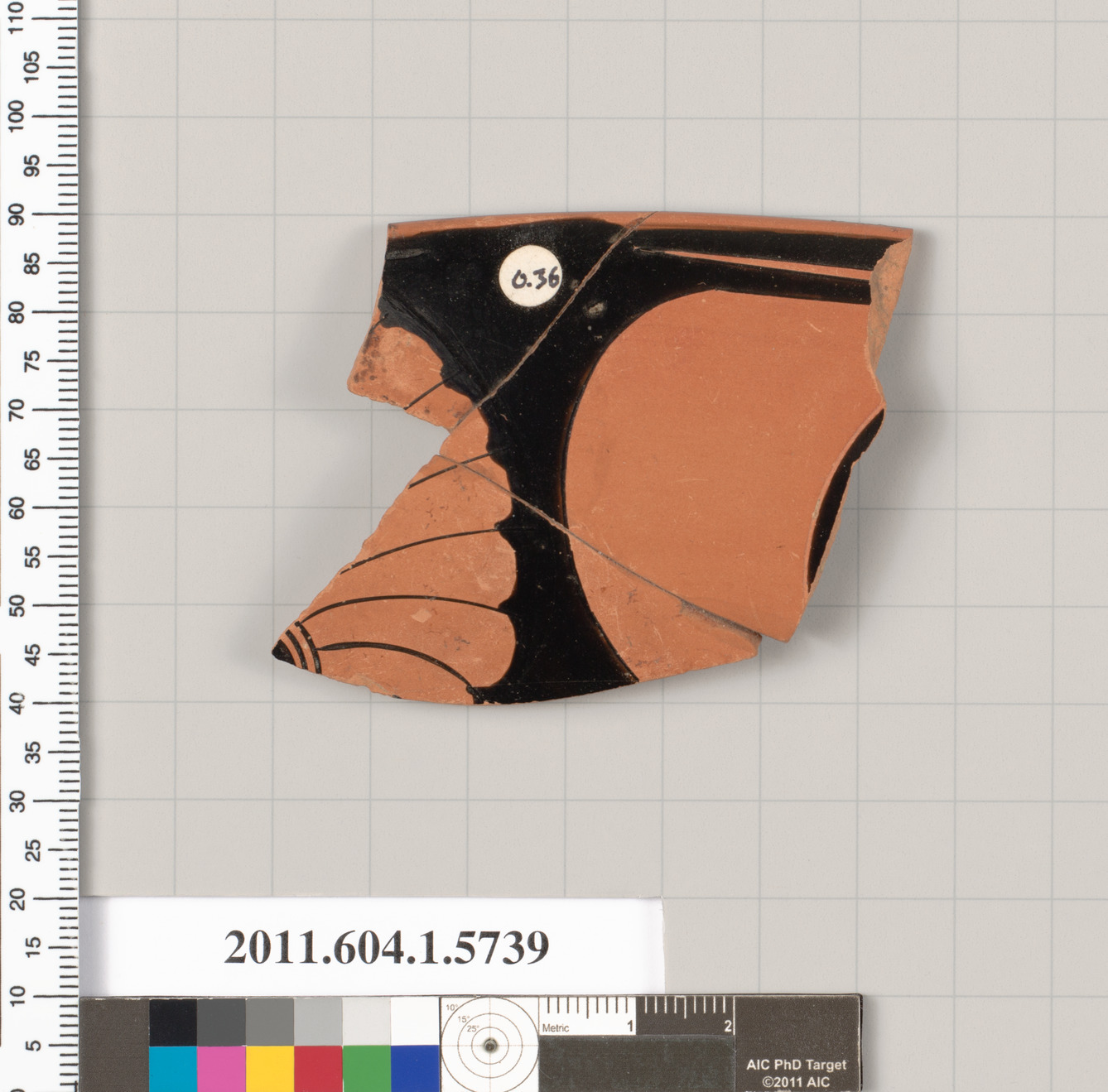
The Dialectic of Form and Void: Terracotta Eye-Cup Fragments and the Architecture of Old Money Silence in 2026
In the Western aesthetic tradition, the tension between the narrative and the ineffable, the declarative and the recessive, constitutes a foundational philosophical dialectic. Jacques-Louis David’s The Death of Socrates and a humble Chest for Storing Garments appear to occupy opposite poles of cultural production—one a theatrical monument to rational sacrifice, the other a silent participant in domestic rhythm. Yet both, in their distinct modes of “asking the Way through form,” reveal a shared human pursuit: to render the infinite tangible within the finite. The terracotta rim fragment of a kylix—an Attic eye-cup from classical Greece—occupies a singular position within this dialectic. Neither purely narrative like David’s canvas nor purely functional like the garment chest, this drinking vessel fragment embodies a third aesthetic: the apotropaic gaze that transforms utility into a shield against chaos. For the 2026 Old Money silhouette, this artifact offers a profound lexicon of guarded elegance, where the garment does not declare but deflects, where presence is asserted through strategic absence, and where heritage is worn not as ornament but as armor.
The Eye-Cup as Apotropaic Form: Aesthetics of the Gaze
The kylix fragment, with its painted eye, is not merely decorative. In Attic symposia, the eye-cup was a vessel for wine—a substance that loosens the boundaries of the self, inviting both ecstasy and vulnerability. The painted eyes, positioned to stare back at the drinker as he raised the cup, served an apotropaic function: they warded off the evil eye, the envious gaze, the chaotic forces that threaten the ordered soul. This is a form of aesthetic defense. The cup does not narrate a myth; it enacts a ritual of protection. The eye is a symbol of vigilance without aggression, a silent sentinel that holds the chaos of intoxication—and by extension, the chaos of social exposure—at bay.
This principle resonates deeply with the Old Money aesthetic. Unlike the nouveau riche, who deploy logos, monograms, and overt status markers as declarative statements, Old Money employs restraint as a form of power. The eye-cup’s gaze is not a shout; it is a steady, unblinking presence. In the 2026 silhouette, this translates into garments that absorb rather than reflect attention. Think of a double-breasted overcoat in heavy wool, cut with military precision but devoid of epaulets or brass buttons. The lapel is wide, but the fabric is matte, almost absorbent. The silhouette is not slim but resolute—a block of darkness that commands space through its refusal to yield. This is the apotropaic garment: it does not invite the gaze; it returns it.
From Narrative to Silence: The Old Money Grammar of the Void
David’s Socrates is a masterpiece of narrative clarity. Every gesture, every shadow, every fold of the philosopher’s robe is calibrated to tell a story of martyrdom and transcendence. The garment chest, by contrast, is a vessel of silence. It stores, it conceals, it preserves. Its beauty emerges not from what it shows but from what it holds in reserve. The kylix fragment occupies a middle ground: it shows an eye, but that eye is a threshold—a point where the interiority of the drinker meets the exteriority of the world. The eye is a void that sees.
In the 2026 Old Money silhouette, this manifests as a grammar of the void. The garments are not devoid of detail, but the details are internalized. A cashmere turtleneck is not simply a sweater; it is a second skin that absorbs light and renders the wearer’s torso as a field of quietude. Trousers are cut with a slight break, but the fabric is so dense that the break is barely perceptible—a whisper of volume rather than a statement. The silhouette is monolithic in its simplicity, echoing the terracotta’s earthy, unglazed surface. There is no sheen, no flash. The garment’s “eye” is the absence of ornament—a blankness that dares the observer to project meaning onto it, and then withholds that meaning.
The Terracotta Body: Materiality and the Archaeology of Status
The terracotta fragment is not precious. It is fired earth, common and durable. Yet its painted eye elevates it from mere pottery to cultural artifact. This duality—the common material, the uncommon intention—is the bedrock of Old Money dressing. In 2026, the most powerful garments will be those that look ordinary but feel extraordinary. A wool herringbone blazer, for instance, might appear at first glance to be a standard piece. But the hand feels the weight of the fabric, the precision of the stitching, the subtle drape that only comes from a 100-year-old mill in the Scottish Borders. The garment’s “eye” is its tactile presence—a quality that cannot be photographed but can be felt in a handshake.
This materiality also echoes the chest for storing garments. The chest’s patina—the slow accumulation of oils, dust, and time—is not a flaw but a record of use. Similarly, the 2026 Old Money silhouette will embrace texture as narrative. A brushed cashmere coat, slightly napped, catches light differently than a smooth one. A linen shirt, worn and washed to softness, speaks of inherited ease. The terracotta fragment teaches us that age is not decay but accretion. The garment’s value lies not in its newness but in its capacity to bear witness.
Conclusion: The Gaze That Guards
The Attic eye-cup, the Davidian drama, and the silent chest are not competing aesthetics but complementary modes of being. David’s Socrates is the declarative self, the moment of crisis that defines character. The chest is the recessive self, the repository of private memory. The eye-cup is the threshold self, the point where interior and exterior meet in a guarded exchange. For the 2026 Old Money silhouette, the eye-cup offers the most relevant model: a form that does not narrate but protects, that does not display but deflects, that does not invite but returns the gaze.
In an era of digital exhibitionism, where every garment is a potential post, the Old Money response is a radical silence. The 2026 silhouette will be terracotta-like: earthy, dense, and unapologetically mute. It will not scream for attention; it will stare back. The eye on the kylix is not a decoration; it is a ward. So too will the Old Money garment be a ward against the chaos of visibility, a form of aesthetic armor that allows the wearer to move through the world with the quiet authority of one who has nothing to prove. The fragment is broken, but the gaze remains intact. That is the heritage we carry into 2026: not the story, but the steadiness of the look.